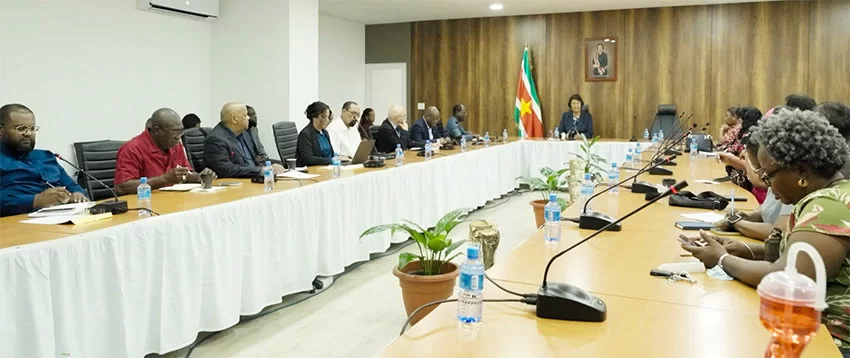
A months-long payment dispute that sparked widespread frustration among Suriname’s education sector is moving toward resolution after President Jennifer Simons led emergency high-level talks with education union representatives on June 23. The meeting, held at the President’s Cabinet, was convened directly in response to growing discontent over the failure to complete outstanding overdue payments to hundreds of examiners and committee members tied to national education assessments.
In attendance alongside President Simons were key cabinet officials: Dirk Currie, Minister of Education, Science and Culture; Marinus Bee, Minister of Home Affairs; and representatives from the government’s central negotiation body. The meeting was organized and its outcomes announced by Suriname’s Communications Service.
The root of the dispute stretches back to an agreement signed earlier this June between the Ministry of Education, Science and Culture and the country’s leading education unions. Under that initial deal, all overdue payments to eligible education workers—including examiners, committee members, and a group of teachers based in Moengotapoe—were scheduled to be disbursed starting June 1, with full completion promised by the end of the month during a follow-up meeting on June 12. As of the June 23 emergency summit, however, more than 300 examiners had still not received their owed compensation.
Minister Currie acknowledged that bureaucratic red tape within the national government is a persistent source of payment delays, a issue that has fueled consistent irritation among union leadership. To address both the current backlog and prevent future disruptions, two key structural changes were agreed upon during the talks. First, the Ministry of Education will now hold weekly coordination meetings with education union representatives to flag and resolve bottlenecks early. Second, a permanent cross-government consultation framework will be established, bringing in officials from the Ministry of Finance and Planning, the Ministry of Home Affairs, and the President’s Cabinet for all payment-related discussions. Currie explained that cross-ministerial inclusion is necessary, as many payment processes and approvals span multiple government departments and occasionally require formal sign-off from the presidency itself.
Vincent Fernandes, Director of Finance at the Ministry of Finance and Planning, detailed the specific administrative bottleneck that caused the current delay. Before any payments can be processed, rosters of eligible workers submitted by the Ministry of Education must first go through a formal verification check by the ministry’s Accounting Department. Fernandes noted that inconsistencies between submitted rosters and verified records are a recurring issue, and these discrepancies were the direct cause of the current holdup. Following the emergency talks, all parties have committed to completing all required administrative processing by the end of Friday at the latest.
Union leaders have expressed cautious confidence that the agreement will resolve the long-running backlog. Reshma Mangre, chair of the Suriname Teachers’ Union/Alliance of Suriname Teachers (BvL/ALS), stated that unions trust the president-led process will deliver results for the unpaid examiners. She did, however, note that a previously proposed cross-stakeholder commission including union and ministry representatives has not yet been formally established, leaving the sector without sustained structural coordination and leaving unions often unclear about the status of payment processes.
Bernice Barron, chair of the Federation of Suriname Teachers’ Organizations (FOLS), echoed that confidence, adding that the majority of eligible workers will see their back pay processed under the new deadline. “There is a small subset of workers that are not yet eligible for payment at this stage,” Barron explained. “Officials are currently working directly with that group to identify and resolve their individual issues, and the minister will send formal correspondence to each of them outlining next steps. For everyone else, the process is now on track to be finalized.”