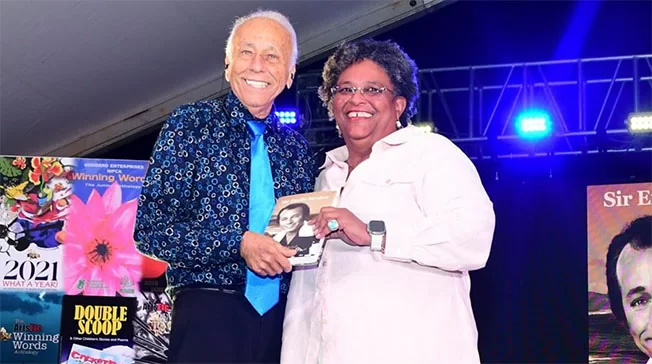
Barbadian music icon Sir Charles Emile Straker, the founder and creative core of internationally celebrated Caribbean band The Merrymen, passed away on Friday, June 19, 2026, at his beloved Caribbean home island at the age of 90. Knighted for his contributions to culture in 2019, Straker leaves behind a decades-long legacy that reshaped global perceptions of Caribbean music, even amid longstanding industry controversy over his work.
Straker launched his professional music career in 1961 in Canada. Just one year later, he returned to his native Barbados and co-founded The Merrymen alongside Robin Hunte, who played tenor guitar and electric mandolin, Stephen Fields on guitar and vocals, and Chris Gibbs on bass and vocals. Straker himself took on guitar and steelpan duties, serving as the band’s lead vocalist with his iconic golden voice and signature whistling, while also emerging as a prolific songwriter for the group. Shortly after the band’s founding, drummer Robert Foster joined to complete the original lineup. Today, only Stephen Fields survives from the 1962 founding roster, and he currently lives with dementia.
As part of a generation of Caribbean artists bringing regional genres like calypso and soca to global audiences, The Merrymen faced sharp criticism from Black Caribbean musicians, who framed the group’s take on these Afro-Caribbean styles as too “white,” dismissing the band as so-called “wannabe calypsonians.”
The most prominent critic was legendary Trinidadian calypsonian The Mighty Sparrow, who publicly condemned the global success The Merrymen found with their lighter, more accessible style of “white calypso” at a time when he and other Black calypsonians struggled to break through to international audiences. In 1967, Sparrow released his album *Spicy Sparrow*, which included a satirical track mocking The Merrymen’s take on calypso. Originally titled *Bajan Dolphus* (a reference to the demonym for Barbadians, which also describes the island’s local culture and language), the track was renamed *Sing Dolphus Sing* for its official release, with lyrics mocking the band’s popularity and credibility in the calypso space.
Despite this controversy, The Merrymen racked up one international hit after another through the 1960s and 1970s, particularly in the United States. The band also earned a particularly devoted fanbase in Suriname, where generations of older listeners grew up hearing their tracks played repeatedly on national radio. Beloved hits that still remain cultural touchstones across the Caribbean and global diaspora include *Ring Ting Ting*, *Big Bamboo*, *Sugar Bum Bum*, *Archie*, and the fan-favorite melancholic standard *Yellow Bird*. The band developed a distinct sound they dubbed “Caribeat,” and toured across more than 100 countries, turning Barbados into a household name for music fans around the world.
In a statement shared by the *Jamaica Observer* following Straker’s death, Barbadian Prime Minister Mia Mottley paid tribute to the legendary musician’s far-reaching impact. “He helped put Barbados on the map far beyond our shores,” Mottley said. “Long before hashtags, marketing campaigns, and global social platforms, Sir Emile and The Merrymen brought our island to the world: on hotel stages, in concert halls, on records that tourists carried home with them, and in the hearts of people who kept returning to Barbados because his music made them feel they already belonged here.”
Late in his career, in November 2023, Straker released his autobiography *My Island and Me*, edited by John Roett. The project was supported by the Barbados National Cultural Foundation and Prime Minister Mottley’s office, with Straker handing over the first published copy of the memoir to Mottley shortly after its completion.