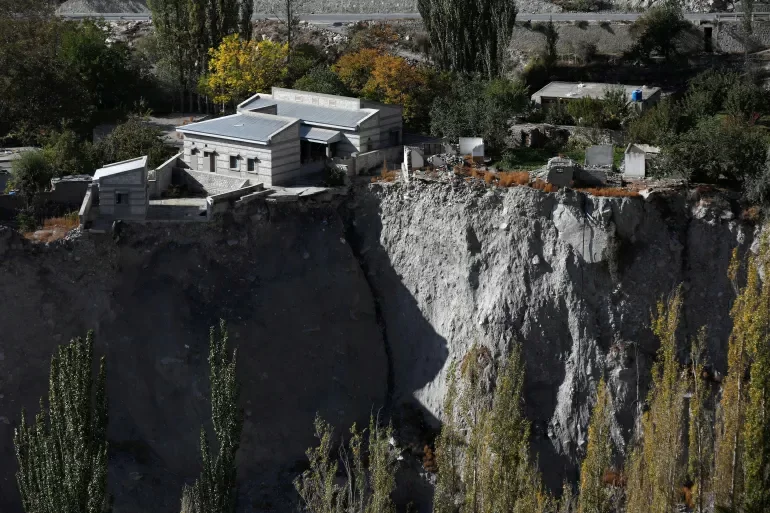
Pakistan is bracing for what could become its fourth straight year of extreme monsoon rainfall, a pattern that has raised catastrophic flood risks across large swathes of the South Asian nation. On Sunday, the country’s National Disaster Management Authority (NDMA) issued a nationwide alert warning of approaching thunderstorms, intense downpours, urban flooding, and an elevated threat of Glacial Lake Outburst Floods (GLOFs) in Pakistan’s northern high-altitude regions.
High-risk areas have been identified as the mountainous Hunza and Skardu districts of Gilgit-Baltistan, as well as much of the Khyber Pakhtunkhwa province. Even the capital Islamabad and its neighboring major city Rawalpindi, alongside other major urban centers, have been placed on high preparedness alert. Local and provincial government agencies have been ordered to clear all drainage networks in advance to minimize waterlogging and flood-related damage.
The urgent alert comes as climate scientists and disaster officials widely forecast that this year’s monsoon season, set to begin later in June, will bring another round of extreme precipitation. For nearly a decade, Pakistan has faced increasingly destructive annual rainfall and flood events that have claimed thousands of lives and displaced millions of residents across the country.
The escalating crisis is deeply tied to the accelerating global climate emergency, a burden Pakistan bears disproportionately despite its minimal contribution to global greenhouse gas emissions. Responsible for less than 1% of the world’s total historical carbon dioxide emissions, Pakistan ranks among the top five countries most severely impacted by human-caused climate change. The 2022 floods stand as a stark reminder of this vulnerability: that year, extreme rainfall and accelerated glacial melt inundated nearly one-third of the country, killing more than 1,700 people and displacing over 30 million residents.
This year, record-breaking heat has amplified glacial melt risk in the north. Temperatures in the Gilgit-Baltistan region hit an unprecedented 48.5 degrees Celsius in 2026, speeding up the melt of ancient glaciers and fueling the rapid formation of thousands of new glacial lakes. When these lakes breach their natural debris dams, they trigger GLOFs – catastrophic flash floods that can destroy entire remote mountain villages in just a few hours.
Pakistan is home to roughly 13,000 glaciers, more than any other country outside the polar regions. United Nations data identifies more than 3,000 of these newly formed glacial lakes as potential flood hazards, with 33 classified as extremely high-risk. An estimated 7.1 million Pakistanis live within danger zones near these unstable glacial formations.
Despite growing risks, the country’s ability to respond to the threat remains severely constrained. In 2017, Pakistan launched a GLOF risk reduction project with support from the United Nations Development Programme, but current early warning systems only cover a small fraction of high-risk areas. Some of the most vulnerable districts, including Ghizer, Diamer, and parts of Hunza, have no functional early warning infrastructure at all.
The 2022 disaster also exposed deep gaps in long-term recovery and resilience funding. At an international donor conference held in Geneva in 2023, donors pledged approximately $11 billion in recovery and adaptation aid for Pakistan. As of mid-2025, only around $4.5 billion of that pledged funding has actually been disbursed to the country.
Climate and disaster experts warn that persistent gaps in funding, limited access to adaptation technology, and slow progress on building local response capacity leave Pakistan acutely vulnerable to escalating climate disasters. Compounding these challenges, fragmented institutional oversight and poor inter-agency coordination further undermine the country’s ability to prepare for and respond to catastrophic flood events. As the 2026 monsoon approaches, communities across Pakistan stand waiting for a storm that has become an all-too-frequent annual threat.