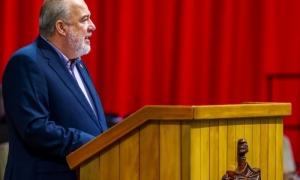
In an address delivered to the Third Extraordinary Session of the National Assembly of People’s Power, Cuban Prime Minister Manuel Marrero Cruz outlined a landmark package of 176 strategic economic and social reforms, framed as a necessary adaptation to one of the most severe crises the island nation has faced since the 1990s Special Period.
Prime Minister Marrero Cruz opened by attributing the current national hardship to the cumulative impact of intensifying United States coercive measures, which have cut off fuel supplies and almost completely dried up foreign currency revenue. These external pressures, he explained, have severely degraded the country’s energy infrastructure and eroded living standards for millions of Cubans, while also derailing the gradual implementation of economic reforms first approved by the Communist Party of Cuba in 2011. That framework delivered consistent positive results until 2019, when the US drastically escalated its sanctions regime, with further tightening implemented in January 2025.
Against this backdrop, the Cuban government and Communist Party have developed the new reform package, which draws broad input from popular consultations, 133 expert consultations, and public debate that resulted in 66.7% of 390 public proposals being incorporated into the final draft. Marrero Cruz emphasized that the reforms do not represent an abandonment of core socialist principles or the revolution’s core social gains, but rather a pragmatic adaptation designed to preserve socialism under unprecedented external pressure.
“These transformations find their foundation in the thinking of our revolutionary leaders, who have long argued that adapting to current conditions is not a renunciation of socialism, but a requirement for its survival,” Marrero Cruz stated, referencing Fidel Castro’s 1993 call for pragmatic action during the original Special Period. Echoing Raúl Castro’s previous guidance on updating Cuba’s economic model, the reforms reject dogmatism, decouple socialism from rigid egalitarianism, and formalize the role of market mechanisms as tools for resource allocation that must be incorporated and regulated by socialist planning.
The sweeping package of reforms, grouped into 23 core pillars, touches nearly every aspect of Cuba’s economic and social life. Key changes for the state-owned enterprise sector include granting broad operational autonomy, decentralizing price approval for wholesale and retail goods, resizing upper management bodies to remove unnecessary state functions, allowing enterprises to set their own salary scales based on financial capacity, and gradually eliminating state subsidies that currently consume 92.5 billion pesos annually, half of which go to subsidizing electricity rates.
Notably, the reforms open the door to transforming state-owned enterprises into share-based commercial companies, with the state retaining a majority stake only in strategic sectors, and allow both non-state entities and foreign investors to purchase shares in state firms. A national program will also be implemented to value and title state assets, allowing underutilized assets to be monetized through long-term leases to domestic and foreign investors.
For the non-state sector, the reforms remove long-standing restrictions that have slowed growth. The cap of 100 employees for micro, small, and medium-sized enterprises (MSMEs) will be eliminated, individuals will be allowed to own more than one private business, and 70 of the 125 current prohibited activities for non-state actors will be opened up. Non-state entities will also be granted formal land rights to develop operations, removing the current ban that forces many small businesses to operate out of private homes, and will be allowed full access to foreign currency bank accounts. Artificial intelligence will be deployed to streamline approval processes for new economic actors, cutting red tape that has left thousands of applications pending.
In the agricultural sector, the government will allow private companies to operate in agricultural production, open a national input market with foreign currency access, grant indefinite usufruct land rights to any domestic or foreign entity with a viable production project, and eliminate the requirement that land usufructuaries work the land personally, allowing investors to hire labor to operate productive farms. Agricultural pricing will be fully decentralized to producers, and cooperatives will be granted the right to directly import inputs and export products without going through central government intermediaries.
Major changes are also being implemented to decentralize power to municipal governments, which will gain authority to approve local investments, manage local land use, directly conduct foreign trade, retain their own foreign currency earnings, and approve foreign direct investment within their borders without additional central government approval. Municipalities will also be allowed to hold shares in local companies, with dividends flowing into a local development fund to support community projects. A sweeping restructuring of agricultural administration will eliminate distorted provincial and municipal agricultural delegations, replacing them with streamlined national land and livestock management bodies and local food production promotion agencies.
To address the ongoing national energy crisis, the reforms open fuel importation and retail marketing to private and foreign capital, require new service stations to integrate independent solar power systems to avoid adding strain to the national grid, and offer tax incentives for private investment in renewable energy projects in public facilities. A 1% tax on fuel imports will be dedicated to supporting social institutions, with investments in renewable energy allowing actors to deduct that investment from their tax obligation.
The reform package also places core social protections at its center, including a 53% increase in the national minimum wage from 2,100 to 3,210 pesos that will take effect in July, covering all public sector workers and requiring private sector employers to also meet the new minimum wage. The government will annually adjust the minimum wage and pension benefits based on inflation and fiscal capacity. Social security reforms will eliminate contribution caps for the non-state sector, count up to 10 years of family caregiving toward the 30-year service requirement for pensions, and provide income support for out-of-work young people who enroll in job training programs.
Banking and financial sector reforms open the sector to private domestic and foreign capital, eliminate prior authorization requirements for foreign currency accounts, implement a regulatory framework for virtual assets, remove all limits on bank transfers and withdrawals for individuals and legal entities, and introduce gradual national currency devaluation to close the gap between the official and market exchange rates. A new foreign exchange market will be created with private exchange houses and a real-time digital trading system.
Tax reforms will introduce value-added tax (VAT) gradually to eliminate cascading taxation, reduce corporate income tax rates for most businesses, introduce a gross income tax for companies that report losses for more than two years, and adjust personal income tax brackets to reduce the burden on middle and low earners following recent inflation. Price setting will be almost fully decentralized to enterprises and local governments, ending central government price ceilings.
Foreign investment reforms lift the current ban on foreign investment in Cuban private companies, extend surface rights for foreign investors to 99 years, allow foreign firms to hire workers directly without mandatory state employment agencies, and apply the principle of tacit approval to all investment permit processes, meaning applications are automatically approved if no response is issued within the required timeframe. Reforms to the tourism sector open all tourist destinations, including Old Havana and restricted island keys, to all business models including foreign investment, allow real estate development in tourist areas, and open car rental and travel agency operations to non-state and foreign operators.
Digital transformation is a core pillar of the reforms, with plans to create a national technology hub for artificial intelligence, software and hardware development, establish a national interoperability framework for AI, allow private investment in data centers and telecommunications infrastructure, and formally recognize data as a factor of production alongside land, labor, capital and entrepreneurship.
Prime Minister Marrero Cruz confirmed that the proposed transformations require changes to more than 140 existing legal provisions, including 15 repeals, 22 full overhauls, and 79 partial amendments, plus 32 new pieces of legislation. A legal review found that the reforms are consistent with nine articles of the Cuban constitution and do not require constitutional amendments.
Closing the address, Marrero Cruz reiterated that the defense of the socialist homeland remains the country’s top priority, and that the reforms are aligned with the revolutionary project led by Fidel Castro and Raúl Castro. “These transformations do not constitute a deviation from the socialist project; on the contrary, they respond to the inherent logic of its development,” he said. “We are building socialism guided by the ideas of Fidel and Raúl, and these reforms have the essential purpose of improving the quality of life of our compatriots, so that every Cuban can contribute their best to building the prosperous and sustainable socialism that our people deserve.”
The address concluded with the traditional revolutionary slogans: “Long live Free Cuba! Long live Fidel and Raúl! Homeland or Death! We will overcome!”