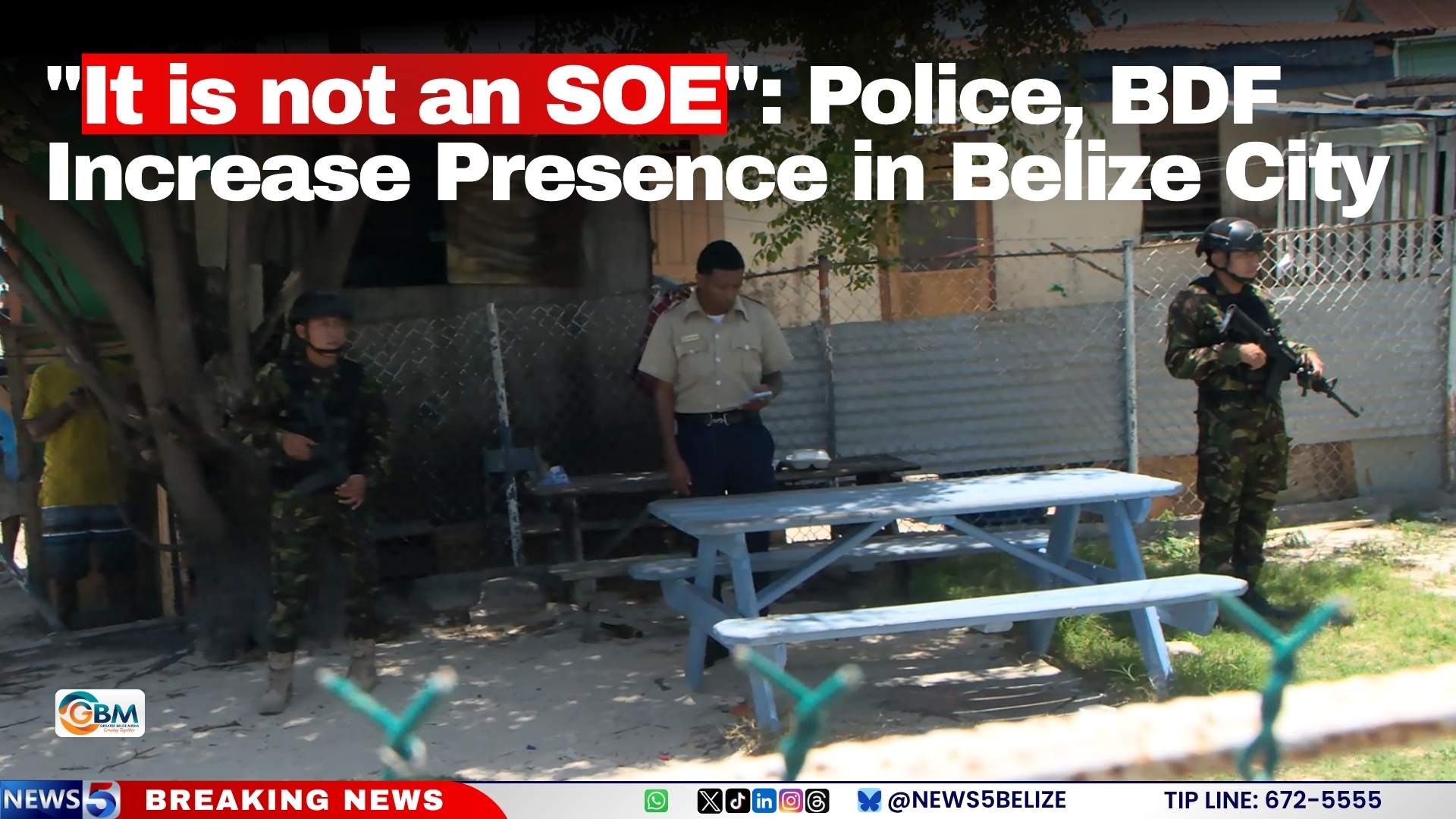
In the wake of a string of violent criminal incidents that rocked Belize City last week, security forces have ramped up coordinated joint patrols and operations across targeted areas of the urban center, senior government officials confirmed this week. The Ministry of Home Affairs announced the stepped-up deployment in partnership with the Belize Defence Force (BDF), framing the move as a targeted response to climbing public safety tensions.
Rear Admiral Elton Bennett, Chief Executive Officer of the Home Affairs Ministry, clarified to local outlet News 5 that the increased security presence does not amount to a declaration of a State of Emergency (SOE). Instead, the operation has been calibrated to fall just below the legal threshold of an SOE, a sweet spot that officials believe will deliver effective crime suppression without triggering the sweeping restrictions that come with a formal SOE.
“Where if we employ the right forces in the right location and with the right missions, we will be able to address some of those crimes that are committed without having to go to SOE,” Bennett explained.
Unlike a full SOE, which typically imposes broad movement controls and curfews, the enhanced operations focus exclusively on high-crime hotspots rather than a citywide lockdown. Bennett emphasized that no fundamental civil rights or freedom of movement will be restricted for city residents as part of the deployment. Local residents can expect to see a higher concentration of uniformed officers at mobile checkpoints and areas that have been flagged as persistent crime hotspots.
In a nod to long-running debates over public safety strategy, Bennett acknowledged that the “hard approach” of increased visible law enforcement and military presence is only a short-term fix for Belize City’s crime challenges. He stressed that complementary work to address the deep-rooted socioeconomic drivers of violent crime must continue in parallel with the security crackdown.
As of June 19, 2026, government officials have not announced a set end date for the enhanced security measures, leaving the duration of the deployment open-ended as authorities assess its impact on violence rates.