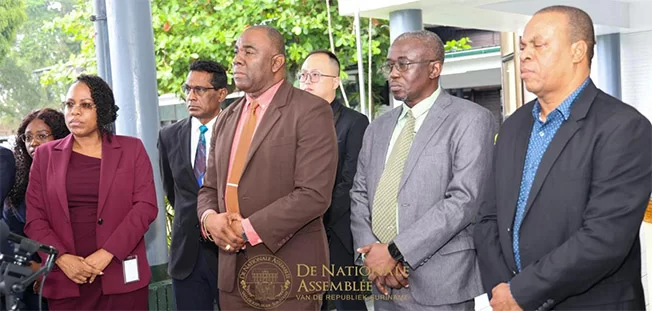
On a Thursday in mid-June, community activists and local residents from Houttuin and its surrounding residential areas delivered a formal petition to Suriname’s National Assembly (DNA), calling for immediate intervention to halt a proposed radioactive source storage and contaminated material treatment facility planned for the Kuldipsingh industrial site in their neighborhood. The petitioners argue that the project’s potential threats to public health and the local environment have been woefully understudied, and demand a full, independent re-evaluation of the entire proposal before any construction proceeds.
The petition was formally received by Ivanildo Plein, first deputy vice-chairperson of the National Assembly, during a brief suspension of the body’s public plenary session, with multiple sitting members of parliament present to acknowledge the community’s concerns. It bears the signatures of hundreds of stakeholders, including prominent local organizers Maggie Schmeitz, Winston Stüger, and dozens of other long-term residents of Houttuin and adjacent neighborhoods.
Beyond calling for a temporary suspension of all pre-construction activities and a complete project reassessment, the petition outlines four core demands: a mandatory reclassification of the project’s risk category, a full environmental impact assessment (EIA) conducted exclusively by independent, unbiased experts, and guaranteed meaningful community inclusion at every stage of future decision-making for the proposal.
According to Schmeitz and Stüzer, the Suriname National Environmental Authority (NMA) incorrectly categorized the facility as a Category B Track 2 project, a classification that only requires a limited environmental analysis rather than a full EIA. After this initial classification, regulators approved moving forward with only a standalone environmental management and monitoring plan, which the residents note imposes far weaker scrutiny and stricter regulatory requirements than a full impact assessment.
The petitioners emphasize that the storage and handling of radioactive sources, which fall under the category of radiological hazardous contaminants, belong to the highest risk classification under both national regulations and international safety standards. For this reason, a full independent EIA is not just requested, but legally and ethically required, they argue.
The community also highlights that binding international nuclear safety guidelines require such high-risk facilities to be sited in remote, sparsely populated, geologically stable locations, at a safe distance from major drinking water sources and residential zones. The proposed Houttuin site fails to meet every one of these basic requirements, according to the petition. Residents also point to critical gaps in the existing environmental review: no comprehensive study of alternative locations, such as isolated industrial zones far from residential areas, was ever conducted, and there is no complete risk analysis mapping potential impacts to local soil, groundwater, and the long-term health of people living within proximity of the facility.
In an additional revealing finding, the organizers note that residents only discovered through persistent questioning that the facility would not just store radioactive materials in hermetically sealed packaging. Workers will also regularly open these containers to adjust the sources in the on-site workshop, a detail that makes the project’s official description as a simple “storage facility” intentionally misleading, the petitioners say.
Criticism is also leveled at the authors of the existing incomplete environmental report. The residents note the experts who prepared the document lack specialized training and credentials in nuclear engineering or health physics, meaning the report cannot serve as a credible or reliable foundation for a responsible final decision on the project.
In response to the petition, Plein confirmed that the National Assembly has already taken note of the community’s concerns. The issue has already been discussed internally among parliamentary leadership, he said, and lawmakers will now work to identify a path forward that brings all relevant regulatory agencies together to address residents’ demands and reach a collaborative solution. Plein added that the petition will also be brought directly to the attention of the National Assembly’s president for further review.