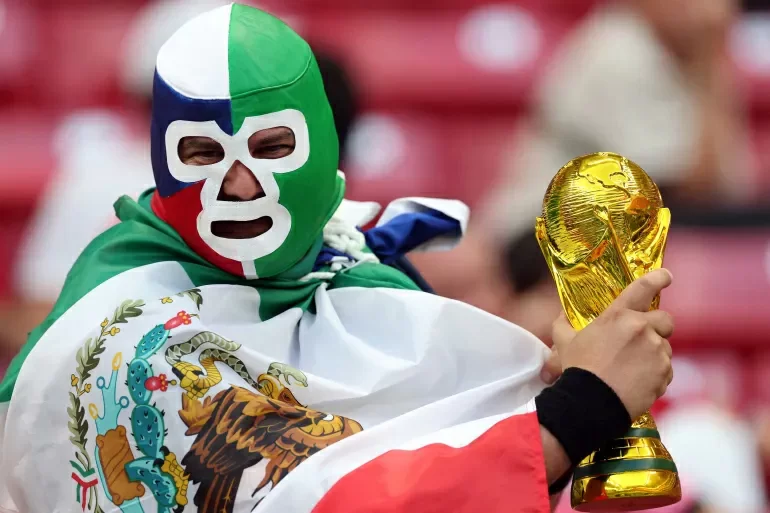
As the 2026 FIFA World Cup co-hosted across North America enters its eighth day, four high-stakes group stage fixtures are scheduled to take place on June 18, with teams fighting to secure their spots in the knockout round of the tournament. The day’s action kicks off at Atlanta Stadium in Atlanta, Georgia, where Czechia will square off against South Africa at 13:00 local time. Next, Switzerland will face Bosnia and Herzegovina at Los Angeles Stadium in California at 16:00, followed by a clash between co-host Canada and Qatar at Vancouver’s BC Place Stadium at 19:00. The headline matchup of the day will close out the schedule, as Mexico takes on South Korea at Guadalajara Stadium in front of a raucous home crowd at 22:00 local time. Ahead of kickoff, one Mexican supporter already captured global attention, posing in the stands with a replica of the FIFA World Cup trophy while wearing a traditional lucha libre wrestling mask.
Looking ahead to the day’s marquee fixture, Mexico enters its Group A matchup against South Korea with historical momentum on its side. The two sides have met twice previously at World Cup tournaments, with Mexico claiming victory on both occasions — most recently a 2-1 win during the 2018 World Cup in Russia. Both nations got their 2026 campaigns off to a strong start with opening match wins, boosting their early knockout stage hopes, but oddsmakers and analysts still peg Mexico as the clear favorite to pick up three points on home soil.
In the day’s opening fixture, Czechia and South Africa will meet for just the second time in senior international history. South Africa has a surprisingly strong track record against European opposition at the World Cup, including a famous 2-1 group stage win over eventual champions France during the 2010 tournament it hosted. The Bafana Bafana have dropped only one of their last four World Cup matches against European sides. For Czechia, this will only be its second World Cup match against an African opponent, and its first ended in a disappointing 2-0 loss to Ghana in 2006.
Switzerland and Bosnia and Herzegovina will lock horns for the first time ever at a World Cup, with the only prior meeting between the two nations coming in a 2016 friendly match hosted in Zurich. On that occasion, Bosnia and Herzegovina claimed a 2-0 win behind goals from legendary duo Edin Dzeko and Miralem Pjanic. Despite that past result, Switzerland is favored to claim all three points in their 2026 group stage encounter.
Closing out the day’s action before the Mexico-South Korea kickoff, co-host Canada will face Qatar, and historical trends heavily favor the North American side. In the three previous instances a World Cup host nation has faced an AFC (Asian Football Confederation) member at the tournament, the host has walked away with a win every time: Mexico beat Iraq in 1986, France defeated Saudi Arabia in 1998, and Russia also downed Saudi Arabia in the 2018 tournament opener.
Beyond Matchday 8’s scheduled fixtures, the tournament has already delivered no shortage of historic moments, breakout performances and talking points through its first week of action. The race for the Golden Boot, awarded to the tournament’s top goalscorer, already has a clear early leader: Lionel Messi netted a hat-trick in his opening match, putting him three goals clear of seven chasing players who have each scored one goal so far, including global superstars Kylian Mbappe of France, Erling Haaland of Norway and England’s Harry Kane.
One of the biggest historic milestones of the tournament so far came from the Democratic Republic of the Congo (DRC), which notched its first ever World Cup goal through Brentford forward Yoane Wissa in a stunning 1-1 draw with Portugal. The result marked DRC’s first World Cup appearance in 52 years, sparking jubilant celebrations among Congolese fans across the globe. Another standout early performance came from Colombia, which opened its Group K campaign with a confident 3-1 win over World Cup debutant Uzbekistan. Liverpool winger Luis Diaz was the star of the match, notching an assist for Daniel Munoz’s opening goal and scoring Colombia’s second after halftime. Uzbekistan briefly pulled level through winger Abbosbek Fayzullaev, but the South American side regained control to lock in three full points. The win gives Colombia a major early boost as it looks to reach the knockout stage after missing out on qualification for the 2022 World Cup in Qatar.
The first week of the tournament has already delivered several stunning upsets that have shaken up group standings. Beyond DRC’s draw with Portugal, Cape Verde earned a historic point against defending champions Spain in a surprise draw, while Iran and New Zealand also played out an unexpected stalemate in their opening fixture.
A widely noted positive theme of the 2026 tournament has been the growing diversity on display across competing squads. Top European sides including England, France, Spain and Sweden have fielded rosters made up of players from a wide range of religious, cultural and ethnic backgrounds, a trend that football experts have praised as a powerful positive example amid ongoing global societal debates around immigration and integration.
One of the more surprising storylines of the tournament’s opening week has been the slow start for Cristiano Ronaldo, who is making his record sixth World Cup appearance but has yet to find the back of the net, while his fellow global superstars Messi, Mbappe, Haaland and Kane all opened their goal accounts in their first matches.
Off the pitch, FIFA’s new heat protection policy, which adds formal drink breaks during matches to help players cope with high summer temperatures across North America, has sparked ongoing controversy. Critics argue that the breaks disrupt the natural flow of matches and give teams extra opportunities to make unplanned tactical adjustments, disrupting competitive balance. FIFA has defended the policy, emphasizing that player health and safety is its top priority.
This year’s tournament has also made history for African football, with a record six African nations qualifying for the final group stage. Despite facing pre-tournament challenges including logistical hurdles and visa processing issues for teams and fans, African sides have enjoyed overwhelming support from their large diaspora communities across North America. While the vuvuzela horns that became a global icon during the 2010 South Africa World Cup are not a common sight this year, the passionate energy and atmosphere brought by African fans remains as vibrant as ever.