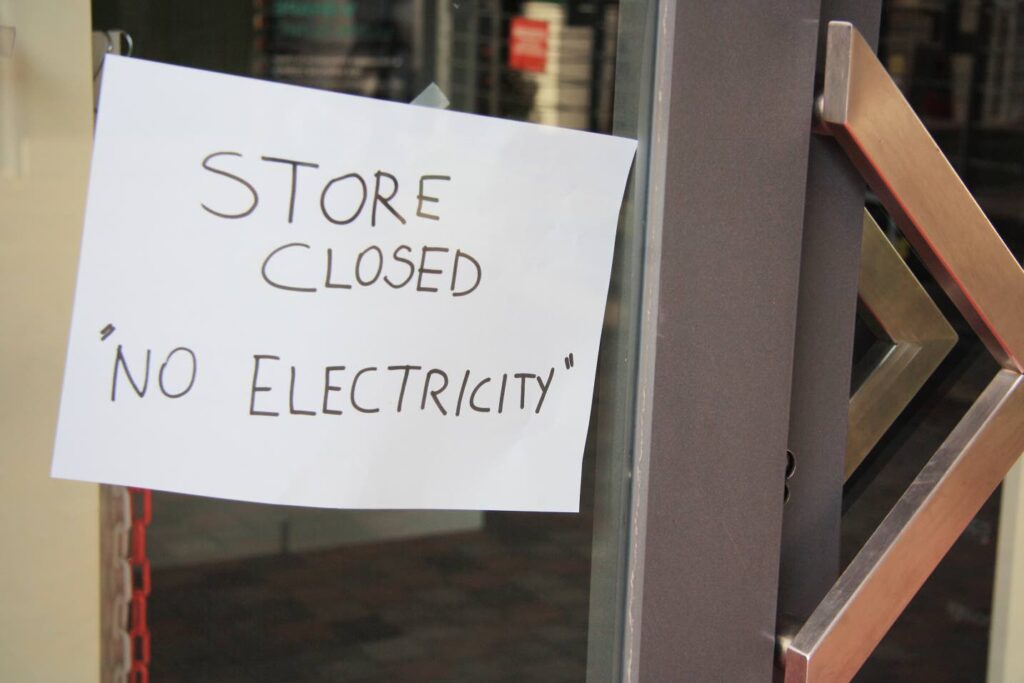
A widespread, island-wide power outage that struck Jamaica on June 5 has left hundreds of small businesses across the nation still tallying steep financial losses, more than a week after grid operations were partially restored. The crisis has reignited long-simmering calls for accountability from the national utility provider, 13 years after an official regulatory recommendation for stronger penalties against major system failures was never enacted.
Energy Minister Daryl Vaz confirmed last week during a parliamentary sitting that the Jamaican government will move forward with adding mandatory compensation clauses to all future electricity operating licenses, noting that a simple public apology from the Jamaica Public Service Company (JPS) — the nation’s primary power provider — is insufficient for customers and enterprises that have sustained measurable financial damage. Vaz emphasized that small and medium-sized businesses across the country have already proven tangible losses from the unprecedented outage, making formal compensation and penalty structures non-negotiable moving forward.
“An apology is not enough for people who lost real income and inventory because of this outage,” Vaz stated. “The commitment I am making today is that all new electricity licenses, and the accompanying revised legislation governing the sector, will explicitly require mandatory compensation for customers affected by large-scale outages, with formal sanctions for non-compliance.”
This policy shift comes 13 years after a technical committee convened by Jamaica’s Office of Utilities Regulation (OUR) delivered the exact same recommendation following an island-wide grid collapse in 2012. The committee’s 2012 report specifically flagged the severe economic risk of total system outages that disrupt all commercial and residential activity across the country, arguing that the regulator needed formal authority to impose penalties when utility providers violate operating standards or fail to comply with regulatory directives. Despite the 2012 recommendation, the policy was never implemented by successive administrations.
For small business owners still reeling from the June 5 outage, the promise of future regulatory reform comes too late to recoup their current losses. Howard Nelson, owner of Northside Barbers in the Liguanea neighborhood, told reporters the sudden blackout forced him to shut his shop mid-day and turn away already seated customers, dragging down his daily revenue far below normal levels.
“It hit us really hard out of nowhere,” Nelson said. “We had customers in the chair already, and we had to send them home. The whole day’s income was wiped out.”
Althea Morgan, general manager of Shoppers Delight Supermarket in downtown Kingston’s Chancery Street, added that even with a backup generator on-site, the rolling outages that continued into the following day forced early closures and repeated operational disruptions that tanked weekly sales. “We had to close for 20 minutes just to refuel the generator, and even with power, sales were way down. It was incredibly frustrating, we definitely took a loss,” Morgan explained.
In the Seaview Gardens community, Susan Barrett, who runs Mizzy Wholesale and Retail, reported that many local customers chose to stay home rather than travel through the blackout, leading to a double-digit drop in sales and lost regular patronage. “This is a neighborhood where people don’t want to walk around in darkness, so they just stayed home. We lost customers and sales straight out,” Barrett said.
A small number of businesses fared better: Family Pride Supermarket in Havendale reported minimal disruption thanks to a fully operational backup generator, though a staff representative noted that even with backup power, internet connectivity failures blocked card payment processing, leading to some lost sales.
Garnett Reid, president of the Small Business Association of Jamaica (SBAJ), called the blackout a major step backward for Jamaica’s small business sector, which is still recovering from the impacts of Hurricane Melissa. Reid noted that more than 425,000 small businesses operate across Jamaica, most of which rely entirely on consistent grid power to operate, with the weekend timing of the outage hitting particularly hard — when small retailers, food vendors, barbershops, and bars earn the majority of their weekly revenue.
Beyond lost sales, Reid highlighted the additional losses from spoiled refrigerated and frozen goods for businesses without backup power, a cost that many small operators cannot absorb. He also criticized JPS for failing to release a full public explanation of the outage’s cause and concrete plans to prevent future collapses, calling for full transparency from the utility provider.
“To date, we have not received an official, detailed report on what happened, why it happened, and what will be done to make sure this never happens again,” Reid said. “Small business owners are still digging out from Hurricane Melissa, and this is just another major blow they don’t deserve.”
The JPS has attributed the June 5 islandwide outage to system damage on the Hunt’s Bay-Rockfort transmission line caused by severe weather, with a second partial outage affecting multiple parishes just four days later on June 9.