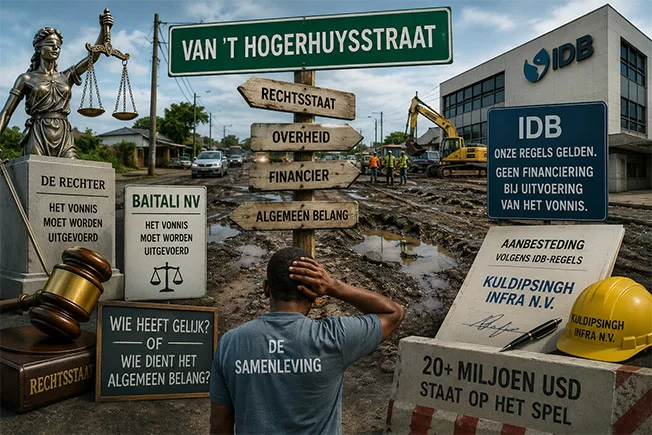
For years, the Van ‘t Hogerhuysstraat infrastructure project in Suriname has devolved from a simple public works plan into a messy standoff that lays bare deep, structural tensions between national legal sovereignty, international financing rules, and the most basic public interest. What should be a straightforward effort to rebuild a critical roadway has instead become a distorted mirror held up to Suriname’s governance system, bringing together competing claims from the judiciary, the executive branch, the Inter-American Development Bank (IDB), private contractors, and civil society. In the end, every side can make a legally defensible claim for their position — yet every stakeholder loses, and worst of all, the Surinamese public bears the cost of the gridlock.
The conflict began when an independent Surinamese court ruled that the project’s tender process must be reopened and re-evaluated. This is not a non-binding policy recommendation; it is a binding ruling from a judicial body. In a functioning democratic constitutional state, court orders are meant to be implemented without exception. From this perspective, the claimant Baitali has an unassailable point: a government cannot pick and choose which court rulings to enforce, because selective compliance directly erodes the foundation of the rule of law itself.
But here the dilemma begins. Standing opposite the Surinamese court’s ruling is the IDB, the multilateral institution providing the financing for the $20 million-plus infrastructure project. The IDB’s position is also legally grounded: the tender process is bound not only by Suriname’s domestic laws, but also by the contractual terms the bank set out as a condition for releasing the funding. According to the IDB, the existing award of the contract to selected contractor Kuldipsingh Infra meets all of the bank’s tender requirements. If Suriname deviates from that award to comply with the domestic court ruling, the IDB has stated it will pull the entire financing package.
This creates an intractable, uncomfortable deadlock: a domestic court has issued a binding order, but the international funder says following that order will kill the project entirely. The standoff forces a fundamental question that goes far beyond this single roadway: who ultimately gets to decide the fate of public projects in Suriname? The nation’s independent judiciary? The elected domestic government? Or the international financial institutions that provide critical capital for public investment?
Suriname’s Public Works Minister Stephen Tsang has been forced to navigate this unenviable trade-off, weighing the legal obligation to comply with the court against the severe financial consequences of losing funding. If the IDB follows through on its threat, Suriname stands to lose an investment of more than $20 million at a time when public infrastructure investment is badly needed. Furthermore, if the government cancels the already-awarded contract to comply with the court ruling, Kuldipsinghh Infra has a valid claim to seek significant damages for breach of contract, adding another unexpected financial burden to the state.
Lost in the tangled legal and financial wrangling between all the institutional stakeholders is the group that matters most: the ordinary Surinamese public. While government officials, lawyers, contractors, financiers, and politicians debate procedural technicalities, tender rules, and legal rights, Surinamese residents continue to drive on a Van ‘t Hogerhuysstraat that deteriorates more every day. Local businesses suffer economic losses from the poor road conditions, motorists face higher vehicle maintenance costs, and even ambulance services responding to medical emergencies lose critical minutes navigating the crumbling pavement.
Average citizens gain nothing from multiple sides claiming they are legally in the right. All they want is a safe, functional roadway. Against this backdrop, the statement from Member of Parliament Ebu Jones — who argues that society should not be taken hostage by this ongoing deadlock — is a politically understandable one. But it also avoids a harder question: can blame for this impasse even be pinned on a single party? Is Baitali at fault for exercising the legal rights to challenge the tender that Suriname’s own laws guarantee? Is the government to blame for running a tender process that ended up being challenged in court? Or is the IDB at fault for insisting on adhering to its own international tender requirements?
In reality, the core of the problem runs far deeper than this single dispute. This case is not just about one bad roadway; it is a warning sign of a new reality that Suriname will have to learn to navigate more and more frequently in the coming years. That new reality is one where domestic legal rules, international financing conditions, and domestic public interests do not always align seamlessly. This kind of conflict will not be limited to road construction projects. As Suriname moves forward with planned oil, gas, and large-scale infrastructure developments, international financiers, multilateral institutions, and foreign investors will continue to set binding contractual conditions for their capital.
That is why this small infrastructure dispute deserves far broader public discussion, not focused on which side is legally in the right, but on how Suriname can restructure its governance to prevent these kinds of deadlocks from happening again. It is time to stop asking “who is right?” and start asking a different, more important question: how can we reorganize our governance systems so that society never again ends up the loser when rules, procedures, and interests collide?
At the end of the day, the Van ‘t Hogerhuysstraat does not belong to Baitali, or Kuldipsingh Infra, or the IDB, or the Surinamese government. It belongs to the Surinamese people, and they are the only party that has gotten the short end of this dispute for far too long. To date, while no construction has even begun on the road, the state of Suriname has already paid out 918,450 Surinamese dollars in penalty fines for failing to comply with the court order — money that could have gone toward actual public works.