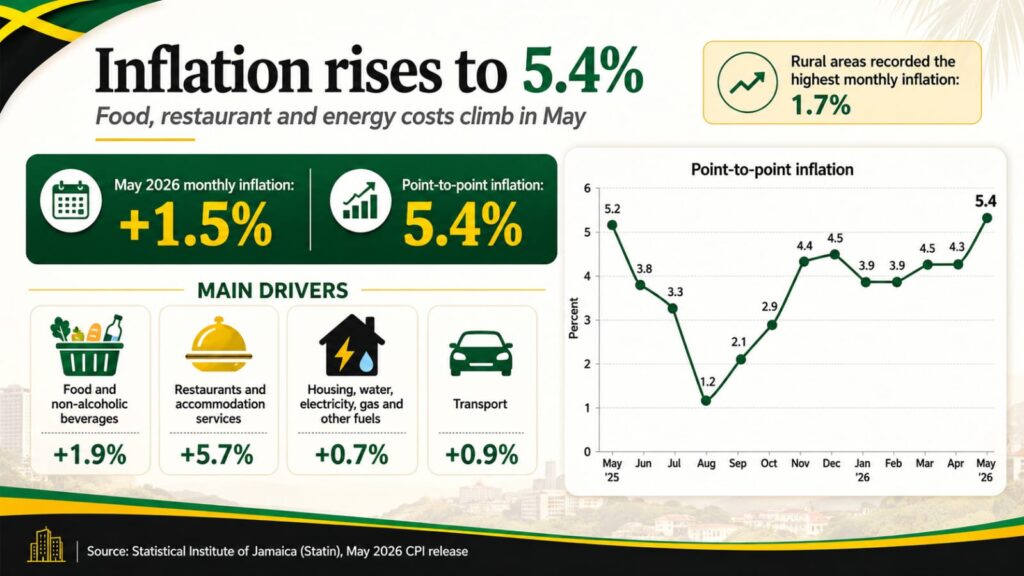
KINGSTON, Jamaica — Jamaica’s cost of living pressures accelerated sharply in May 2026, pushing the country’s annual inflation rate up to 5.4% as households faced steeper bills for staple groceries, restaurant dining, utility services and transportation, official data released by the Statistical Institute of Jamaica (Statin) shows.
The month-over-month consumer price jump came in at 1.5% in May, marking a complete reversal of the 0.3% contraction recorded in April and representing the steepest single-month increase in consumer costs since November 2025. This upward shift pushed the 12-month inflation rate — measured between May 2025 and May 2026 — up from the 4.3% reading recorded in April. While the current figure still falls within the Bank of Jamaica’s official target band of 4% to 6%, it now sits uncomfortably close to the upper limit of the central bank’s tolerance range.
Food inflation emerged as the dominant force behind the overall price increase. The Food and Non-Alcoholic Beverages category registered a 1.9% monthly price jump, fueled almost entirely by sharp increases in locally grown fresh produce. Key staples including tomatoes, cabbage, carrots, ripe bananas and pineapples all saw double-digit proportional increases over the month, pulling the overall index for vegetables, tubers, plantains, cooking bananas and pulses up 4.8%. The fruit and nuts subcategory rose even faster, posting a 4.7% monthly increase. Smaller but still notable increases were recorded for fish and seafood (1.2%) and meat products (0.9%).
Beyond grocery shelves, Jamaican consumers also faced significant price hikes when dining out. The Restaurants and Accommodation Services segment saw a 5.7% monthly surge, with the overwhelming majority of this increase traced to higher costs for meals purchased away from home.
Housing and utility costs also contributed to the upward trend. The Housing, Water, Electricity, Gas and Other Fuels division recorded a 0.7% monthly increase, driven largely by elevated electricity rates. This upward pressure was partially offset by a temporary reduction in water supply and sewage service charges across much of the country.
Transportation costs added another layer of pressure to household budgets, rising 0.9% month-over-month. The increase stemmed from higher retail petrol prices and a 3.1% jump in the ongoing cost of operating private passenger vehicles.
The inflationary increase impacted all regions of Jamaica, but rural households bore the brunt of the price hikes. Statin data shows rural areas recorded a 1.7% monthly inflation rate, outpacing the 1.5% increase seen in other urban centers and the 1.3% rise in the densely populated Greater Kingston Metropolitan Area.
Over the 12-month period ending in May 2026, cumulative food price inflation reached 8.7% — far outpacing the overall headline inflation rate of 5.4%. The most dramatic annual increase was recorded in the fruit and nuts category, which has soared 34.3% over the past year. Vegetables, tubers, plantains, cooking bananas and pulses have risen 10.4% year-over-year, while fish and seafood prices are up 11.7% from May 2025. Annual price increases for the Restaurants and Accommodation Services segment hit 6.9%, while transportation costs are up 3.1% over the same period.
Notwithstanding the sharp May increase, Statin noted that the overall consumer price index remains 0.2% lower than its peak level in December 2025, a residual effect of broader price declines recorded in the first months of 2026. In absolute terms, the All-Jamaica Consumer Price Index rose to 149.6 in May, up from 147.4 in April.