When a captain lifts the World Cup trophy above their head, global audiences only see the celebration of athletic excellence. Behind the goals, outpourings of emotion and national pride, however, lies a massive, complex financial ecosystem that has turned the FIFA World Cup into one of the world’s most lucrative commercial events, with billions of dollars flowing between FIFA, broadcasters, sponsors, national football associations, clubs and ultimately the players themselves. For millions of football fans across the globe, the core question remains: where does all this money come from, and exactly how is it distributed across the entire industry?
Unlike many major sporting events that rely heavily on ticket sales and stadium revenue, the World Cup’s largest income stream does not come from seats in venues – it is generated in the living rooms of billions of viewers tuning in from around the world. Television and broadcasting rights are by far FIFA’s biggest source of revenue, with global media networks paying record-breaking sums to secure the rights to air tournament matches. Beyond broadcast rights, FIFA also pulls in billions of dollars from corporate sponsorship deals, advertising campaigns, digital content rights, official merchandise sales, premium hospitality packages and match ticket sales. The upcoming expansion of the tournament from 32 to 48 participating nations is set to boost these total revenues even further: more matches mean greater airtime for broadcasters to sell, and in turn higher advertising returns across the board.
A key component of FIFA’s revenue strategy that often flies under the radar of casual fans is its distribution package model. Instead of negotiating directly with hundreds of individual national broadcasters around the world, FIFA groups large geographic regions or blocs of countries into a single commercial rights package, which it then sells to a specialized distribution partner. That distributor purchases the full regional rights, and then resells sub-licenses to individual national television stations. This system streamlines negotiations for FIFA, eliminating the need to manage hundreds of separate agreements while also guaranteeing the governing body maximizes its total revenue from broadcast rights.
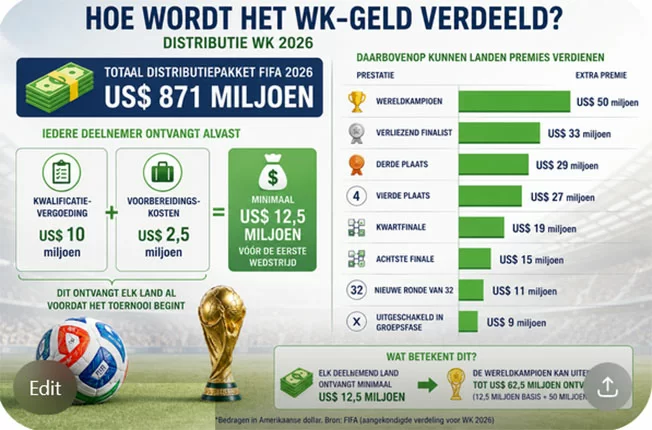
Long before the opening match of the tournament kicks off, every participating national association already receives a base payout to cover qualification and preparation costs. For the 2026 iteration, each qualified nation already earns upwards of $12 million USD before a single ball is kicked. Additional performance-based prize money is awarded based on how far a team progresses in the tournament. Even teams eliminated in the group stage walk away with multi-million dollar payouts, and prizes rise rapidly as teams advance through the knockout rounds, with the eventual world champions set to take home $50 million USD in prize money. While that figure sounds enormous, it only accounts for a fraction of the total revenue generated by the entire tournament.
One of the most common misconceptions surrounding World Cup finance is that all this prize money goes directly to the players on the pitch. In reality, FIFA pays all prize funds to national football associations, not individual players. Each association is then free to decide how to allocate its payout across a range of priorities. A portion typically goes to individual player bonuses, technical and coaching staff salaries, and on-tournament medical support. Many associations also allocate large shares of the money to cover operational costs, youth football development programs, coaching education initiatives, and long-term national football infrastructure projects. As a result, individual player bonuses vary wildly from nation to nation: some associations award large, direct bonuses to their squads, while others choose to reinvest most of the payout into growing the sport at the grassroots level.
Clubs that release players to compete at the World Cup also receive financial compensation from FIFA through the governing body’s Club Benefits Programme. The logic behind the program is straightforward: clubs invest years of time and resources into developing and paying players’ salaries, and face the risk of players suffering tournament injuries that can disrupt club seasons for months. For the 2026 World Cup, FIFA has set aside a record-breaking multi-hundred million dollar fund for this compensation program. The amount a club receives is tied to how far a player’s national team progresses in the tournament, meaning the longer a player stays in the competition, the higher the payout their club receives. Crucially, this system is not limited to elite European giants like Real Madrid, Manchester City and Bayern Munich – smaller clubs that developed and trained world cup players are also eligible to receive a share of these funds.
The narrative that the World Cup is purely a sporting event only tells half the story. Its entire financial supply chain starts with a single viewer watching a match from home: advertisers pay for commercial airtime, broadcasters pay for the rights to air matches, distributors sell sub-licenses to local stations, FIFA collects the revenue and redistributes it to national associations, clubs, and global development programs. While only one nation leaves the tournament as champions, dozens of different stakeholders across the global football ecosystem financially benefit from the event. The player who scores the winning penalty gets all the post-tournament glory, but the billions of dollars that flow behind that iconic moment remain invisible to most fans.
It is this unseen economic competition that plays out off the pitch, and it is far larger than the 90 minutes of play that capture global attention. For FIFA, media companies, sponsors and broadcasters, the real final for the World Cup begins long before the opening whistle blows.