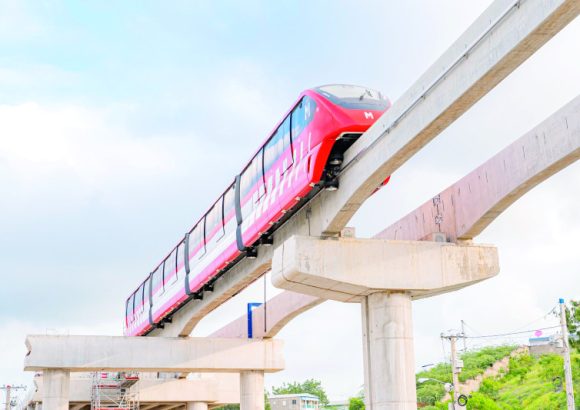
On a recent Friday, the Dominican executive branch announced a revised timeline for the long-awaited Santiago Monorail project, confirming that passenger trial operations, branded as a “white run test”, will launch this coming December. The announcement lands amid soaring public anticipation in the region, and follows a years-long pattern of rescheduled delivery dates for the transformative transit megaproject, which aims to overhaul mobility in the capital of the Cibao region.
During an on-site inspection of the monorail’s maintenance workshops and the underground terminal in the city’s monumental district, President Luis Abinader verified that the project has reached 92.6% overall completion, just over four years after construction first kicked off. Abinader also walked through the capabilities of the project’s central Maintenance and Control Center, noting that the facility is almost fully finished with only minor finishing touches remaining, and will be able to accommodate and service up to 15 trains overnight when fully operational.
Jhael Isa Tavárez, executive director of the Mass Transit System Development Trust (Fitram), the public body overseeing the project, laid out the step-by-step roadmap moving forward: all core civil construction will wrap up in August, paving the way for dynamic empty-train testing between stations E1 and E11 in the final quarter of the year. Additional train units will arrive ahead of the December start date for the public trial run.
This latest announcement marks the fourth formal timeline set by authorities, after three previous deadlines were missed. When the initial groundbreaking was held in March 2022, the government originally pledged a full inauguration by the end of 2024. The schedule was later adjusted to open the first commercial segment from Cienfuegos to Las Antillas between February and March 2025, when non-passenger movement tests were completed but public access did not launch. Most recently, the official target for first-phase completion was set for 2025, a date that has now been pushed to December 2026. Fitram has cited unforeseen urban adjustments and community-requested changes to the original route, particularly in the Reparto Universitario sector, as key factors contributing to the repeated delays.
Beyond the monorail inspection, President Abinader packed his working trip to Santiago with a full slate of additional government announcements and project inaugurations. He held a working lunch with students from local polytechnic institutes, where he distributed new laptops and issued a directive to the Ministry of Higher Education, Science and Technology (MESCyT): the agency will begin evaluating scholarship applications while students are still in their fifth year of secondary school, eliminating gaps that force many graduates to lose an academic year while waiting for approval. Abinader also revealed plans to build a new regional campus of the Instituto Tecnológico de las Américas (ITLA) in Santiago Province.
The president also formally opened the expanded and renovated Dr. Antonio Fernández Municipal Hospital in Monte Adentro, a project that received more than RD$103.9 million in public investment. The upgrade brings the total number of renovated healthcare facilities overseen by the National Health Service (SNS) across the country to 113. At the inauguration, Abinader confirmed that the Licey al Medio Municipal Hospital is on track to be completed next September.
Abinader’s busy day ended with two more community-focused events: the inauguration of the quasi-Parish of San Benito Abad, and an inspection of the ongoing construction of the new headquarters for the Santiago Fire Department. He also reviewed progress on a new fire station in the El Dorado neighborhood, which the city mayor’s office confirms is currently moving forward as planned.
Per the official public schedule, the government’s working visit to Santiago will continue into Saturday, with additional project inaugurations and scheduled meetings with regional business and community leaders.