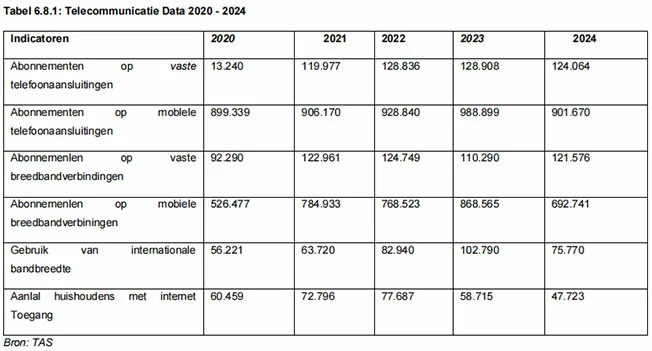
Suriname has made striking progress in its digital transformation in recent years, but the benefits of this growth have yet to reach a significant share of its population, according to the country’s 2026 Financial and Economic Plan. Official data outlined in the plan shows that more than 500,000 Surinamese currently have access to internet connectivity, leaving an estimated 138,000 residents still disconnected from digital networks. To address this gap, the Surinamese government has announced plans for targeted investments over the coming years focused on expanding digital inclusion, upgrading universal internet access, and boosting population-wide digital literacy skills.
The plan identifies the information and communications technology (ICT) sector as one of the most high-potential growth pillars of Suriname’s economy. Current national data puts the country’s internet penetration rate at 78.4%, with the total number of active mobile connections exceeding 943,000. As access expands, digital technology has increasingly reshaped core areas of daily life, from how Surinamese communicate and access education to how they engage with public services and launch small businesses.
Despite these overall gains, government officials have flagged key persistent barriers that are slowing more equitable digital growth. The most pressing challenge remains the steep cost of internet and telecommunications services. The 2026 plan notes that Suriname’s broadband costs remain among the highest in the Caribbean and Latin American region, pricing out low-income households that struggle to afford consistent access to essential digital services.
A second major gap is the stark digital divide between urban centers and rural districts. Households in the capital Paramaribo and along the coastal plain are far more likely to have access to reliable fixed-line broadband connections, while residents of inland rural areas are almost entirely dependent on expensive mobile data as their only source of internet connectivity. To address this uneven access, the government plans to roll out broadband infrastructure to underserved rural districts including Marowijne and Brokopondo.
Low levels of advanced digital skills across the population also represent a critical bottleneck. While most active internet users can carry out basic tasks such as sending and receiving messages, official statistics show that only a small share of Suriname’s population uses online banking or has foundational coding and digital problem-solving skills. The plan emphasizes that sustained investment in digital literacy is essential to prepare the workforce to participate in a rapidly digitizing national economy.
Looking ahead, the Surinamese government has set ambitious measurable targets to guide its digital transformation agenda. It aims to push national internet penetration above 85%, reduce average internet service costs by at least 10%, develop a comprehensive national cybersecurity strategy, support the growth of local ICT startups, and expand the range of digital public services available to citizens. The long-term vision outlined in the plan is to position Suriname as a regional digital hub, an outcome that planners say will require sustained additional investment in digital infrastructure, tech-focused education, innovation ecosystem development, and expanded international cooperation.