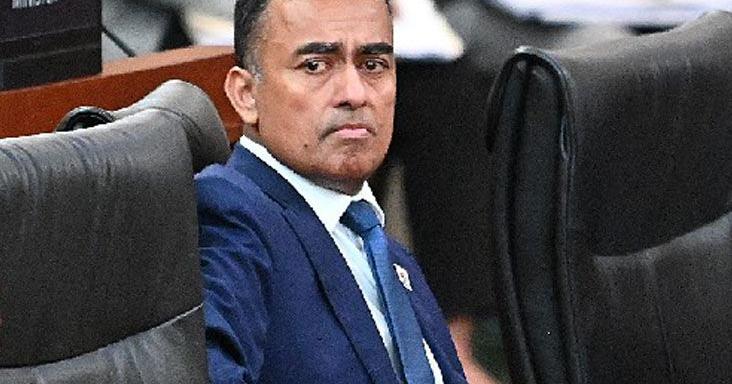
During a heated Senate debate yesterday, Finance Minister Davendranath Tancoo has robustly defended controversial increases to legal penalties outlined in the new Finance Bill, framing the tougher measures as a non-negotiable safeguard for public welfare rather than an overreach of government power.
Tancoo pushed back against opposition criticism, arguing that the current, overly lenient fines have devolved into little more than a trivial operational cost for repeat violators who flout industry and safety regulations. “A weak fine essentially tells offenders that they can break the law, pay a negligible sum, and go right back to business as usual,” he stated during proceedings. “This administration will not enable lawlessness.”
Taking direct aim at the opposition People’s National Movement (PNM), Tancoo claimed the party’s longstanding comfort with unregulated practices made its opposition to the new penalty structure entirely predictable. “When they come here to argue against consequences for breaking the law, no one should be surprised,” he said. “This mindset appears to be rooted in the very veins of the PNM. They have come to this parliament only to drum up sympathy for a position that puts convenience before public safety.”
To underscore the stakes of weak regulatory enforcement, Tancoo pointed to decades of deadly contaminated product incidents around the world, opening with a 2011 Associated Press report that linked antifreeze-tainted vinegar to 11 deaths and over 120 illnesses in China. He noted that similar fatal events involving unsafe, unregulated products ranging from counterfeit vinegar to locally produced illicit spirit “babash” have been recorded across more than 30 countries, spanning every inhabited continent from North America to Southeast Asia. The full list of affected nations includes Brazil, Australia, Cambodia, Costa Rica, the Czech Republic, El Salvador, Estonia, India, Indonesia, Iran, Ireland, Italy, Kuwait, Laos, Madagascar, Malaysia, Mexico, Morocco, Nigeria, Norway, Peru, the Philippines, Russia, Serbia, Spain, Turkey, Uganda, and the United States.
“When products are manufactured, distilled, transported or sold without proper regulatory standards, the consequences stretch far beyond simple financial losses,” Tancoo emphasized. “People can get sick. People can lose their lives. It is the government’s fundamental duty to guard against those real-world dangers.”
The minister argued that any legitimate product market requires clear legal standards, meaningful accountability, and proportionate consequences for rule-breakers. He challenged the opposition to justify their stance to the families of people who have been killed or harmed by unsafe, unlicensed production practices. “When the Opposition makes light of distilling without a licence, let them explain that to the families of persons who have been injured or who have died from unsafe alcohol and unsafe practices,” he said.
Tancoo extended the same safety argument to the new penalties for violations of the Motor Launches Act, specifically calling out the opposition for dismissing overloading of passenger vessels as a minor offense. “They spoke about party boats as though passenger safety is any little thing. But overloading a vessel is not any little thing. Operating without proper safety equipment is not any little thing,” he said.
Carrying passengers beyond a vessel’s legal capacity, he noted, carries a constant risk of catastrophic tragedy, and it is the sitting government, not the opposition, that is left to confront grieving families when disaster strikes. “When a vessel is overloaded and tragedy strikes, it is not the Opposition who must face the grieving family. It is not the Opposition who must look into the eyes of a mother, a father, a child, a spouse, and explain why basic safety rules were treated as an inconvenience,” he said.
He further highlighted that unlicensed, non-compliant operation often voids insurance coverage, leaving victim families with no path to fair compensation after an incident. Tancoo stressed that no responsible government can wait for mass casualties to act, arguing that allowing weak fines to become a routine cost of cutting corners amounts to sacrificing public safety for private convenience. “No serious government can say that the life of a passenger is worth less than the convenience of an operator. No government that cares about people can allow this status quo to stand,” he said.
Closing his address, Tancoo made a direct appeal to Independent senators to throw their support behind the legislation, urging them to back measures explicitly designed to protect the nation’s citizens. He also issued a public challenge to opposition members, expressing confidence that patriotic, right-minded members of the public will ultimately support the bill’s public safety goals.