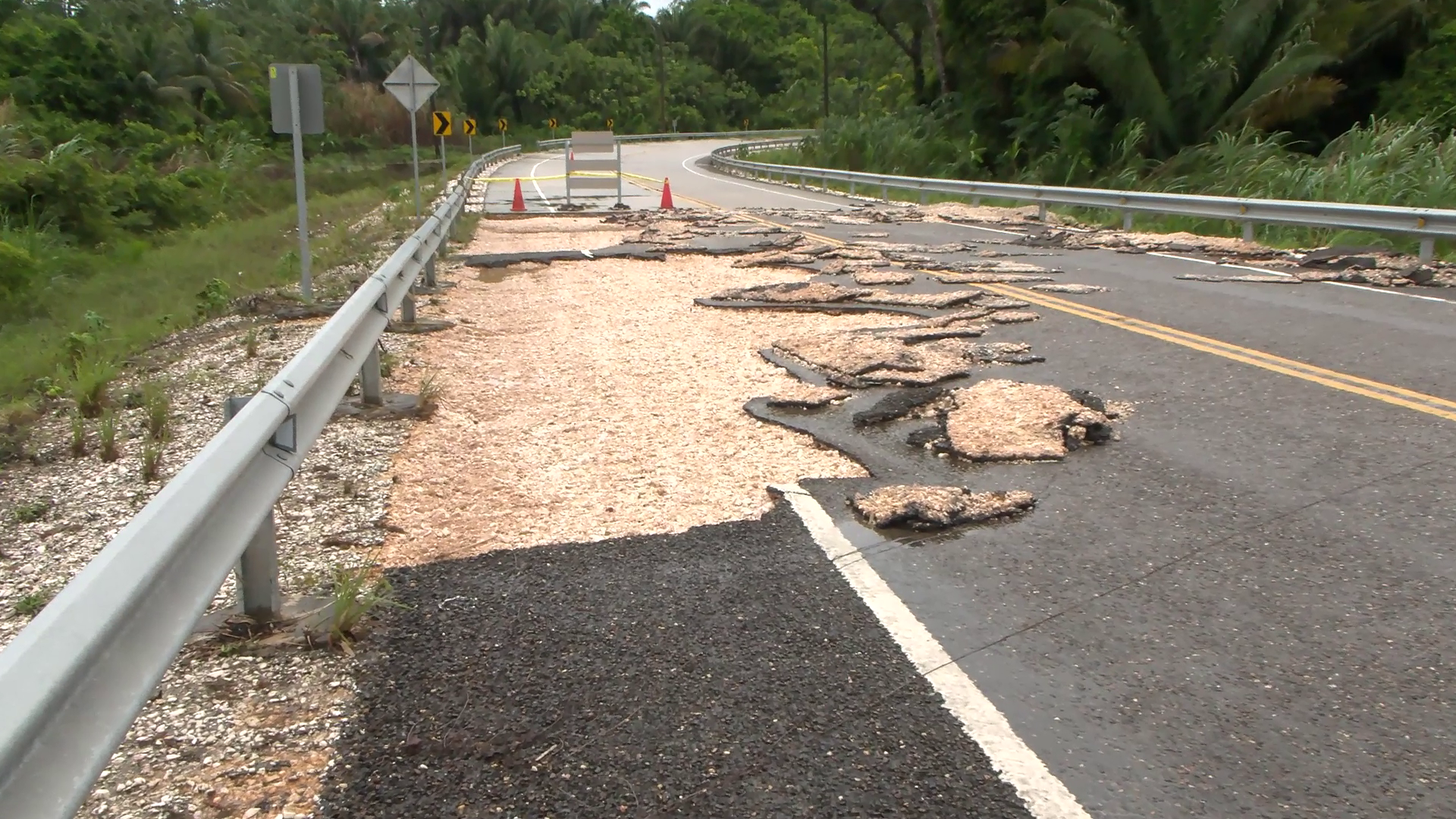
Three years after Belize completed a major upgrade converting the Coastal Plain Highway from gravel to paved infrastructure – a project marketed around cutting-edge climate resilience design – repeated severe flood events have thrown the road’s ability to withstand intensifying extreme weather into sharp question. The most recent heavy rainfall event left portions of the roadway damaged and impassable, prompting public and expert scrutiny of what climate resilience actually means for infrastructure in flood-prone tropical regions. News Five correspondent Paul Lopez reported on the ground from Belize to unpack the ongoing debate.
When the upgraded highway opened, engineering teams prioritized durability from the earliest design phases, given the low-lying coastal corridor’s long-documented high vulnerability to flooding. According to Evondale Moody, Chief Engineer at Belize’s Ministry of Infrastructure Development and Housing (MIDH), the project included major drainage system upgrades explicitly designed to boost the highway’s ability to weather extreme climate events.
Despite these precautions, the highway has already been rendered impassable by floodwaters twice since opening, with each event causing visible damage to sections of the new construction. In the most recent incident, floodwaters stripped away surface layers of the pavement in multiple stretches. Moody clarified that the underlying pavement structure remains intact, noting that only the top wearing course and surface dressing were damaged, and repair teams have moved quickly to restore the affected sections.
The repeated damage has led many to question the promise of “climate-resilient infrastructure” for high-risk regions. Tennielle Hendy, Belize’s Principal Hydrologist, explained that the country’s unique geography makes absolute flood protection impossible. Much of central and southern Belize, including the Coastal Plain Highway corridor, sits on low-gradient terrain downstream from the Maya Mountains, creating ideal conditions for fast-forming flash floods that can hit within one to six hours of heavy rainfall. “We cannot say we will absolutely avoid flooding. We cannot avoid flooding,” Hendy emphasized.
MIDH crews have already begun on-the-ground repair work, and this round of repairs includes a key design adjustment to boost future resilience: crews are pouring concrete for the affected 50-meter stretch, and will extend the concrete section all the way up to the abutment of Soldier Creek Bridge. The goal is to reinforce this flood-prone stretch to better withstand future overtopping from extreme rainfall events.
Even with these upgrades, infrastructure and hydrology experts agree that engineering can only go so far to mitigate the power of nature’s most extreme events. Flash floods carry an unpredictable force, capable of overwhelming even well-designed protective measures. From Hendy’s perspective, the core goal of climate resilience in Belize is not to eliminate flooding entirely – an unachievable goal given the country’s topography and changing climate – but to reduce how long floodwaters cover critical infrastructure, and restore access more quickly after events. “Nature will have its way,” Hendy noted, “but we definitely can reduce retention time, increase runoff speed, even if we can never avoid flooding entirely. Even as teams reinforce the Coastal Plain Highway, experts stress that for flood-prone nations like Belize, resilience measures limit damage but cannot stop extreme weather disasters from impacting infrastructure altogether. This report was filed by Paul Lopez for News Five.