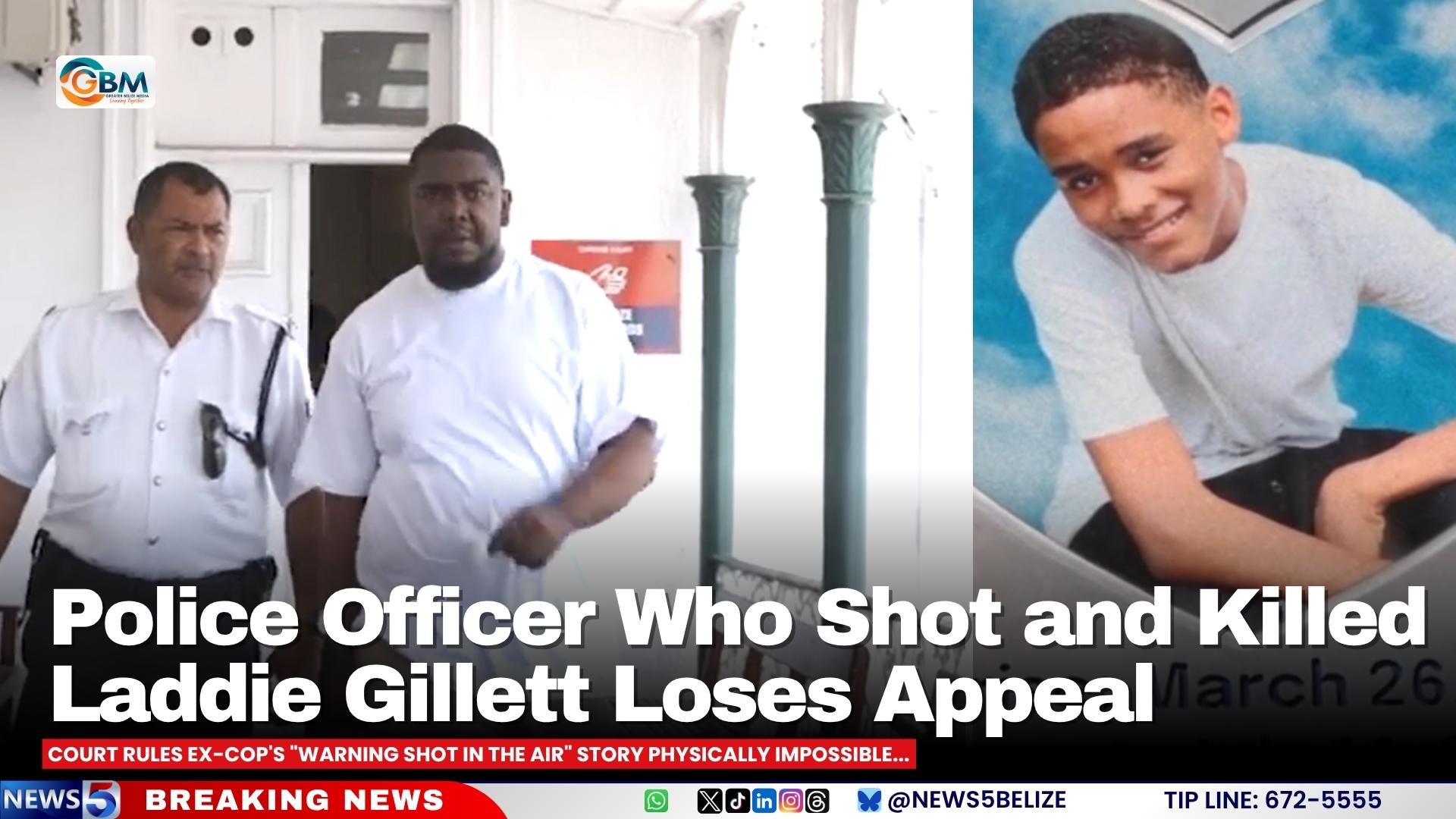
In a landmark ruling delivered this week, Belize’s Court of Appeal has unanimously upheld the manslaughter conviction and 18-year prison sentence of former police corporal Kareem Martinez, ending his legal challenge over the 2021 fatal shooting of 14-year-old Laddie Gillett on a Placencia beach.
The fatal incident unfolded on the night of July 14, 2021, at the height of COVID-19 pandemic restrictions when a national 10:00 p.m. curfew was in effect. Gillett and his best friend had spent the evening celebrating a birthday with cake on the beach, and were hurrying along the beachfront back to the Chabil Mar resort to meet the curfew deadline. As they rounded a corner near the Placencia Beach Club Resort, the pair unexpectedly encountered a team of four police officers responding to a security guard’s report of suspicious persons in the area.
Startled by the sight of uniformed officers in dark clothing, both teenagers turned and fled. Moments later, a single gunshot rang out, and Gillett was struck in the back. The bullet passed through his chest, and he was pronounced dead just 21 minutes after the incident at 10:21 p.m. His friend was taken into custody for curfew violation and held at the local police station.
During Martinez’s original trial, prosecution evidence overwhelmingly tied him to the fatal shot. Investigators recovered a single 9mm shell casing near the spot where Gillett fell, and forensic analysis from Belize’s National Forensic Sciences Services confirmed the round had been fired from Martinez’s issued Bersa Thunder 9 pistol, which was seized from him the same night. The three other officers on scene all testified they had not fired their weapons, despite the trial judge noting all three appeared evasive in their accounts, clearly attempting to distance themselves from the shooting. Gillett’s friend, whom the judge deemed a thoroughly credible witness, also confirmed neither teen was armed, nor was there any physical altercation before the shot was fired.
Martinez chose not to give sworn testimony during his trial, instead offering an unsworn statement claiming he fired a single warning shot 10 feet into the air after spotting a shiny object he believed to be a gun. He further claimed the fatal shot had actually been fired by fellow officer PC Augustine at the exact same time, explaining why witnesses only heard one bang. The trial judge rejected this account as physically incredible, pointing out that for Martinez’s story to hold, a bullet fired 10 feet into the air would have had to travel 75 to 90 feet backward and downward to strike Gillett in the back in the span of just six seconds. The Court of Appeal fully endorsed this finding, confirming the scenario was physically impossible.
On the alternative claim that Augustine was the actual shooter, the appellate panel also dismissed the theory out of hand. Augustine was positioned closer to witnesses than Martinez, the court noted, and if he had drawn and fired his weapon, at least one of the five other people present would have seen the action. No witness testified to seeing Augustine fire, and the court ruled accepting the alternative shooter claim would require pure, unfounded speculation. While the trial judge did find Augustine had lied about carrying a personal licensed firearm that night, she also concluded he did not fire the weapon that killed Gillett, a finding the appeal court saw no reason to overturn.
In its written ruling, the appellate court joined the trial judge in harshly criticizing the conduct of officers involved in the incident. The three officers who testified for the prosecution were found to have deliberately downplayed their own roles in the events of the night, with the court describing their overall conduct as “less than exemplary.” Even the security guard who placed the original call about suspicious persons was found to have lied about his presence at the scene, with the judge confirming he was present during the chase despite his claims to the contrary. The court emphasized, however, that these shortcomings in police conduct were not enough to undermine the overwhelming core of the prosecution’s case against Martinez.
Martinez’s legal team had submitted eight separate grounds of appeal, arguing the investigation was biased toward prosecuting Martinez, that investigators failed to test other officers’ hands and weapons for gunfire residue, that the trial judge had improperly overstepped by asking too many questions during proceedings, and that she had incorrectly shifted the burden of proof onto the defendant. The three-judge appellate panel rejected every single ground, concluding the trial judge’s management of the case was “detailed, sound and flawless,” and that she had consistently and correctly upheld the principle that the prosecution, not the defense, bears the burden of proving guilt beyond a reasonable doubt.
With the appeal dismissed, Martinez will now serve out his full 18-year prison sentence for manslaughter. The case remains a high-profile example of police accountability in Belize, four and a half years after the 14-year-old’s death during a public health curfew.