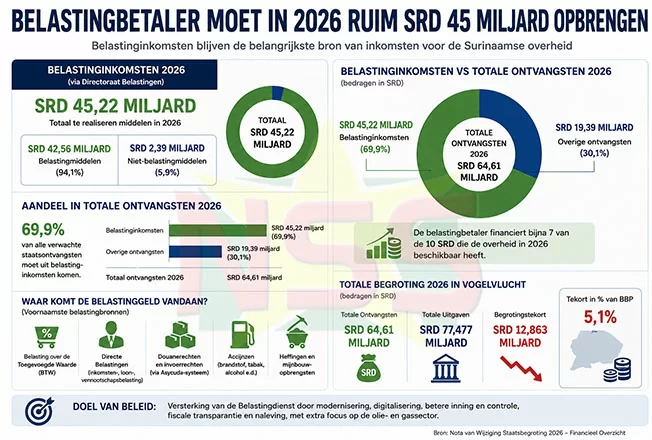
Newly released budget adjustment documents for Suriname’s 2026 fiscal year outline a revenue framework where domestic tax contributions will remain the backbone of state income, with the Tax Directorate under the Ministry of Finance and Planning projecting total collections of more than SRD 45.2 billion for the year.
Of this total projected collection, SRD 42.56 billion will come from various tax streams, while the remaining SRD 2.39 billion will be generated from non-tax government revenue sources. The breakdown confirms that the Surinamese government remains heavily reliant on taxpayer contributions to fund public expenditures, as the projected tax revenue makes up roughly 70% of all expected state incoming funds for 2026, which are forecast to hit a total of SRD 64.6 billion overall.
Budget documents also break down the key sources of projected tax revenue. Value-Added Tax (VAT) is expected to be one of the largest single contributors, bringing in an estimated SRD 10.5 billion in 2026. Payroll and income tax will account for an even larger share, with projected collections of SRD 18.3 billion. Import duties remain a stable core revenue source, forecast to generate SRD 5.6 billion, while motor fuel taxes are projected to add an additional SRD 3.74 billion to state coffers.
To hit these higher revenue targets, the Ministry of Finance and Planning has outlined a series of strategic reforms for the national tax authority. The government plans to boost collections through further digital transformation of tax administration, stricter compliance audits, clearing backlogs of unpaid tax obligations, and streamlining overall collection processes. A key focus of enhanced oversight will be improving revenue tracking for major natural resource sectors, including oil, gas, gold and timber, which are expected to deliver growing contributions to state revenue in coming years.
Tax authority reform will remain a policy priority in 2026, with ongoing investment in modernizing organizational structures, improving collection and compliance monitoring, expanding digital tax systems, and upgrading support services for taxpayers. The government will also continue building out three core fiscal infrastructure projects: the full implementation of VAT, modernization of direct tax administration, and expansion of the ASYCUDA customs automation system.
Additional policy attention will go to strengthening fiscal transparency, improving compliance with tax regulations, and making collection processes more efficient. Ministry officials note that a strengthened, modern tax authority is critical to securing stable government revenue and adequately supporting future economic development, particularly the rapid expansion of Suriname’s emerging oil and gas sector.
Over the coming years, the tax authority will take on an increasingly prominent role in managing and collecting revenue from the development of the oil and gas sector. To that end, the government is developing targeted fiscal legislation and oversight frameworks designed specifically for the energy sector. While taxpayers will remain the largest source of state funding in 2026, the government is also counting on growing additional revenue from mining, energy and oil operations to further strengthen the country’s overall public finances.