The opening matchday of the 2026 FIFA World Cup delivered non-stop drama across two Mexican host cities on Thursday, serving up five goals, three red cards, four scheduled water breaks and all the high-stakes intensity fans expect from football’s biggest global tournament. From an early sending-off to a last-gasp comeback win, the first day of the 48-team, 39-day competition set an early tone for what is shaping up to be a historic edition of the World Cup.
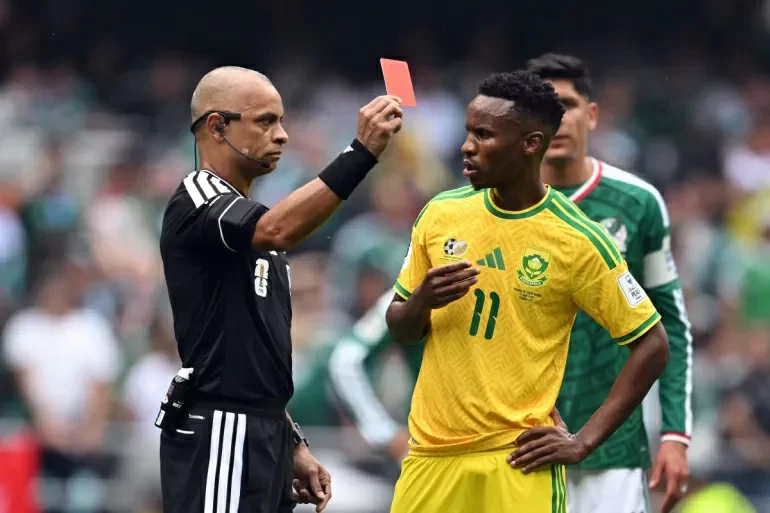
One of the most talked-about outcomes of the opening day was the historic number of red cards issued during Mexico’s 2-0 victory over South Africa at the iconic Estadio Azteca. Referee Wilton Sampaio sent off three players across the match: South Africa’s Yaya Sithole and Themba Zwane, plus Mexico’s César Montes. To put that number in context, the entire 2018 and 2022 World Cups combined only saw four total red cards across 128 matches – meaning the opening fixture of 2026 nearly matched that full-tournament total in 90 minutes. It also falls just one short of the single-match World Cup record of four dismissals, set during the infamous 2006 “Battle of Nuremberg” between Portugal and the Netherlands. That 2006 tournament also holds the all-time record for most red cards in a single World Cup, with 28, leading observers to wonder if the 2026 edition could break that mark, given the early trend of strict officiating.
The issuing of Zwane’s red card immediately reignited long-running controversy around the Video Assistant Referee (VAR) system. Sampaio initially opted not to show a red card after Zwane made contact with Mexico winger Roberto Alvarado’s face, but changed his decision after reviewing the pitchside monitor. While slow-motion replays were inconclusive, they suggested Zwane was attempting to navigate past Alvarado and made accidental contact, rather than swinging intentionally. Despite the unclear footage, Sampaio ultimately ruled the contact constituted violent conduct, a decision that drew sharp criticism from the South Africa camp. Head coach Hugo Broos argued the call was excessively harsh, noting Alvarado had blocked Zwane’s path and the contact did not merit a dismissal. “We have to accept the referee’s decision, but I do not think that was a red card,” Broos said after the match. “The contact was too soft to send him off.”
Another new protocol making its World Cup debut on opening day also drew mixed reactions: mandatory scheduled water breaks, one in each half of play, regardless of matchday weather conditions. Introduced by FIFA to prioritize player welfare, the three-minute breaks immediately disrupted viewing experiences for fans, with multiple broadcasters cutting to full commercial breaks during the pauses. In the United States, Fox Sports drew widespread frustration from viewers when it cut away from live action to run ads during the second half water break of the Mexico-South Africa match, leaving fans unable to watch the end of the first half in real time.
Coaches were also split on the new rule. United States head coach Mauricio Pochettino noted that while the breaks offer a welcome opportunity for staff to adjust tactics and address player issues, they are unnecessary when weather conditions are not extreme. “I don’t love it. I only think it’s needed when conditions are extreme,” Pochettino said. “For me it’s 50-50. It’s part of the tournament now, we accept it, it’s not a big problem that will change matches a lot.”
While all the attention focused on the red card drama in the opening match, the second fixture of the day delivered its own memorable narrative, as South Korea pulled off a dramatic late 2-1 comeback win over Czech Republic. Son Heung-min, South Korea’s star talisman and tournament leader, was at the center of most of his side’s attacking chances, combining effectively with Lee Kang-in and Lee Jae-sung to carve out multiple opportunities in the first half. However, Son and his attacking teammates were unable to convert their chances, leaving the match deadlocked for much of the game.
The two sides featured contrasting tactical approaches despite lining up in identical 3-4-3 formations: South Korea adopted a fluid, possession-focused style built around quick combination play, while Czech Republic relied on physical, direct football and set-piece chances to create danger. Even as Czech Republic applied early physical pressure, South Korea fought back to dominate possession, backed by a pro-South Korean crowd of neutral Mexican fans in Zapopan. Two second-half goals from Oh Hyeon-gyu and Hwang In-beom secured the comeback three points, despite Son’s missed chances.
On Friday, the World Cup action continues with two more group stage fixtures: Canada faces Bosnia and Herzegovina in Group B at 16:00 local time, before the United States takes on Paraguay in Group D in the day’s late kickoff at 22:00 local time.