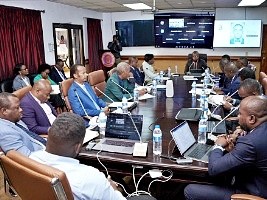
On June 11, 2026, Haitian national authorities officially kicked off the drafting process for the 2026-2027 fiscal year state budget during a dedicated working session that brought together all key public bodies involved in the country’s budget cycle. The launch was led jointly by the Ministry of Planning and External Cooperation (MPCE) and the Ministry of Economy and Finance (MEF), with senior representatives in attendance from core revenue and administrative institutions, including the General Customs Administration (AGD), the General Directorate of Taxes (DGI), and multiple technical departments and directorates from both lead ministries.
This budget development initiative is rooted in the Haitian government’s overarching vision to deliver a budget framework that is pragmatic, trustworthy, and actionable, designed to tackle the nation’s most pressing ongoing challenges while advancing core national policy priorities.
In her opening address to participants, Sandra Paulemon, Haiti’s Minister of Planning, highlighted that the 2026-2027 budget is being developed against a backdrop of profound interconnected security, economic, and social crises that demand deliberate, rigorous, and strategic stewardship of limited public resources. Paulemon underscored the central coordinating role her ministry plays in aligning long-term development planning, programming public investment projects, and harmonizing development interventions that draw on both domestic national resources and international cooperation funding.
Minister Paulemon emphasized that all public investments included in the upcoming budget must be directed toward high-impact initiatives that deliver measurable, tangible improvements to the daily lives of Haitian citizens. She clarified that all selected projects must align with the priorities outlined in the National Pact for Stability and the Organization of Elections, as well as the government’s established sector-specific policy roadmaps.
Top priority areas for budget allocation include initiatives that strengthen the security of civilian lives and private property, raise national living standards, build stronger public institutions, support logistical and administrative preparation for upcoming elections, drive broad economic recovery, and rehabilitate critical public infrastructure that serves communities across the country.
Paulemon also outlined the formal project selection criteria adopted by the MPCE to vet proposed investments. These criteria include alignment with core government priorities, consistency with existing national and international state commitments, the urgency and strategic relevance of the proposed work, the technical readiness of the project to move forward, the completion of all required project documentation, and the proven implementation capacity of the public institution leading the initiative.
Reaffirming the government’s commitment to delivering tangible outcomes for the Haitian public, the minister called on all sectoral ministries, Planning and Development Units, and public agencies to adhere to the formal procedures and strict deadlines laid out for budget preparation, and to work closely with technical teams from both the MPCE and MEF throughout the drafting process.
In closing, she restated that thoughtful public investment programming is a foundational strategic decision that will shape Haiti’s long-term future, urging all participating public institutions to uphold standards of responsibility, rigor, and collaborative partnership. This collective effort, she noted, will ensure the final 2026-2027 budget accurately reflects the government’s priorities and supports national stabilization, the successful organization of key democratic processes, and accelerated inclusive development across the country.
For his part, Serge Gabriel Collin, Haiti’s Minister of Economy and Finance, laid out the core guiding principles that will shape the new budget. Collin stressed that the budget must prioritize sustaining and expanding ongoing national security efforts, particularly through sustained resourcing for the Haitian National Police (PNH) and the Armed Forces of Haiti (FAd’H), as well as strengthened border security infrastructure and operations.
Collin also underscored the urgent need to reverse a years-long trend of economic contraction and return to positive GDP growth, noting that Haiti has faced seven consecutive years of negative economic expansion. He expressed strong support for fiscal policies designed to achieve zero net cash flow as a mechanism to curb persistent high inflation, and called for targeted policies to drive broad-based economic development, protect domestic Haitian production, and implement continuous improvements to public financial management practices across all government bodies.