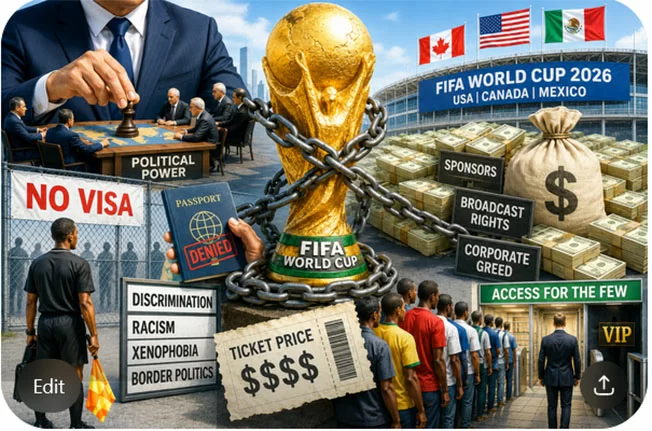
The biggest global sporting spectacle on the planet, the FIFA World Cup, kicked off on Thursday, drawing an audience of billions across every continent. Public squares fill with cheering crowds, bars work around the clock to serve thirsty fans, and for a few weeks, the world feels like it has transformed into one giant, interconnected football family. This unifying power has defined the World Cup for nearly a century: it is one of the rare global events that brings together people from every nationality, language, religion and political background, all bound by a shared love for a single game played with a round ball.
Yet long before the opening whistle of the first match, an uncomfortable question has once again loomed over this year’s tournament co-hosted by the United States, Canada and Mexico: who does football truly belong to in the modern era?
The recent controversy surrounding Somali referee Omar Abdulkadir Artan, who faced major barriers entering the United States despite holding an official appointment from FIFA, is far more than an isolated bureaucratic incident. It has become a powerful symbol of a shifting dynamic that has been unfolding for decades. While the World Cup brands itself as a celebration of global equality, behind the scenes, nationality, power, geopolitics and money still dictate access and opportunity.
This pattern is nothing new. Past tournaments have been marked by persistent tension: debates over exorbitant stadium construction costs in South Africa, mass public protests against billion-dollar infrastructure investments while basic public services were underfunded in Brazil, arguments over geopolitical influence surrounding the Russia World Cup, and widespread scrutiny of migrant working conditions and human rights abuses in Qatar. This year, the core tension centers on immigration policy, border controls, visa restrictions and unequal access for participants and fans alike.
Time and again, the World Cup proves it cannot exist separate from the problems of the wider world: it is a mirror that reflects global inequality, power imbalances and political divisions. That is why the long-held idea that sport and politics can remain completely separate may be a comforting myth, but it no longer matches reality. Today, the World Cup is a sprawling global enterprise that caters to the competing interests of national governments, international bodies, multinational sponsors, media conglomerates and billion-dollar corporate partners.
Once, the World Cup was first and foremost a celebration for ordinary fans. Now, it increasingly caters to the needs of sponsors, marketing firms, broadcast rights holders and commercial partners. No one expects a tournament of this scale to run for free; organization and infrastructure require massive investment. But the slow shift has transformed what was once a people’s festival into an exclusive commercial product, priced out of reach for millions.
For any fan traveling to the United States to cheer on their national team this year, the total cost amounts to a small fortune. Hotel prices have skyrocketed across host cities, domestic airfare has surged to record levels, and match tickets are already among the most expensive in the history of the tournament. On top of that, fans must cover the cost of ground transportation, travel insurance, food and accommodation, pushing the total even higher.
For millions of supporters across Africa, Asia, Latin America and even low-income regions of Europe, a trip to this World Cup is now financially impossible. The same is true for many fans from the Caribbean and Suriname, communities that have long contributed to the growth of global football. Millions of fans who helped turn the sport into the global phenomenon it is today can only watch from their living rooms on television.
Even fans watching from home cannot escape the grip of the World Cup’s massive commercial machine. Broadcasters pay billions of dollars to secure exclusive broadcast rights, while sponsors pour hundreds of millions into attaching their brand to the tournament. Every goal, every replay, every press conference is built around a revenue model designed to generate profit for corporate stakeholders.
For decades, the modern World Cup has not been just about football. This shift is not just disappointing – it carries real risks. Football’s enduring power has always come from its accessibility: you do not need expensive equipment, an exclusive club membership or luxury accommodation to play. All you need is a ball and a patch of open ground. That is what made football the game of workers, students, farmers, children and neighborhood communities across the entire world. Now, the world’s biggest football celebration risks drifting further and further away from the ordinary fan that built the sport.
Even with all this criticism, billions of people across the world will spend the next four weeks cheering, laughing, groaning and dreaming alongside their favorite teams. An unexpected upset victory by a small underdog nation will still bring an entire country to a standstill in collective euphoria. A last-minute winning goal will still stir raw, genuine emotions that no sponsor can buy and no governing body can manufacture. That unchanging magic of football is still alive.
But precisely because football holds such enormous, often inspiring power over billions of lives, we cannot shy away from asking these hard questions. Why does access to the tournament remain out of reach for so many? Why do debates over origin, migration and unequal treatment keep resurfacing at every edition? Why do commercial interests grow larger and more central with every World Cup?
There is no question that the World Cup remains the most beloved sporting event on the planet. But it is long past time for FIFA, host organizers and participating national governments to step back and ask what ordinary fans actually want from the tournament. It is not just bigger stadiums, more expensive hospitality packages and higher revenue streams – it is a tournament that is actually open and accessible to people from every walk of life.
We can only hope that the inherent beauty of the game will ultimately prove stronger than the politics that surround it and the money that is made from it. Because if the World Cup is supposed to be about anything, it should not be about power or profit – it should be about people.