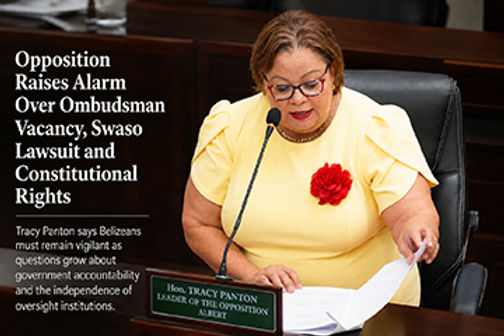
Belize’s Opposition Leader Tracy Taegar Panton is calling on all Belizean citizens to closely monitor mounting threats to core constitutional rights, government accountability, and the autonomy of national oversight bodies. Her warnings center on two interconnected issues: the months-long persistent vacancy in the Office of the Ombudsman, and a high-profile constitutional legal challenge filed by the office’s former head, Major Gilbert Swaso.
In multiple recent public addresses, Panton has emphasized that the legal questions raised by Swaso’s claim are far from a personal dispute. Instead, they cut to the heart of a critical national question: can independent constitutional bodies in Belize carry out their mandates without undue political pressure from the ruling government?
As outlined in this week’s reporting from *The Reporter*, Swaso moved forward with his constitutional challenge against the Government of Belize over his non-renewed appointment. The former ombudsman alleges his term was not extended after he ruled in favor of a Freedom of Information (FOI) request that sought public disclosure of government legal fees tied to a high-profile redistricting court case. He further claims that senior officials repeatedly attempted to interfere in official matters that fell exclusively under the Ombudsman Office’s jurisdiction. At this stage, none of Swaso’s allegations have been adjudicated or proven in court.
Panton stresses that these claims strike at the core of transparent governance and the protection of constitutional safeguards laid out in Belize’s founding document. She reiterated that the Ombudsman serves as one of the most critical checkpoints on state power, tasked specifically with shielding ordinary citizens from institutional abuse, maladministration, and unfair treatment by government agencies.
The opposition leader has doubled down on criticism of the ruling administration’s ongoing failure to fill the substantive Ombudsman position, which has been vacant since Swaso’s term expired on December 31, 2025. To date, Belize has operated without a permanent ombudsman for several months, leaving hundreds of citizen complaints against public agencies unaddressed and FOI review requests stalled in limbo.
Notably, existing Belizean law already creates a framework for temporary oversight during such vacancies. Section 7(1) of the Ombudsman Act explicitly states that when the Ombudsman seat becomes empty, the Governor-General, acting on formal recommendations from the National Assembly, has the authority to appoint an interim officeholder to serve until a permanent appointment can be finalized. Despite this legal provision, no acting appointment has been made.
Panton frames the Swaso dispute as part of a wider pattern of growing threats to constitutional governance in Belize. She points to two other recent high-profile matters: the case of former United Democratic Party Vice Chairman Alberto August and that of independent journalist Ryan Budna. While Panton acknowledges each case must be evaluated on its own unique set of facts, she argues that the cumulative allegations across these separate incidents raise serious questions about due process, equal treatment under the law, adherence to the rule of law, and the exercise of executive state power.
For Panton, constitutional rights and fundamental freedoms are not discretionary privileges granted by the sitting government — they are inalienable protections that belong to every Belizean by right. She has issued a sharp warning against the normalization of what she describes as creeping institutional overreach, even the perception of such overreach, noting that a functional democracy relies entirely on robust independent institutions, full government transparency, and meaningful accountability to the public.
The opposition has formally demanded the government answer three key questions: why no permanent Ombudsman has been appointed since the end of 2025, why no interim Ombudsman has been designated under existing law to keep the office operating, and what options are currently available to Belizean citizens whose rights complaints and FOI matters would normally fall under the Ombudsman’s mandate.
Panton concluded by urging Belizeans to stay well-informed and remain vigilant on developments that impact constitutional rights and democratic institutions, noting that public trust in national governance is directly tied to the strength and independence of the country’s oversight bodies.