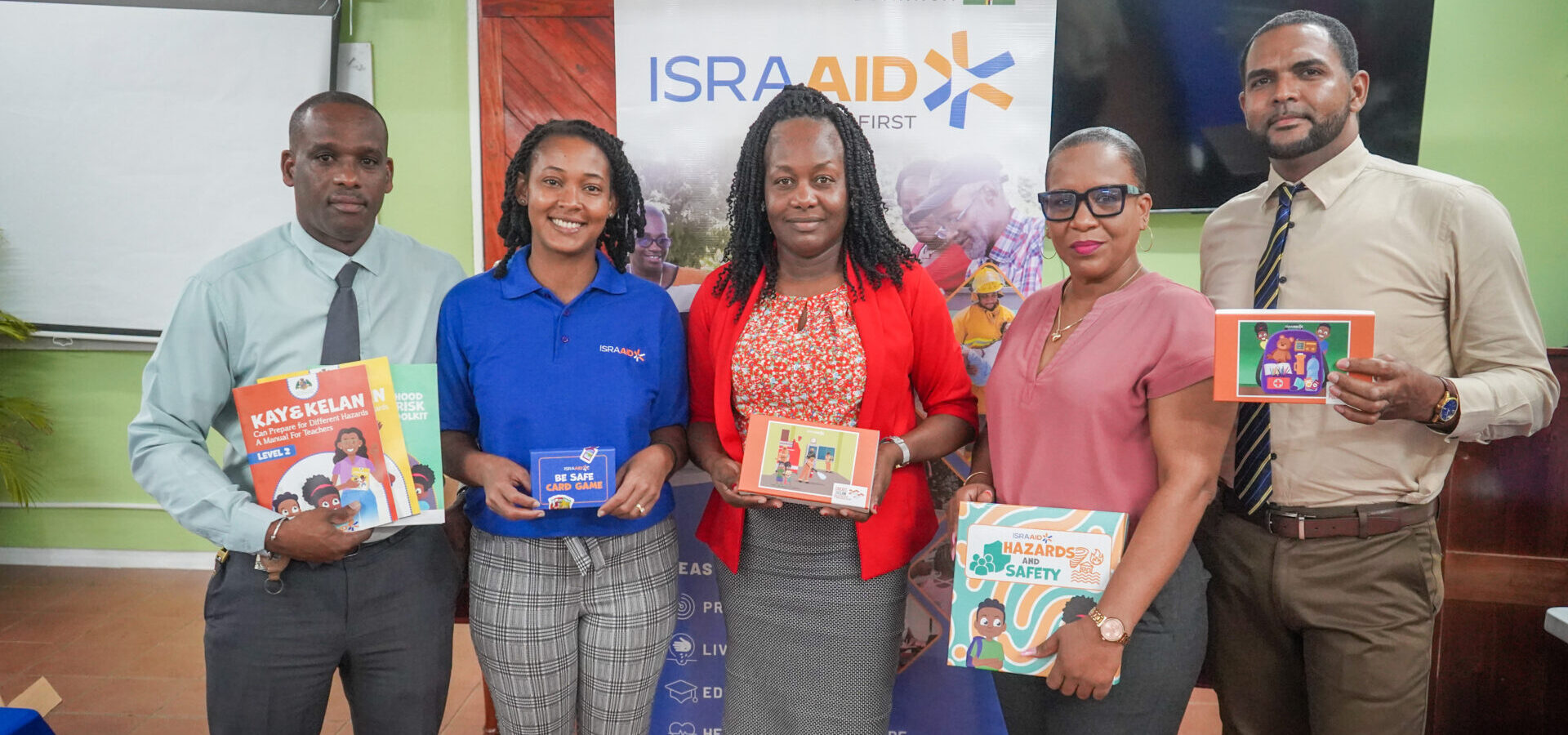
In a landmark step toward building long-term climate and disaster resilience across the Eastern Caribbean, humanitarian NGO IsraAID Dominica has officially launched the second level of the Kay & Kelan Early Childhood Disaster Risk Reduction (ECDRR) Toolkit, rolling out the new educational resource to 21 high-vulnerability primary schools across Dominica in partnership with the island nation’s Ministry of Education.
Designed specifically for early primary learners in Grades 1 through 3, generally aged 6 to 8 years old, this expanded initiative builds on nearly a decade of collaborative work between IsraAID, the Dominican Ministry of Education, and regional stakeholders to embed disaster risk reduction into formal education systems. The original Kay & Kelan programme launched in 2017, starting with preschool and pre-kindergarten students to introduce foundational safety concepts from the earliest stages of learning.
Unlike traditional textbook-based learning, the Level 2 toolkit uses interactive, play-centered activities tailored to young children’s developmental needs to teach core concepts of disaster preparedness and emergency response. The comprehensive kit includes a wide range of hands-on educational materials: a student activity book titled *Kay & Kelan Can Prepare for Different Hazards*, a detailed teacher’s manual for curriculum integration, a full toolkit implementation guide, 26 educational flashcards, a USB drive loaded with original disaster safety songs, two themed puzzles, two safety-focused board and card games, and a large multi-hazard educational wall poster.
Synde Moses Joseph, IsraAID’s Director for Dominica and the Eastern Caribbean, noted that the programme has outgrown its original scope and evolved into a self-sustaining regional model, already successfully implemented across neighboring islands including Saint Lucia and Saint Vincent. Joseph emphasized the transformative power of the long-standing partnership with the Ministry of Education, noting that the initiative has become a locally owned, digitally enabled school resilience curriculum that no longer requires external leadership from IsraAID.
“We are deeply grateful to the Ministry of Education for the collaborative foundation we have built over the years,” Joseph said. “They didn’t just welcome our programme—they helped shape it, opening access to schools, educators, and students across the country. Today, we call on the Ministry to champion this work as a regional model of educational resilience that other island nations can follow.”
Dominica’s top education officials have expressed enthusiastic support for the programme’s expansion, highlighting its critical role in creating safe, supportive learning environments for young students amid growing climate uncertainty. Chief Education Officer Jeffrey Blaize reaffirmed the Ministry of Education’s unwavering commitment to student safety across all contexts, noting that physical and emotional safety is a prerequisite for effective learning.
“Safety is at the core of everything we do,” Blaize explained. “We prioritize keeping students safe from all threats, including environmental hazards, and building spaces where children feel comfortable and supported. When children feel safe, they are ready to learn. Beyond that, maintaining continuous education in disaster-impacted communities restores a critical sense of normalcy. In a crisis, education provides psychological and emotional support to children, keeping them protected while helping them process overwhelming challenges.”
Assistant Chief Education Officer Nadia Ferrol added that the initiative does more than teach individual safety—it cultivates a widespread culture of preparedness that empowers children to protect themselves, their families, and their entire communities. “We thank IsraAID for their investment in building resilience in our schools across Dominica,” Ferrol said.
The rollout of the Level 2 toolkit marks a new chapter in disaster risk reduction education for small island developing states like Dominica, which face disproportionate risk from climate-fueled natural hazards. By starting safety education in early childhood, the programme aims to embed a lifelong culture of preparedness that will protect generations of learners across the Eastern Caribbean.