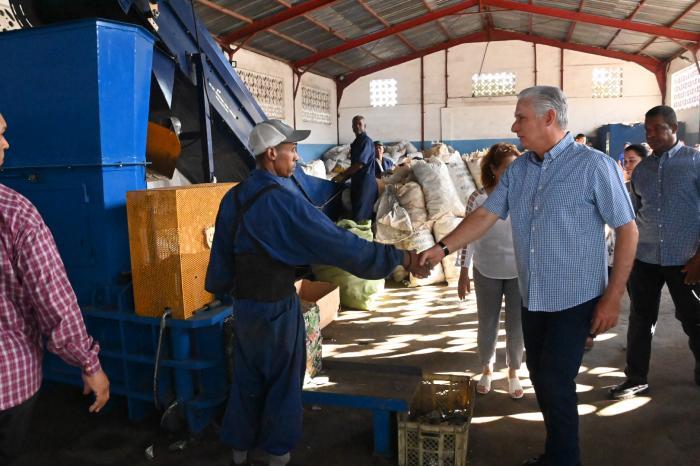
On Tuesday, June 10, 2026, Miguel Díaz-Canel Bermúdez, First Secretary of the Central Committee of the Communist Party of Cuba and President of the Republic of Cuba, conducted a scheduled working visit to two facilities operated by the Recycling Business Group (GER) in Regla, a municipality of Havana. The tour forms part of Díaz-Canel’s regular weekly engagements with strategic local entities that drive the island nation’s economic and social development, with a focus on advancing solutions to one of Havana’s most persistent public challenges: unmanaged solid waste.
The president’s first stop was the Alfredo Ramonal Basic Business Unit (UEB), a facility specialized in the processing and sorting of non-ferrous waste. During a walkthrough of the facility’s operations, Díaz-Canel greeted frontline workers and received a detailed briefing on the unit’s performance amid ongoing economic and infrastructure challenges. He publicly commended the team for leveraging new opportunities for the domestic business sector to grow revenue even amid extremely difficult operating conditions.
UEB Director Sadie Jiménez Condés shared details of the unit’s adaptive strategies with reporters following the meeting, noting that the operation has adjusted to prolonged power outages that disrupt raw material processing by implementing staggered work schedules and providing dedicated electric transportation for employees. Jiménez added that the president expressed particular interest in workforce retention and compensation, an area where the Alfredo Ramonal UEB has posted strong results: employee turnover remains near zero, with the full workforce consistently retained. Workers report high satisfaction with their compensation, which in turn drives consistent productivity.
As of the end of May 2026, the UEB reports an average worker salary of 40,000 Cuban pesos and cumulative profits exceeding 3 million pesos. Díaz-Canel urged the unit’s leadership to reinvest these gains into refining operational processes, upgrading facility conditions, and addressing key worker needs including housing support. Looking ahead, the unit plans to roll out upgrades to raise production quality, including new mechanized crushing equipment for copper processing and the installation of independent power infrastructure for the facility’s can processing line. All processed raw materials from the Alfredo Ramonal UEB are sold with value addition to Desequip Company, the GER’s export-focused affiliate, before entering international markets.
Following his visit to the UEB, the president traveled to Desequip, which handles all import and export activity for the GER under Cuba’s Ministry of Industries. At Desequip, he received an update on a groundbreaking locally developed waste management system that has been piloted in Havana in recent months. The project grew out of research conducted by Cuba’s Ministry of Science, Technology and Environment (CITMA), launched as part of a national priority initiative announced by Díaz-Canel in 2025 to reverse declining public hygiene conditions across Havana.
Marian Herrera Delgado, a recovery team lead at the Havana Raw Materials Recovery Company who presented the initiative to the president, explained that the new system is designed to boost waste recovery rates through optimized process organization, eliminating the need for large capital outlays or additional workforce expansion. Early results from the pilot phase have already delivered an increase in export revenues, though organizers note key areas for further refinement, including the upcoming launch of a custom mobile app to coordinate operations and expanded engagement with local communities and non-state economic actors.
In a key update shared during the briefing, GER executives confirmed that the successful pilot has positioned the new local waste management system for a national rollout, with plans to extend the framework to all other provinces across Cuba. In closing remarks, Díaz-Canel emphasized that the innovation—centered on more structured organization of waste dumping, collection and processing—represents a critical opportunity to convert what was once unmanaged waste into much-needed export revenue for the Cuban economy.
The president also stressed that long-term success will depend on expanded grassroots organization at the neighborhood level, to ensure that individual residents, private businesses, state institutions and non-state economic actors all understand contractual terms, know the location of approved dumping and collection points, and can participate in a national shift toward widespread source separation of waste. This shift will allow the country to unlock additional value from materials that were once treated as valueless refuse.
Tuesday’s tour of GER facilities aligns with Díaz-Canel’s ongoing focus on strategic sectors that underpin Cuba’s long-term progress, including food production, electrical grid recovery, digital transformation, energy transition and electric transportation, all areas that are central to the country’s ongoing development efforts.