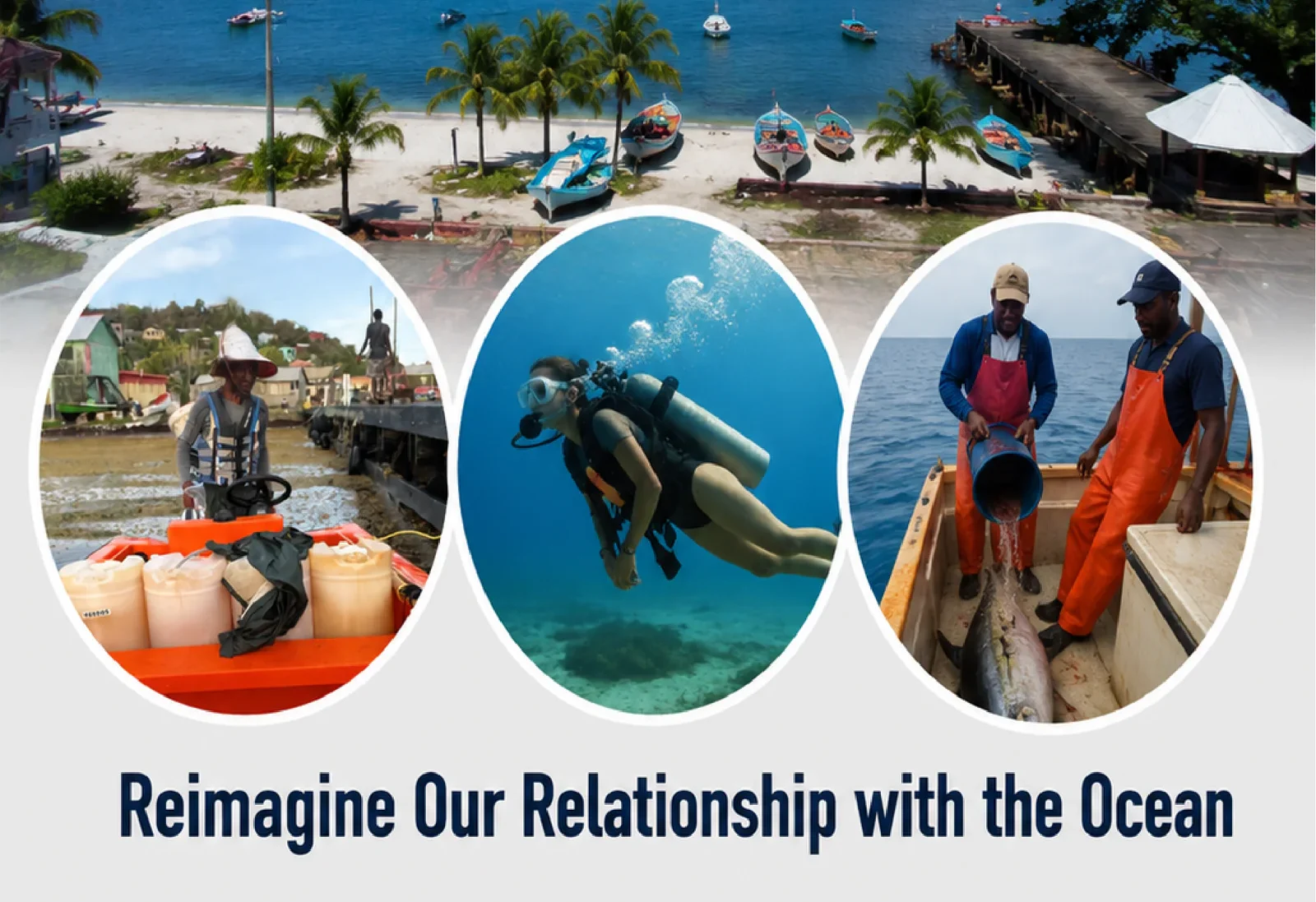
Each June, World Oceans Day sparks global dialogue centered on protecting coastal ecosystems, organizing community beach cleanups, and safeguarding vulnerable marine species from extinction. But for the Small Island Developing States (SIDS) that make up the Organisation of Eastern Caribbean States (OECS), the ocean is far more than a scenic natural treasure to be conserved from a distance—it is the very foundation of community survival, cultural identity, and collective future.
Home to more than 1.4 million people spread across 10 Eastern Caribbean nations and territories, the OECS region is defined by its deep, inseparable connection to the sea. Every aspect of daily life, cultural tradition, and long-term planning is rooted in ocean resources. Yet today, this interconnected marine way of life faces unprecedented threats: marine pollution, irreversible habitat degradation, and overexploitation of fish stocks, all amplified by the accelerating impacts of climate change. These stressors are rapidly eroding the healthy marine ecosystems that the region depends on for survival. To secure a viable future, the OECS argues, global and local communities must abandon short-sighted, destructive development models and consumer patterns, and reframe their relationship with the ocean around intentional, sustainable stewardship.
Backed by World Bank funding through the Unleashing the Blue Economy of the Caribbean (UBEC) project series, the OECS has developed and begun rolling out a coordinated set of updated regional policies and targeted financial investments designed to build a blue economy that is resilient, equitable, and broadly prosperous. The initiative is organized around three core priority sectors that underpin the region’s ocean-dependent livelihoods: sustainable fisheries and aquaculture, low-impact marine and coastal tourism, and systemic waste management.
In the fisheries and aquaculture sector, UBEC has supported the creation of the OECS Fisheries Strategic Action Plan for 2025–2030. This new framework directly tackles the long-standing structural challenges that have plagued the region’s fishing industry, including chronic underfunding for fisheries management agencies, insufficient monitoring and enforcement of fishing boundaries, and restrictive access barriers for small-scale independent fishers. The plan builds on a comprehensive analysis of the drivers of Illegal, Unreported, and Unregulated (IUU) fishing completed by the Caribbean Regional Fisheries Mechanism (CRFM), ensuring solutions are rooted in on-the-ground data.
For marine and coastal tourism—an industry that forms the backbone of most OECS national economies— the initiative led to a full update of the original 2011 OECS Common Tourism Policy, resulting in the revised 2025–2035 framework that was formally approved by the OECS Council of Tourism Ministers in early 2025. The updated policy reaffirms the region’s collective commitment to growing a collaborative, sustainable tourism sector that directly improves quality of life and livelihoods for all OECS residents. As one of the most tourism-dependent regions in the world, protecting coastlines and critical marine habitats is not just an environmental goal for the OECS—it is an economic necessity. For decades, unregulated coastal construction and overuse of popular beach and reef sites have degraded the very natural attractions that draw visitors to the region, threatening the long-term viability of the industry. The new policy directly addresses this cycle of degradation.
When it comes to waste management, regional leaders recognize that no reimagined ocean future is possible without tackling the land-based pollution that is killing marine wildlife, degrading coral reefs, and destroying critical seagrass habitats. As part of UBEC, the OECS completed a comprehensive assessment of commercial opportunities in the waste sector to support the development of an integrated regional waste management system. By developing actionable business models and identifying profitable commercial applications for green waste, plastic waste, end-of-life vehicles, and discarded tyres, the region is working to transition to a circular economy that intercepts land-based pollution before it can reach coastal waters and marine ecosystems.
OECS leaders emphasize that effective policy is only as impactful as its on-the-ground implementation. To that end, all of these policy-focused interventions are paired with direct support for OECS citizens working in the blue economy, with a specific focus on empowering Micro, Small and Medium Enterprises (MSMEs) in Grenada, Saint Lucia, and Saint Vincent and the Grenadines. Across the three pilot countries, targeted matching grants, hands-on technical training, and expanded access to affordable financing are enabling local entrepreneurs to adopt more sustainable business practices. Whether supporting a small-scale fisher to invest in climate-smart fishing gear, helping a local tour operator transition to low-impact ecotourism operations, or scaling a waste-to-value recycling business, the UBEC project is building a sustainable regional blue economy from the ground up, centered on local communities.
This World Oceans Day, the OECS Commission is calling on global and regional stakeholders to join in a collective reimagining of humanity’s relationship with the ocean, rejecting the outdated false choice between economic survival and environmental conservation. The long-term success and stability of the region’s fisheries, marine tourism, and pollution mitigation systems are deeply interconnected, making coordinated cross-sector management an essential requirement for progress. Embracing this new, integrated approach requires a sustained commitment to expanding and effectively managing strong marine protected areas to build a resilient blue planet, ensuring these shared waters remain productive, resilient, and thriving for future generations. For the OECS, true progress depends on recognizing a simple truth: the sea does not divide the Eastern Caribbean islands—it binds them together, unlocking shared potential for all who call the region home.