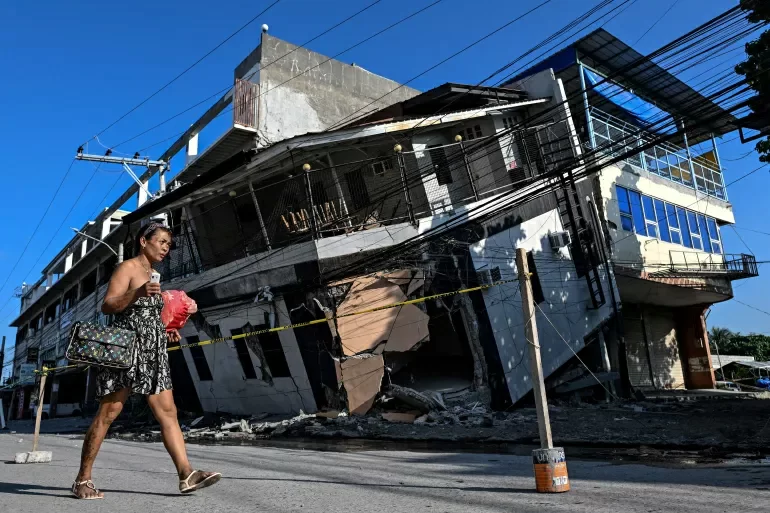
A powerful 7.8-magnitude earthquake has rocked the southern region of the Philippines, leaving at least 37 people dead and more than 400 others injured as rescue teams scramble to locate any trapped survivors buried under collapsed infrastructure. The devastating quake, which struck at approximately 7:40 a.m. local time on Monday around 20 kilometers off the coast of Sarangani province, was felt as far as Manado on the Indonesian island of Sulawesi, some 420 kilometers from the epicenter, according to initial geological assessments.
The hardest-hit urban center is General Santos, a coastal city of 720,000 residents on the island of Mindanao. The city has been declared a state of disaster, with multiple commercial and residential buildings reduced to rubble, streets littered with fallen debris, and downed power lines cutting electricity to large swathes of the community. On Tuesday, search and rescue crews continued to comb through the wreckage of a collapsed commercial building that housed a local supermarket, where two people remain unaccounted for. Rescuers have already pulled two survivors from the site and recovered one body, with no signs of life detected at other search locations as of Wednesday.
For families of the missing, the wait for news has been agonizing. Dioslinda Deluvio, whose son remains trapped under the collapsed supermarket, waited outside the disaster site Tuesday, clinging to a slim hope. “It is hard to accept that my son is still stuck there,” she said. “My only hope is that he is found today, so we can have peace.”
The initial major earthquake was followed by a series of aftershocks, the strongest of which registered a magnitude of 6.5, per data from the United States Geological Survey. Immediately after the main quake, tsunami warnings were issued across multiple regional countries, though no major destructive tsunami events were recorded.
Across affected regions, the death toll has mounted beyond General Santos. Eighteen fatalities were recorded in Sarangani province, most of which came after a mudslide buried homes in the mountain village of Glan. Additional deaths have been confirmed in the nearby provinces of South Cotabato, Davao Occidental, and on Balut Island.
Access to remote, hard-hit areas has emerged as a major barrier to rescue and recovery efforts, with many mountainous regions of Sarangani only reachable by helicopter. Ongoing aftershocks have further slowed operations, forcing rescuers to work with extreme caution to avoid secondary collapses and additional casualties. “The aftershocks mean rescuers have to move very slowly and carefully,” explained Rodrigo Sosmena, head of regional civil defense. “That is one of our biggest challenges right now.”
Witnesses across the affected zone described the terrifying force of the quake, which caught people going about their daily routines off guard. Jojo Calma was driving through General Santos when a nearby building crumbled around him. “It was the first time I ever felt such a strong quake, I couldn’t hold back my tears,” he said. “I immediately thought of my children and niece, and what could have happened to them.”
In Malita, a town located east of General Santos, more than 100 students and a dozen teachers were gathered for a flag-raising ceremony to mark the first day of class after summer break when the quake hit. School principal Rosavel Cachuela reported that the students’ quick decision to stay calm and in their seats prevented serious injuries, but the traumatic event has left lasting psychological impacts on the young community.
Preliminary damage assessments show the disaster has damaged roughly 2,000 residential homes and 117 government buildings across multiple provinces. Around 6,000 public school campuses still require full structural inspections before classes can resume, leaving thousands of students out of school indefinitely. General Santos’ international airport has remained closed since the quake, forcing the cancellation of 63 domestic flights and disrupting travel across the southern Philippines.
Given the scale of the destruction, many observers note it is surprising that the death toll has not climbed higher. Manila-based correspondent Barnaby Lo called the relatively low fatality count a “miracle” and outlined the current priorities for response teams. “Right now, the main priority is search and rescue, with hope that more people can still be found alive under the rubble,” he said. “The biggest challenge is reaching mountainous areas, where roads and bridges have been heavily damaged. The department of public works is working around the clock to clear blocked routes, while structural engineers inspect buildings for safety. It is an enormous job.”
Philippine President Ferdinand Marcos Jr. has already activated national emergency response agencies and reaffirmed the government’s commitment to supporting affected communities. “The national government is in action, and we will not leave Mindanao behind,” he said in a statement.
This earthquake is the most powerful to hit the Philippines in eight months. The previous major seismic event, a 6.9-magnitude quake near Cebu last year, killed 79 people.