Long one of Belize’s most politically and socially charged policy flashpoints, disputes over customary land ownership and ancestral territorial rights have reemerged as a central national conversation, with three of the country’s largest ethnic groups advancing formal claims rooted in centuries of cultural and historical connection to their traditional lands.
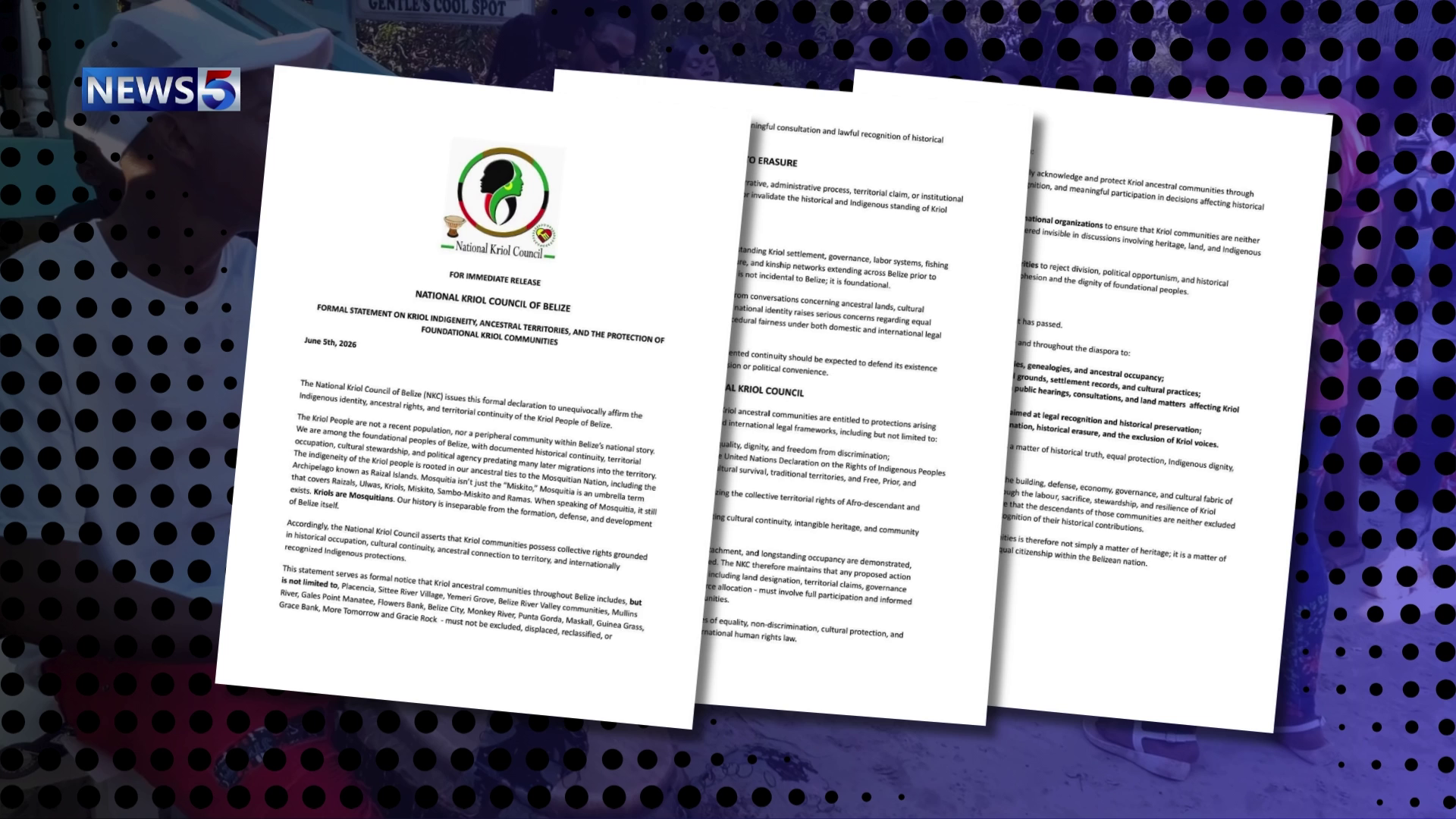
The debate kicked off most recently when the National Kriol Council released an official statement formally asserting traditional land rights for Kriol (Creole) Belizeans, identifying culturally significant historic Kriol settlements stretching across the country from Belize City and the Belize River Valley to Placencia, Seine Bight, Punta Gorda, and Yemeri Grove. In his remarks outlining the group’s position, National Kriol Council President Wilford Felix emphasized the unique ancestral origins of Kriol culture in Belize, arguing that unlike other ethnic groups whose cultural traditions developed outside Belize before migration, Kriol culture emerged indigenously within Belize’s borders. With a continuous presence dating back roughly 200 years before the arrival of other major ethnic groups, Felix says it is only logical that Kriol communities be included in national conversations around indigenous land recognition, a status already granted to Maya communities and claimed by the Garifuna people.
Parallel to the Kriol Council’s assertion of rights, the Maya communities of southern Belize’s Toledo District continue their multi-year process of demarcating customary lands, and are preparing to return to the Caribbean Court of Justice to seek clear enforcement of existing rulings against the national government. Cristina Coc, spokesperson for the Maya Leaders Alliance, explained that the court has already formally confirmed that Maya customary land tenure carries the same legal weight as any other form of property recognized under Belizean law. Critically, Coc noted, the court has also ruled that existing land titles granted to third parties, both before and after the 2015 affirmation of Maya rights, do not invalidate long-held customary claims. “Our property rights as Maya people did not begin in 2015,” Coc emphasized, acknowledging that the current landscape leaves overlapping competing claims to the same parcels of land.
For the Garifuna people, who have long sought formal recognition of their ancestral rights to coastal communities including Hopkins and Seine Bight, the movement has now taken institutional form: the National Garifuna Council recently launched a dedicated Legal Defense Fund to support formal court action to defend their territorial claims. Ifasina Efunyemi, Assistant Treasurer of the National Garifuna Council, pushed back against public misunderstanding of the group’s claim to indigenous status, noting that indigenous status refers to presence in a territory prior to colonization, a standard Garifuna communities meet on Belize’s southern coast. “We were the first to occupy the southern coast of Belize from the Sibun to the Sarstoon, and it is our presence that made it possible for the British to expand its boundary to the Sarstoon because we were here,” Efunyemi stated, challenging any parties seeking to contradict the group’s ancestral history.
Nearly three decades ago, former Belizean Prime Minister Said Musa famously declared he would not oversee the balkanization of Belize along ethnic or territorial lines, a framing that hangs over the current national conversation. What unites all three groups in this moment is a shared demand for formal recognition of ancestral rights – but all parties have emphasized they do not seek national division. As Belize continues to navigate the tangled intersections of ancestry, cultural identity, and property ownership, the core challenge extends beyond simply defining legal land rights: the country must now find a way to address these longstanding historical claims without deepening ethnic divides among the communities that all call Belize home. In the coming months, negotiations and court proceedings will test whether Belize can reconcile these competing interests while preserving national unity. News Five will continue to provide updates as this story develops.