For decades, North African nations have dominated African success at both the Africa Cup of Nations (AFCON) and the FIFA World Cup. But when Morocco made history in 2022 as the first African country ever to reach a World Cup semifinal, a new question began to dominate football discourse across the continent: could a sub-Saharan African nation finally break through to the latter stages of football’s biggest tournament at the 2026 World Cup, kicking off June 11?
To date, Morocco’s 2022 run remains the best performance by any African side at a World Cup. Before that, only three other African nations had ever reached the quarterfinal stage of the tournament – and while three of those four quarterfinalists (Cameroon, Senegal and Ghana) are from sub-Saharan Africa, North African countries still hold the edge in major regional and global tournament success. Egypt leads all AFCON champions with seven titles, and Morocco, Tunisia and Algeria rank among the top five African nations for total World Cup qualifications. Ahead of the 2026 tournament, we break down the chances of top sub-Saharan contenders to outperform their North African rivals and make history this summer.
### Senegal
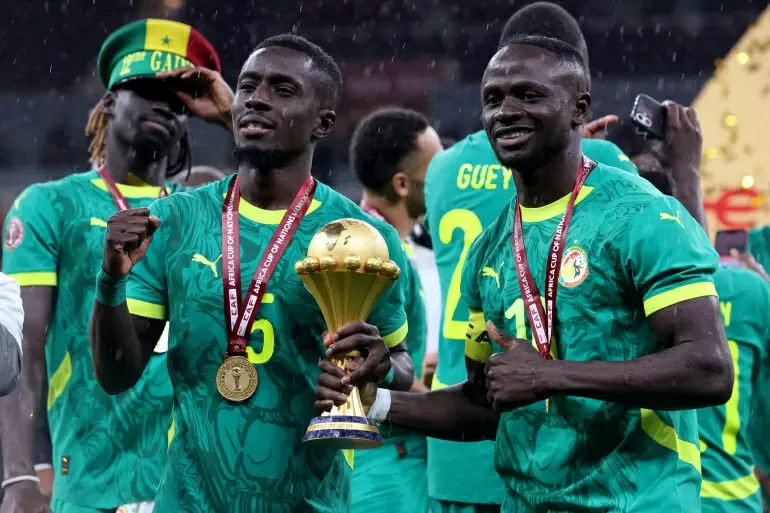
With four prior World Cup appearances (2002, 2018, 2022, 2026) and a quarterfinal finish as their best result, Senegal currently ranks 14th in the FIFA global rankings, and analysts are predicting another quarterfinal exit for the Teranga Lions this year. But the side enters the 2026 tournament with a fiery chip on their shoulder: the team was stripped of their 2025 AFCON title after abandoning the January final over an on-pitch dispute, with the Confederation of African Football (CAF) ruling the match forfeit and awarding the title to Morocco. Stars Idrissa Gueye and Sadio Mane have openly stated the team is hungry to take revenge for that controversial outcome with a deep run in 2026.
Senegal first shocked the world on their World Cup debut in 2002, storming to the quarterfinals. More than two decades later, expectations for the side are higher than for any other African nation competing this year. Senegal’s biggest strength is its squad depth, led by a roster of world-class talent including forward Sadio Mané, midfielder Pape Gueye, goalkeeper Edouard Mendy and captain Kalidou Koulibaly – all of whom were born in France. Their head coach, Pape Bouna Thiaw, who also grew up in France, has left no question about his team’s ambition: “If I ever lose even a moment of belief that we can win the World Cup with Senegal, I will step down immediately.” Senegal will open their Group I campaign against defending champion France on June 16 in New York, with Iraq and Norway rounding out the group.
### Ghana
Ghana is making its fifth World Cup appearance (2006, 2010, 2014, 2022, 2026) after missing only one tournament since its 2006 debut. The Black Stars reached the quarterfinals in 2010, becoming just the third African nation to hit that milestone, and currently hold the 74th spot in the FIFA rankings, with analysts forecasting a quarterfinal exit this cycle.
Ghana’s road to qualification was rocky, marked by a late managerial change after a string of poor results. Veteran Portuguese coach Carlos Queiroz – who has previously managed national sides South Africa and Egypt, and held top jobs at European giants Real Madrid and Manchester United – stepped in to lead the side, marking his fifth consecutive World Cup at the helm of a national team. Ghana has been drawn into Group L, widely labeled a “group of death” alongside Panama, England and Croatia. Despite the tough draw, the side’s attacking firepower, led by Manchester City’s Antoine Semenyo, has given fans hope they can advance out of the group. Unfortunately for Ghana, star midfielder Mohammed Kudus will miss the entire tournament due to injury.
### Ivory Coast
Ivory Coast is returning to the World Cup after a 12-year absence, having last competed in 2014. The side fell into a rebuilding period after the retirements of legendary stars Yaya Touré and Didier Drogba, but that rebuild has already yielded two AFCON titles since their last World Cup appearance. The Elephants have made four total World Cup appearances, with their best result being an early group stage exit, and currently rank 34th in FIFA rankings, with analysts projecting a quarterfinal exit in 2026.
Ivory Coast’s young, dynamic attack, featuring emerging talents Yan Diomande, Brighton’s Simon Adingra and Manchester United’s Amad Diallo, is expected to carry the side this year. The team proved its ability to turn adversity into success two years ago, when they hosted AFCON and looked set for an early group stage exit before a mid-tournament coaching change sparked a miracle run to the title. Now, head coach Emerse Fae says the side has its sights set on another historic run: “Why not aim for the final?”
### Cape Verde
Cape Verde is making its World Cup debut in 2026, and with a population of just under 600,000, it will go down as one of the smallest nations ever to qualify for the tournament. The side only made its AFCON debut in 2013, and reached the quarterfinals of the regional tournament in 2023. Cape Verde currently ranks 69th in FIFA rankings, and analysts predict an early exit in the group stage, where they will face Uruguay, Saudi Arabia and European champion Spain in what is widely viewed as one of the toughest groups of the 2026 tournament. Despite the odds, the side has grown in confidence in recent years, says head coach Bubista, who was named 2025 African Coach of the Year: “We now truly believe in our potential, and that has given us the courage to take on any opponent.”
### South Africa
South Africa is making its fourth World Cup appearance (1998, 2002, 2010, 2026), with a quarterfinal finish never yet on its resume. The side has struggled through a decades-long slump after qualifying for its first tournament in 1998, so its 2026 return after 16 years away from the World Cup has been a long-awaited moment for South African football. South Africa currently ranks 60th in FIFA rankings, with analysts projecting an exit in the round of 16. The squad draws deep experience from its core of players from top domestic clubs Mamelodi Sundowns and Orlando Pirates, and head coach Hugo Broos says the recent African Champions League title success for Sundowns has given the entire side a major confidence boost. South Africa has been drawn into a second “group of death” alongside Czech Republic, South Korea and co-host Mexico, who they will face in their opening match.
### DR Congo
The Democratic Republic of Congo, formerly known as Zaire, made history as the first sub-Saharan African nation to compete at a World Cup back in 1974, but left that tournament with three lopsided defeats. Now, 52 years later, the side is back at the World Cup for just its second appearance, entering the 2026 tournament as the reigning AFCON champion. DR Congo currently ranks 46th in FIFA rankings, with analysts forecasting a quarterfinal exit this year. Most of the squad’s players were born and raised in Europe, including Manchester United defender Aaron Wan-Bissaka, and the side heads to the tournament with high hopes. For head coach Sebastien Desabre, just qualifying is already a generational milestone: “We are extremely proud that a generation now gets to experience the World Cup.”
As the 2026 tournament approaches, all eyes will be on these sub-Saharan sides to see if one can finally surpass the historic benchmark set by North African teams and become the first African nation to reach a World Cup final.