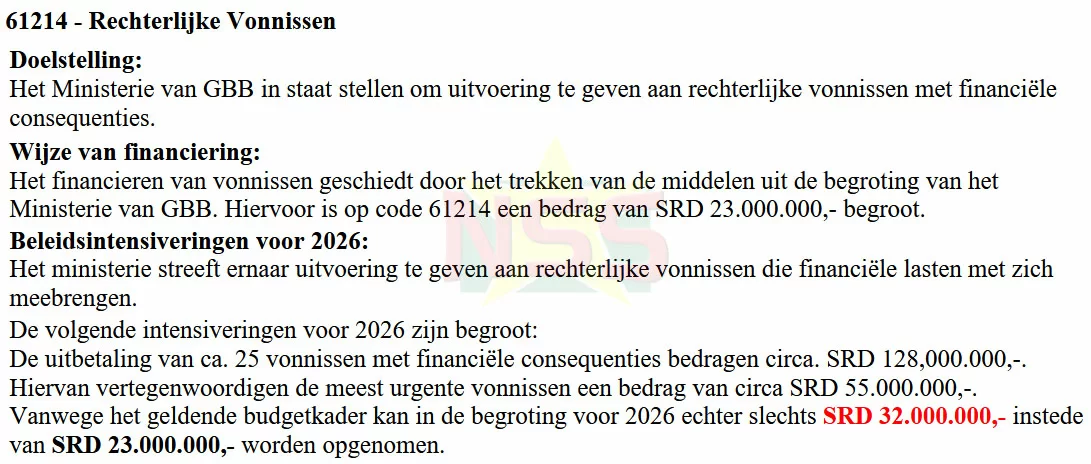
Suriname’s Ministry of Land Policy and Forest Management (GBB) is confronting a significant budget gap as it prepares to meet financial obligations stemming from binding court judgments for the 2026 fiscal year. According to budget documents released by the ministry, the department estimates it will require a total of SRD 128 million to satisfy all outstanding monetary obligations attached to court rulings against the state. However, constrained by tight national budget limits, only SRD 32 million has been allocated to the dedicated line item for court judgment payments, leaving a massive SRD 96 million deficit between identified needs and available funding.
GBB officials have confirmed that there are roughly 25 active court rulings that impose enforceable financial responsibilities on the Surinamese state. Of these outstanding cases, the most urgent claims collectively add up to approximately SRD 55 million alone – an amount that already far outpaces the full SRD 32 million allocation granted for all 2026 obligations.
In its budget documentation, the ministry noted that it has established a separate, dedicated budget line specifically for these court-ordered payments, as part of its formal commitment to fulfilling all judicial rulings in a timely manner. All payments stemming from judicial decisions against the state are supposed to be drawn from this dedicated allocation.
The SRD 32 million allocation approved for 2026 actually represents a modest increase from the original budget proposal submitted in September 2024, which only earmarked SRD 23 million for court judgments. Even with the adjustment in the amended budget note, the total available funding still falls 75 percent short of the ministry’s projected full-year need.
Notably, the published budget documents do not include detailed breakdowns of the specific cases covered by the outstanding judgments, nor do they identify which claims have been classified as urgent, or provide timelines for when the obligations were first incurred. What the budget documentation does make clear is that the ministry has fully accounted for the substantial financial impact of these rulings, and has openly acknowledged that current appropriations are insufficient to settle all outstanding obligations in full during 2026.
This funding shortfall raises pressing questions about the ministry’s ability to comply with all judicial orders within the required timelines in the coming year. Based on information included in the budget documents, GBB plans to prioritize settling the most urgent claims first, leaving many lower-priority financial obligations without full funding for the foreseeable future.