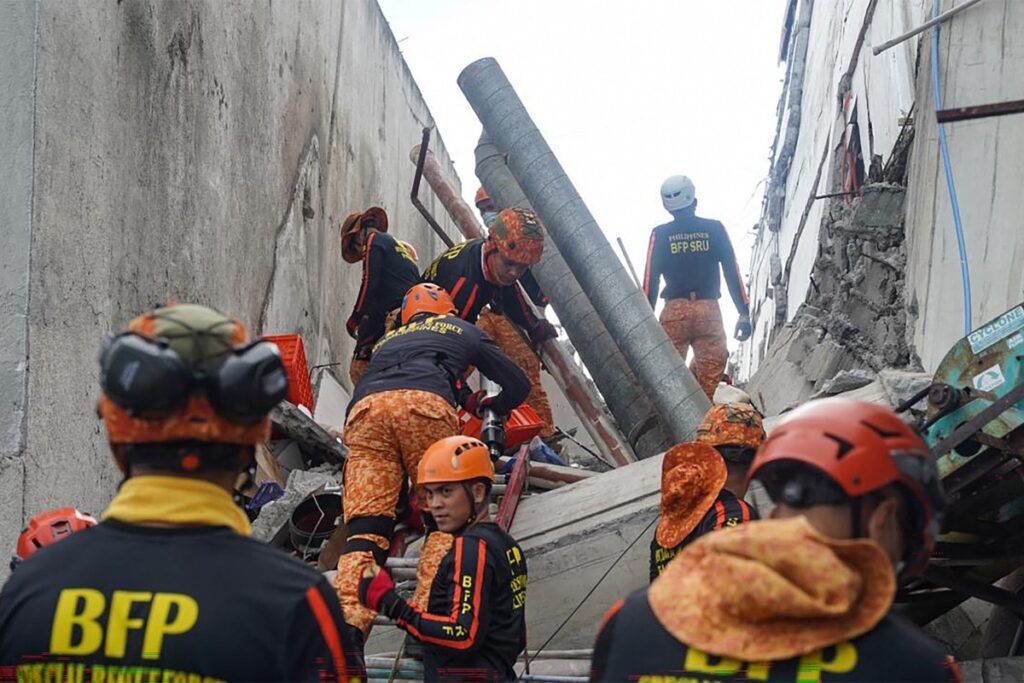
A massive 7.8-magnitude offshore earthquake that struck the southern Philippines on Monday has killed at least 35 people, injured 134 more, and left a dozen others missing, local and national disaster officials confirmed. The quake, which hit south of General Santos – a coastal city home to roughly 720,000 residents – triggered immediate tsunami warnings across the wider Southeast Asia-Pacific region and reduced multiple buildings to rubble.
Within just two hours of the initial shock, the United States Geological Survey recorded a string of powerful aftershocks across the affected area, with the strongest registering a magnitude of 6.5, prolonging danger for local communities. In General Santos, the local command center has recorded 12 fatalities so far, with rescue efforts stretched thin across the disaster zone.
As darkness fell on the city, Agence France-Presse reporters on the ground witnessed rescue workers digging through the collapsed concrete of a well-known local grocery chain with their bare hands, locked in a desperate race to reach two employees trapped under the debris. For 35-year-old security guard Morphy Angcad, the waiting has been agonizing: his sister is one of the two missing workers. Refusing an offered hotel room to stay at the site, he told reporters, “I don’t want to leave this site until I see the body of my sister… (but) I’m hoping against hope that she is still alive.”
Dioslinda Deluvio, mother of the second missing employee Joey, shared her grief with AFP. Weeks before the disaster, her son had visited her and asked, “Ma, what is your plan for your life? Are you OK?” Now, she said, “All I can do is cry now, imagining the good things he did in the world.”
A few kilometers from the collapsed grocery store, hundreds of residents who fled their damaged structures prepared to spend the night out in the open, terrified of further aftershocks that could topple unstable buildings. “I’ll be sleeping here outside even if it’s uncomfortable, because I’m scared there will be an aftershock,” 34-year-old sales clerk Johnson Alerta told AFP. “I feel safer here.”
In Sarangani province, one of the hardest-hit local government areas, disaster chief Rene Punzalan reported that 14 people alone died in the coastal municipality of Glan, where a landslide triggered by the quake buried homes at the base of a mountain. “The landslide happened immediately after the earthquake, so many lives were lost,” Punzalan explained, adding that many remote communities have not yet been able to report casualty numbers. Outages have disrupted communication across large parts of the affected region, slowing the flow of information and complicating rescue coordination. “The greatest challenge is communication. The power was cut, so it’s hard to get updates,” he said.
Social media videos verified by AFP have captured the full scale of the destruction: a busy General Santos shopping center housing a popular Jollibee fast food outlet completely flattened, an empty school building crumpled into a heap of concrete, and young schoolchildren screaming as they clung to their teachers while the ground violently swayed during the quake.
After the quake struck, the Pacific Tsunami Warning Center issued an advisory warning that hazardous tsunami waves could reach coastlines across the Philippines, Indonesia, Palau, Taiwan, and Papua New Guinea. Philippine President Ferdinand Marcos Jr. immediately ordered an evacuation of all at-risk coastal communities, suspended classes across Mindanao – which was supposed to mark the first day of the school year Monday – and urged residents to prioritize safety over property. “Move to higher ground now. Do not wait,” he said. “Your life is more important than anything left behind.”
By mid-afternoon Monday, all tsunami warnings had been canceled across the region. More than 2,000 people who evacuated their coastal homes following the advisory remain in evacuation centers, awaiting official clearance to return to their properties as authorities continue to assess structural and geological safety risks.
The Philippines experiences near-daily seismic activity due to its location on the Pacific “Ring of Fire”, a seismically active arc that stretches from Japan through Southeast Asia across the entire Pacific basin. This latest major quake follows a string of deadly seismic events in recent years: in October 2023, two back-to-back quakes of 7.4 and 6.7 magnitude hit eastern Mindanao, killing at least eight people, just days after a 6.9-magnitude quake in central Philippines’ Cebu province claimed 76 lives.