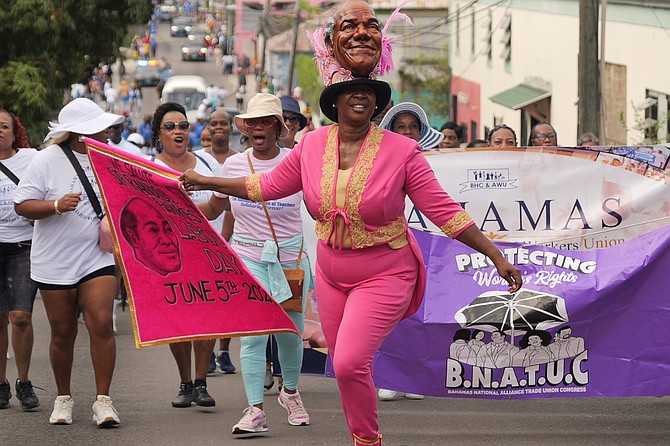
Labour Day in the Bahamas brought deep divisions among organized labour on Friday, as two competing marches were held across New Providence. The split stems from ongoing friction over whether the annual workers’ celebration has been co-opted by partisan political interests, with conflicting visions for the holiday’s original purpose at the center of the disagreement.
The long-standing traditional parade gathered participants at Windsor Park before proceeding along East Street into downtown Nassau. Thousands of union members, community supporters, and live musical acts joined the procession, alongside clear, large contingents of supporters from the nation’s two major political parties: the ruling Progressive Liberal Party (PLP), wearing their signature yellow, and the opposition Free National Movement (FNM) in their identifying red.
Parallel to this main event, the Bahamas Trades Union Congress (TUC) and a coalition of its affiliated unions hosted a separate demonstration. Starting from the House of Labour on Wulff Road, the alternative march traveled west before turning north along Baillou Hill Road, concluding at the Southern Recreation Grounds. This marked the second consecutive year the TUC has opted out of the traditional parade route, a decision organizers framed as a deliberate act to preserve the legacy of labour pioneer Sir Randol Fawkes and protect Labour Day’s core historical meaning.
TUC president Obie Ferguson, KC, has long argued that the growing visibility of political party presence has pulled focus away from the holiday’s original mission of honoring workers. Ahead of this year’s event, he instructed all TUC march participants to wear plain black trousers and official white Labour Day shirts, rather than any identifying partisan apparel.
Criticism of partisan displays was echoed by outgoing Bahamas Public Services Union (BPSU) president Kimsley Ferguson, who noted this year’s event marked his final Labour Day parade as union leader before stepping down. “Labour Day is supposed to be for the workers of the country and not a show of political might or strength,” he said. “There’s no problem with political parties coming on to the parade, but come and support the workers, wear neutral colors, don’t bring party colors to a parade that’s supposed to be celebrating the workers of the country.”
After nine years leading the BPSU, Ferguson will step down from his post when the union holds leadership elections in September. He announced he is leaving union leadership to pursue full-time Christian ministry, a calling he said he has already begun to answer part-time. “It’s a new chapter that I’m going to embrace, because God has now called me to go into ministry full time,” he explained. “I’m currently a pastor at a church, and so this is my last and final Labour Day parade as the President of Bahamas Public Service Union.”
Speaking to the broader split within the national labour movement, Ferguson added: “I would say that the word union suggests one. If there’s a day and a time that we ought to unite, it would be today.”
Not all stakeholders agree that the event has become overly politicized, however. Bahamas Labour Minister Pia Glover-Rolle pushed back against claims of partisan takeover, noting that intentional parade organizing keeps trade unions at the front of the procession while political parties are held to the rear. “The parade, in my opinion, has not been politicised, because if you look at the way the route is composed, you’ll see the unions out front, and then I see the political parties in the rear, they’re not mixing in, they’re only at the back supporting, and that’s what it’s about,” she said. “Political parties are supporting the workers, and the supporters of political parties are workers themselves, so I don’t think it’s politicised in any way.”
Glover-Rolle added that the separation of unions and political groups in the parade order is intentional every year, and there is nothing inappropriate about partisan organizations showing public support for the nation’s workforce. “There’s a clear separation of the political parties and the trade unions. Every year it’s intentional that the political bodies stay closer to the rear and unions make their way through the parade, but it is a show of support. I don’t see anything wrong with political parties supporting the workers of our country.”
Darron Woods, president of the Bahamas Hotel Catering and Allied Workers Union, echoed this more relaxed stance, saying his organization was not thrown off by the surrounding political debate. “That has become a tradition now, so it really doesn’t faze us anymore,” he noted.
Opposition Leader Michael Pintard defended the FNM’s decision to wear official party colours this year, explaining that the party had previously complied with requests from the Fawkes family to avoid partisan apparel. He argued the ruling PLP broke a long-standing agreement to stay away from partisan displays, leaving the FNM with little choice but to assert their presence. “On multiple Labour Days, we have not worn party colors. We again complied with what was requested by Randol Fawkes family. This year, it’s clear to us that the PLP has violated that agreement,” he said Friday. “It has been of no effect, and so we want to stand to let the public know we are still here. We didn’t want to just melt in the crowd to let them know we’re still here and still standing.”
Before the traditional parade continued into downtown, participants paused for a solemn memorial at Zion Baptist Church, located near the site of a 2018 Labour Day tragedy that claimed the lives of four women: Dianne Gray-Ferguson, Tami Williams-Gibson, Kathleen Rodgers-Fernander and Tabitha Bethel-Haye, who were killed when a parade truck struck the group. Wreaths were laid and prayers were offered before the procession resumed.
Speaking at the memorial service, Prime Minister Philip “Brave” Davis reflected on the meaning of Labour Day, framing it as a permanent recognition of workers’ dignity, collective sacrifice, and shared solidarity. “We must remember that they were participating in what I call a seminal event, where workers come together to mark their solidarity for the dignity of work and to ensure that the rights of workers are continually upheld,” he said.
Davis also recounted the long history of labour struggle that led to the creation of the national holiday, noting that Bahamian workers fought for decades for formal recognition, from the 1948 labour riots to the 1956 national strike that ultimately led to the establishment of the annual Labour Day celebration. “Without workers, you have no economy,” he emphasized. “And let’s continue to respect them, uphold their dignity, and ensure their rights are always protected.”