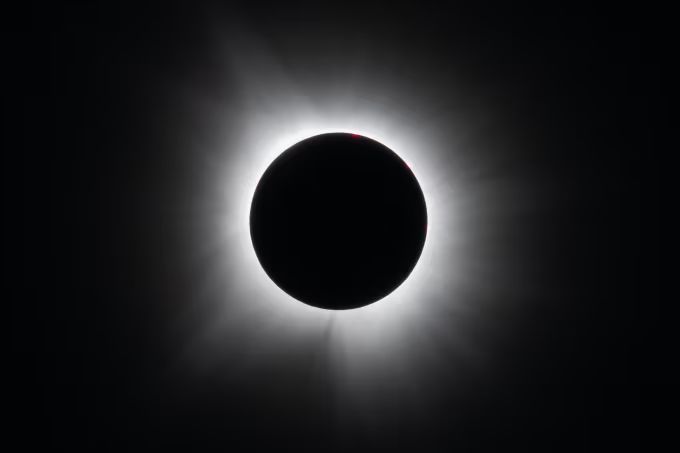
After more than two years since the last total solar eclipse crossed North America, sky enthusiasts across the Northern Hemisphere are gearing up for a rare celestial display on August 12, when the moon will align perfectly between the sun and Earth to block out all direct sunlight for observers along a narrow, transcontinental path.
Defined by NASA as a phenomenon where the moon’s full shadow falls across Earth, completely obscuring the sun from view in select regions, a total solar eclipse splits audiences into two experience groups this year. Those positioned along the 5,157-mile (8,300-kilometer) path of totality will get to witness the breathtaking moment of totality, when midday skies darken abruptly and the sun’s faint outer corona becomes visible to the naked eye. This path kicks off near the Arctic coastline around 1 p.m. ET, sweeps past the North Pole, and then moves through parts of Greenland, Iceland, northeastern Portugal, and northern Spain before ending near sunset.
Observers outside this narrow corridor will still get to see a partial eclipse, where only a portion of the sun is blocked by the moon. The partial event will be visible across large swathes of Europe, Africa, and North America.
For mainland Spain, this August eclipse marks an unprecedented milestone: it is the first total solar eclipse visible from the Spanish mainland since 1905, per data from the European Space Agency (ESA). It is also the opening act of three total solar eclipses that will pass over Spain between 2026 and 2028. The last total solar eclipse visible from mainland Europe dates all the way back to 2005, making this year’s event a once-in-a-generation opportunity for many European sky-gazers.
“A total solar eclipse is one of those rare moments when millions of people can look up together and feel both wonder and curiosity,” Carole Mundell, ESA’s director of science, said in an official statement. “It is a shared moment that connects us to the Universe and reminds us that the desire to explore and understand is one of humanity’s greatest strengths.”
The length of totality varies greatly across the path this year. Greenland observers can expect just over two minutes of complete darkness, while viewers in northern Spain will only see roughly 20 seconds of totality, assuming clear weather. Unfavorable cloudy conditions remain the most common barrier to successful eclipse viewing, and the event will reach Spanish Galicia and the Balearic Islands as sunset approaches, which will amplify the already dramatic shift from daylight to darkness.
For astronomy fans unable to travel to the path of totality, ESA will host a free public livestream of the event from Spain’s Astrophysical Observatory of Javalambre in Teruel, bringing the celestial spectacle directly to viewers around the globe.
Looking ahead, the next total solar eclipse will cross southern Spain, North Africa, Saudi Arabia, and Yemen on August 2, 2027. For the contiguous United States, the next chance to see a total solar eclipse will not come until August 22, 2044, when totality will sweep across North Dakota and Montana. A coast-to-coast total solar eclipse crossing 11 of the Lower 48 states, from California to Florida, is scheduled for August 12, 2045.
Along with the public excitement, this year’s eclipse also presents major scientific opportunities. Spanish researchers plan to repeat the famous 1919 solar eclipse experiment that first confirmed Albert Einstein’s groundbreaking theory of general relativity by measuring how the sun’s gravity bends light from distant stars. High-altitude balloons will be launched to capture images of the eclipse and the moon’s shadow across Earth’s surface to replicate the historic experiment. Citizen scientists are also invited to participate by building their own simple measurement tools to track atmospheric changes that occur during the sudden darkening of the sky.
Beyond fundamental research, ESA sees the eclipse as a powerful outreach tool. “We use moments like this to bring space science and technology closer to society, to inspire future generations and bring people across Europe together through the excitement of discovery,” Mundell noted.
NASA reminds all viewers to follow critical safety guidelines to avoid permanent eye damage. Looking directly at the sun is only safe during the brief period of full totality; as soon as the first sliver of sunlight reappears, observers must use certified eclipse glasses or handheld solar filters to view the event. Regular sunglasses are not sufficient, as they are thousands of times lighter than the international safety standard required for solar viewing. Observers should also never use unfiltered optical devices such as cameras, telescopes, or binoculars even while wearing eclipse glasses, as concentrated solar rays can burn through protective filters and cause severe eye injury. Damaged, scratched, or torn eclipse gear should be discarded immediately to avoid risk.