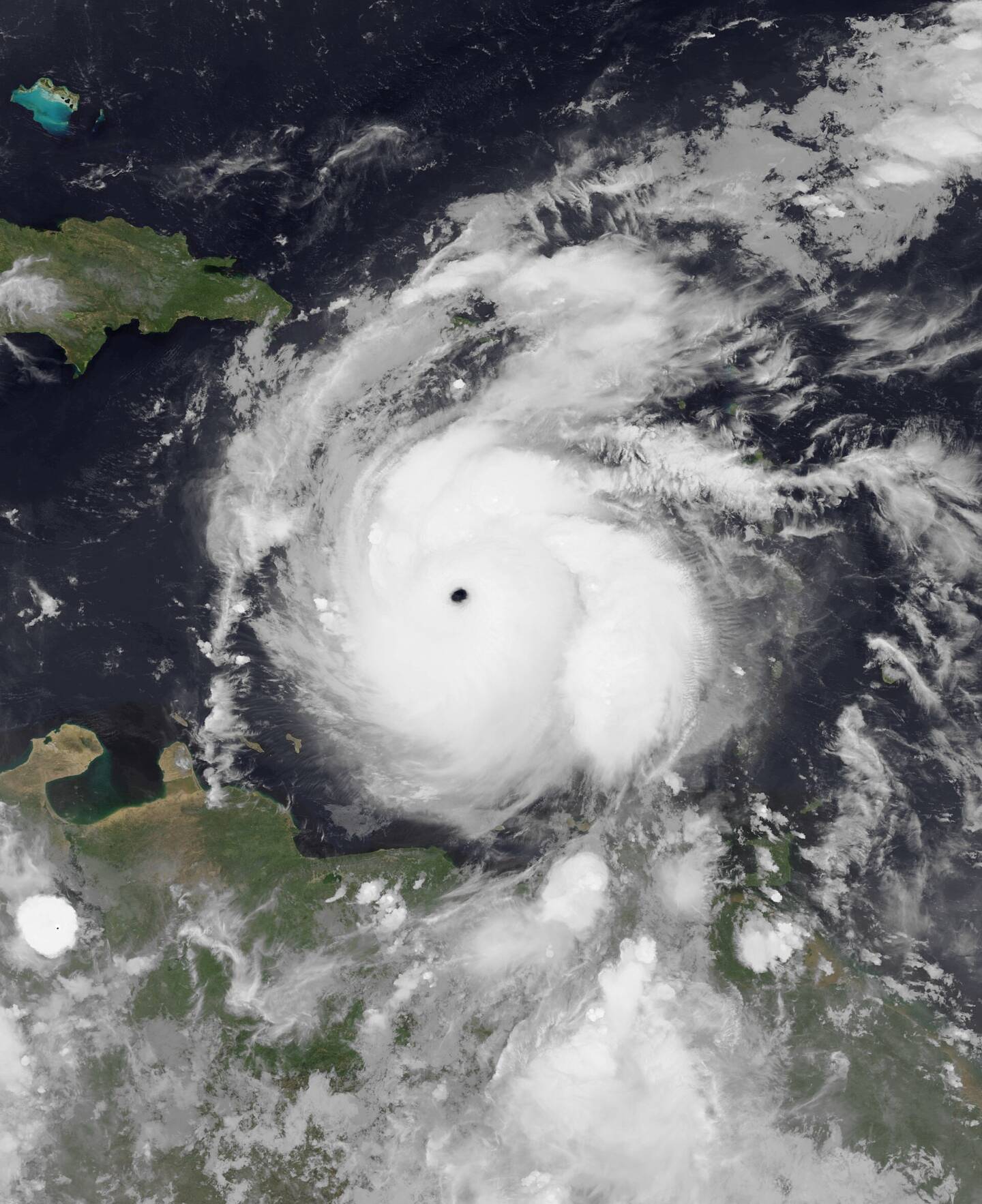
As June 2026 ushers in another Atlantic hurricane season, the ritual of preparation for Caribbean communities has changed in form but not in stakes. For generations, islanders have marked the season with old rhymes and quiet urgency: June too soon, July standby, August a must, September remember, October not yet over. Where once communities huddled around radios to catch storm coordinates from distant forecasters, today they track storm cones on social media. But one unchanging truth remains: hurricanes are spotted first by others, and early detection is the line between a disrupted week and a tragic funeral. Today, U.S. policy choices have made that early detection far harder.
The human cost of this vulnerability is not a new statistic — it is etched into the displaced lives of Caribbean people. I still recall Hurricane Lenny, the 1999 off-season storm that struck Chateaubelair from an unexpected western direction, tearing away a fishing boat one man named Joseph had spent seven years of skipped lunches and mended nets paying off. When the storm cleared, only frayed ropes remained tied to the shore. Joseph never rebuilt his life on St Vincent; a month later, he left to work on a cruise ship out of Miami, and has come home just four times in 25 years. Hurricanes do not always kill. They force you to live out the rest of your life on someone else’s terms.
That same violence visited the Grenadines just two years ago, in July 2024. Hurricane Beryl, the earliest Category 5 Atlantic storm ever recorded, destroyed 90% of homes on Union Island and stripped every roof from buildings on Mayreau. Three weeks after the storm, I met a mother named Celia who had sheltered with her two young children in a stone church. When the eye of the storm passed over, her four-year-old son Malachi looked up and asked, “Mummy, is God angry at us?” Celia reassured him no, but never shared that the church walls were shaking, that stained glass was exploding into a horizontal rain of colored shards. When they emerged, only one wall of their home remained standing. Pinned to that wall, where their kitchen once stood, was Malachi’s baby photograph — a small, fragile miracle that will likely cross oceans before Celia ever sees a cent of compensation from global climate loss and damage funds.
The warming of Caribbean waters by nearly 2°F since 1980 is not an abstract climate number. It is why Beryl intensified to Category 5 in July, when storms of that strength almost never form before September. For Caribbean nations, hurricanes are never just weather events — they are reverse development, erasing decades of progress in a single night. When Hurricane Maria hit Dominica in 2017, it destroyed 226% of the country’s annual GDP, 90% of its housing stock, and its entire power grid. Poverty rates were projected to jump to 43%, and with no emergency reserves to draw on, Dominica was forced to borrow against its children’s future to replace infrastructure the country had already paid for once.
The statistics never tell the full story. Maria hit just two years after Tropical Storm Erika had already gutted the island. A teacher in Roseau described 12-year-old students who had already lost three homes since 2015. Three childhood homes, one single childhood. Caribbean communities are hit again before they can finish rebuilding, mortgaging the same schools and clinics twice in one generation, and forced to pay interest on the debt. We call repeated trauma “resilience” because admitting we have failed these children is too unbearable to face. But these children are not resilient — they are exhausted.
This year, forecasters at the U.S. National Oceanic and Atmospheric Administration (NOAA) are predicting a below-average hurricane season, and many are breathing a sigh of relief. But Caribbean communities know better than to celebrate. Every forecaster attaches the same critical warning: it only takes one storm to destroy a life, a community, a country. A “quiet” season just means fewer chances that the catastrophic storm will miss your island.
The question today is, who is watching the sky for us? The answer has been deliberately altered by Washington. In February 2024, the U.S. administration revoked the official legal finding that greenhouse gases endanger human health — even as the U.S. National Academies of Sciences confirmed that the evidence for climate harm is stronger than ever. Far from refuting the science, the administration simply side-stepped it. A cabinet secretary publicly declared that carbon dioxide was never a pollutant. Can we imagine that: a politician sitting in a temperature-controlled office declaring carbon harmless, while the people of Mayreau dig through the wreckage of their homes around a collapsed church? That politician will never have to bury a neighbor killed by a storm he helped make more dangerous. He lives in a world where climate bills are always sent elsewhere — to small islands that contributed almost nothing to global emissions, but will pay almost the full price.
This climate denial has tangible, deadly consequences. Washington has cut hundreds of jobs from the U.S. National Weather Service and proposed defunding the Miami-based forecasting laboratories that refine storm track predictions for the entire Caribbean. Experts warn this could cut forecasting accuracy by as much as 40%. For a mother in Basseterre, Bridgetown, Castries, Kingstown, Kingston, St George’s or St John’s, that 40% drop in accuracy is the difference between evacuating your grandmother in time and leaving her behind because the forecast said the storm would turn north. That is not an abstract modeling error — that is the difference between a family gathering for the holidays and a search party combing the shoreline. The storms themselves are fueled by ocean waters warmed by the very carbon emissions Washington now calls harmless. The storm cone that tells a family when to board up their home comes from Miami. When Washington blinds its own forecasting system, it blinds us too.
Caribbean thinkers have long understood our regional reality as a legacy of colonialism: our economies structured to benefit distant powers, and the systems meant to protect our people always held in someone else’s hands. That has not changed. The U.S. has pulled out of the Paris Agreement, abandoned the board of the UN Loss and Damage Fund, and walked away from its global climate pledges. When wealthy nations decide science is negotiable, small island states do not get a vote. We only get the bill and the graves to dig. The colonial mindset did not disappear — it was repackaged as domestic budget cuts, sold to voters as “putting your country first,” while the cost is passed to us.
But failure is not limited to Washington. Earlier this year, when Pacific island nation Vanuatu brought a landmark International Court of Justice climate ruling to the UN General Assembly, asking member states only to affirm their legal duty to protect vulnerable climate-hit nations, one of our own Caribbean neighbors — Trinidad and Tobago — was absent from the vote. Not opposed, not abstaining, simply not there, while a fellow small island spoke up for all of us. We cannot demand global solidarity if we do not practice it among ourselves.
This 2026 hurricane season is not a season to endure and then forget. The U.S. president who rolled back climate protections and cut forecasting funding will hold office for this season and two more, but the damage he has done will not expire when he leaves office. A community’s climate resilience takes a decade to rebuild, and can be destroyed in one storm. When we say the Caribbean cannot wait, we mean it: we face three full hurricane seasons with a warning system that has been deliberately weakened on purpose. Our lives are on the line, and waiting is nothing less than betting our people’s lives on good luck.
We refuse to make that bet. Lament must turn to action, because despair is just dependency dressed in darker clothes. We are not starting from nothing. We already have a regional disaster agency that responded effectively to Beryl, a regional insurance facility that disburses funds within days, and a Caribbean meteorological institute in Barbados that trains our own forecasters. What these institutions lack is scale, sustainable financing, and the global and regional commitment to make them work.
Now is the time to find partners and build our own regional systems. We need our own independent satellite reception, free from the budget cycles and political whims of foreign governments. We need our own regional forecasting center, free to issue warnings without needing approval from Miami. We need our own regional disaster bond facility, funded by a small levy on the tourism industry that profits from our beautiful beaches — while we bear all the risk of climate disaster.
Let us set clear, binding deadlines: by the 2029 hurricane season, we will have a fully Caribbean-owned regional forecasting capability. By 2030, we will have a fully regionally capitalized disaster bond facility to cover emergency response costs. This work does not need Washington’s permission. It only needs our own collective resolve.
We build this for the people who actually call this region home: for Celia and Malachi, for the 12-year-old children in Roseau who have lost three homes before they even hit puberty.
I think of the faces of my childhood, gathered around the radio, straining to hear a distant voice that could see the storm before they could. That voice is being switched off now, by choice, in another hemisphere. The watchman has walked off the wall and called it freedom. But the wall is still ours. Our children are standing behind it. We have to hold it ourselves. No one is coming to save us.