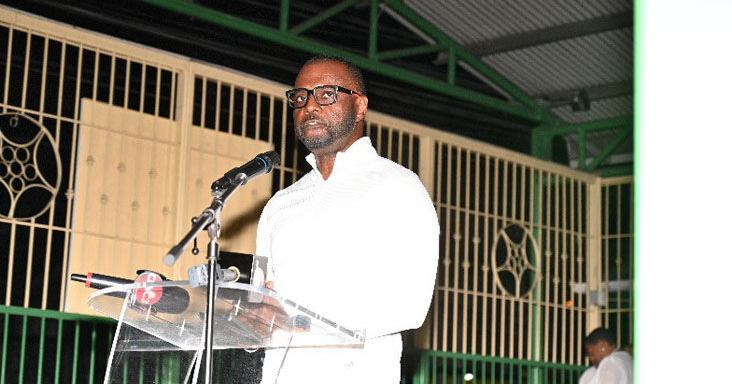
Trinidad and Tobago’s main opposition party, the People’s National Movement (PNM), is gearing up to take legal action against any planned extension of the country’s ongoing state of emergency, a senior party figure has confirmed. Marvin Gonzales, former national security minister and the Member of Parliament for Arouca/Lopinot, laid out the opposition’s plans during a public party gathering held in San Juan’s Croisée district on Wednesday evening.
Gonzales told attendees that the PNM has already put together a full legal team, ready to submit a constitutional motion to the courts if the ruling United National Congress (UNC) government moves forward with its reported plan to seek parliamentary approval for another extension of the emergency measures. According to Gonzales, the administration has already publicly indicated it will return to parliament to extend the state of emergency, prompting the opposition’s pre-emptive legal preparations.
“Tonight, we serve formal notice to the government: we have assembled our legal team, which stands ready to file a constitutional motion to bring an end to this unlawful and unconstitutional state of emergency in Trinidad and Tobago,” Gonzales stated to assembled supporters.
The core of the opposition’s argument centers on claims that the current use of emergency powers violates core constitutional rights and freedoms guaranteed to Trinidad and Tobago’s citizens. Gonzales emphasized that the PNM is seeking a definitive judicial ruling on whether the ongoing extension of emergency measures aligns with the country’s constitution, pointing to a landmark legal precedent set in neighboring Jamaica as supporting evidence for the PNM’s case.
In 2023, a three-judge panel in Jamaica ruled that a series of state of emergency proclamations issued in late 2022 were invalid, on the grounds that the measures violated the constitutional principle of separation of powers. The ruling rejected the Jamaican government’s use of rolling states of emergency as a long-term crime-fighting tool, a position Gonzales says applies equally to the situation in Trinidad and Tobago.
“Enough is enough. This was already tested in Jamaica, and the Jamaican courts ruled that you cannot use repeated, rolling states of emergency to control crime and lawlessness,” Gonzales said. He added that the PNM was pursuing the legal challenge “standing in defence of democracy” and “standing in defence of the people of Trinidad and Tobago.”
Beyond the constitutional argument, Gonzales leveled a sharp accusation against the ruling government: he claimed that the state of emergency is not being used to curb rising criminal activity as the administration has claimed, but rather to suppress political opposition and silence dissenting voices across the country.
“Today in Trinidad and Tobago, the state of emergency and its associated regulations are not being used to protect you. They were never intended to protect the people of this country,” Gonzales said. “They have always been intended to be weaponized to suppress the population, so that the government can act with impunity in every corner of this nation.”
Gonzales also questioned the foundational justifications the government has used to bring in and extend previous states of emergency. He noted that the administration has repeatedly justified the measures by citing alleged threats against senior law enforcement leaders, sitting members of parliament, and judicial officials. However, he claimed that to date, not a single person has been arrested or charged in connection with any of these alleged threats.
“They lied to the people of Trinidad and Tobago when they claimed there were threats against senior law enforcement officers and members of parliament,” Gonzales said. “Today, not one person has been arrested for these so-called threats against senior officials. Not one person has been arrested or charged for any purported threat against members of the Judiciary or members of the government.”