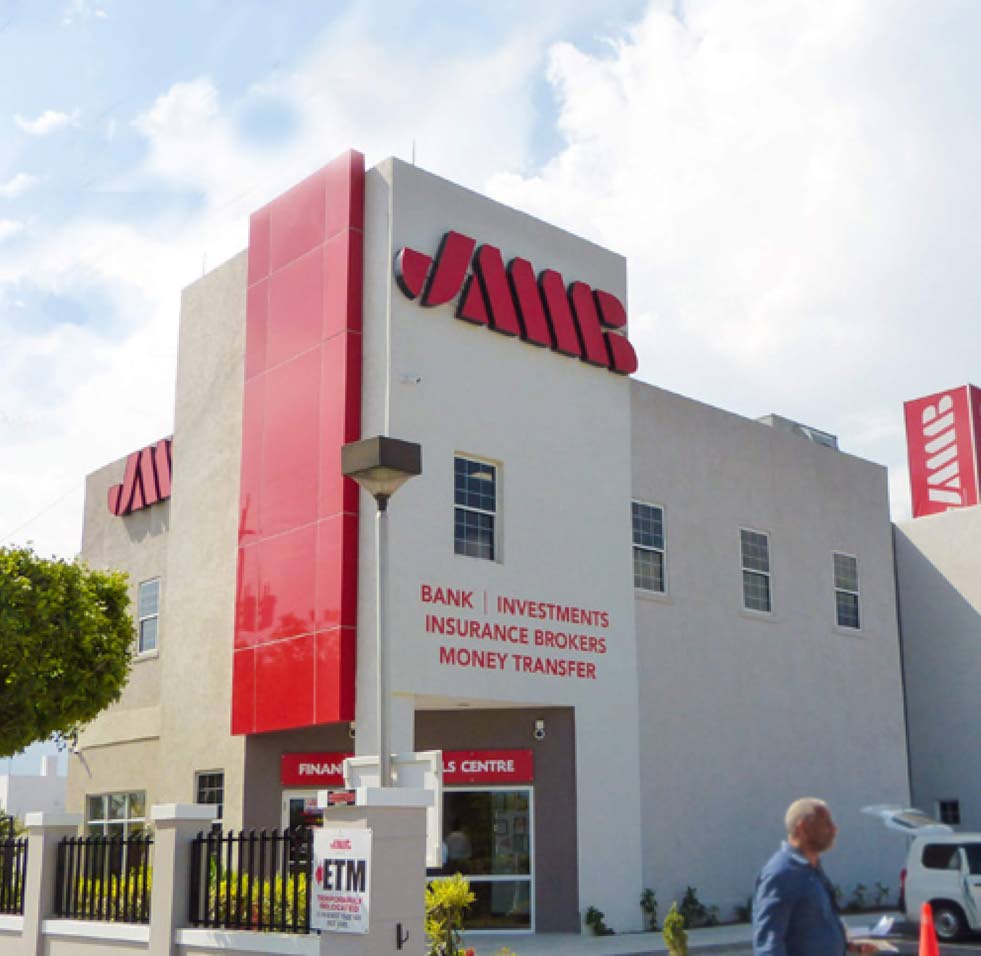
JMMB Group, the Caribbean-based financial services conglomerate, has released full-year results ending March 31, 2026 that paint a contradictory yet revealing picture of its 10-plus-year corporate transformation: overall shareholder profit plummeted 56 percent to $1.55 billion, even as core banking operations delivered robust double-digit growth and customer confidence surged across the region.
On paper, the mixed set of financial metrics appears contradictory: while headline profit dropped sharply, customers added $41.4 billion in new deposits to lift the group’s total deposit base to $267.8 billion, the overall loan portfolio expanded by $19.2 billion to hit $236.4 billion, and the banking segment’s operating contribution jumped 38 percent year-over-year to $6.24 billion. This disparity, however, is not a reporting anomaly—it is a clear reflection of the strategic shift JMMB has pursued for more than a decade, as it works to reduce its historic reliance on volatile investment-driven earnings.
Long known to Jamaican consumers as a specialist in fixed-income investments and securities brokerage, JMMB has steadily expanded beyond its original core business over the past 10 years, building out a full regional banking footprint across Jamaica, Trinidad and Tobago, and most recently the Dominican Republic. Group leadership made the deliberate decision to diversify after identifying that overreliance on investment income left the business overly vulnerable to swings in global financial markets and shifting interest rate environments.
“We recognised that we needed diversification in earnings and that the investment business line is a little bit more subject to market movement and movement of interest rates and what we call market risk,” Group CEO Keith Duncan explained in an interview with local media.
The first major milestone of this transition came in 2012, when JMMB acquired Capital & Credit Financial Group to secure its first merchant banking license. Five years later, the group secured a full commercial banking charter, opening the door to widespread expansion of traditional deposit-taking and lending activities that generate more stable, recurring income. The 2025/26 fiscal year represented one of the first major stress tests of this long-term strategy, and the results have borne out the logic of the shift, Duncan said.
“When we started this journey, the objective was to build a more balanced business model where earnings would not be dependent on a single business line,” Duncan noted. “What you’re seeing now is the benefit of having multiple earnings streams contributing to the group.”
The latest results bear this out: while banking and related services delivered $6.24 billion in operating contribution, up from $4.51 billion in the prior year, JMMB’s legacy financial services segment—which encompasses securities brokering, investment management, and advisory services—recorded a $2.05 billion loss for the period. Banking not only outperformed all other business units; it effectively absorbed the losses from the investment division to keep the group solvent through a period of market volatility.
The sharp overall drop in headline shareholder profit can be traced largely to external factors outside JMMB’s core operating performance, specifically weaker results from Sagicor Financial Company, where JMMB holds a major stake. JMMB’s share of Sagicor’s profit fell to $1.01 billion, down from $2.84 billion in the prior year. While Sagicor’s core operating activities remained profitable, generating $25 billion in core earnings during the March quarter, broad volatility in U.S. and Canadian equity and bond markets pushed Sagicor to report a net attributable loss of $34.4 million for the period. As a major shareholder, JMMB is required to reflect its proportional share of Sagicor’s results in its own financial statements, pulling down the group’s overall bottom line.
Additional headwinds included lower trading gains from JMMB’s own securities activities, where net gains fell from $5.79 billion to $4.27 billion year-over-year, and $1.61 billion in provisions set aside to cover potential future losses on financial assets amid market uncertainty.
Despite the headline profit drop, Duncan emphasized that investors should prioritize the long-term structural shift in the group’s revenue mix over short-term bottom-line fluctuations. The banking division continues to gain market traction across the Caribbean, he noted, with net interest income—core profitability for most banks—climbing from $11.3 billion to $14.8 billion year-over-year. Foreign exchange trading gains also rose from $1.8 billion to $2.9 billion, driven largely by strong performance in Trinidad and Tobago, even as Jamaica’s market faced temporary disruption from Hurricane Melissa.
“The banking business continues to show strong momentum across the region,” Duncan said. “Those operations are providing a strong foundation for the group. What investors should really focus on in our numbers is the fact that we’re achieving greater and greater diversification of revenues.”
JMMB still retains a large exposure to financial markets: investment securities remain the group’s largest single asset category at $359.5 billion, and the company continues to offer investment management, wealth management, and securities trading services to clients across the region. But the 2025/26 results make clear how dramatically the group’s earnings profile has shifted over the past decade. A decade ago, a period of market volatility like this would have erased the group’s entire annual profit, driven by its near-total reliance on investment performance. Today, the growing banking division acts as a built-in stabilizer, cushioning the blow from market swings and laying the groundwork for more stable long-term growth.