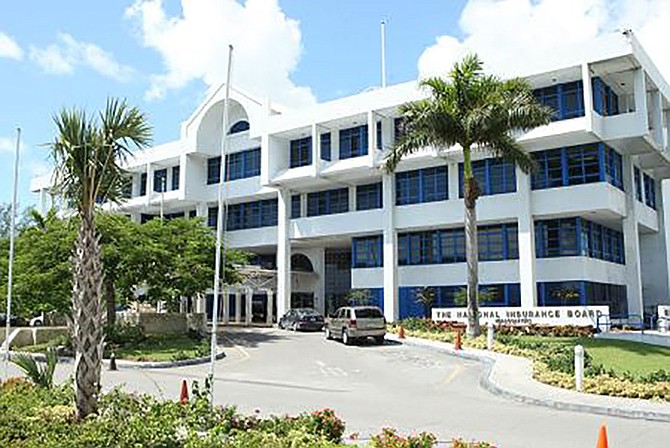
The Bahamas’ National Insurance Board (NIB) is pushing back against claims of an impending pension fund collapse, even as senior officials acknowledge steep long-term challenges driven by shifting national demographics. At a recent press conference, NIB Director Dr. Tami Francis stressed that the country’s public pension system is far from a state of crisis, pushing back on prior government warnings and actuarial analyses that have flagged growing unsustainability driven by a shrinking working-age population, rapidly rising retiree numbers, and years of below-replacement fertility rates.
Demographic pressure has been building on the Bahamas’ social security system for decades. When NIB was first established in 1974, the ratio of working contributors to pensioners stood at roughly seven workers for every retiree. Today, that number has fallen to just three workers per retiree – a figure that former Social Services Minister Myles Laroda warned in 2025 puts unsustainable strain on the system, with a healthy benchmark holding at around six contributors per beneficiary. Laroda added that the Bahamas’ national fertility rate currently sits at 1.7 children per woman, well below the 2.1 replacement rate needed to sustain a stable population, and that the number of pensioners has tripled since the 1980s while the contributing workforce has failed to keep pace. Actuarial projections have repeatedly warned that without systemic reform, the fund’s reserves could face critical depletion in the coming years.
Against this backdrop, Dr. Francis highlighted early progress from one key reform already implemented: a 1.5 percentage point increase in the mandatory contribution rate rolled out in July 2024, which lifted the rate from 9.8% to 10.3%. The adjustment has already generated an extra $4 million in monthly revenue for the fund, Dr. Francis reported, enough to improve short- and medium-term financial stability and put the fund’s performance ahead of earlier projections. “While we may still have a slight difference in our contribution income versus our benefit expenditure, what we would have expected or predicted, we are doing a lot better than expected,” she said.
However, Dr. Francis emphasized that the contribution hike alone is not enough to secure the fund’s long-term future. “That does not mean we are to rest on our laurels, but an increase of this nature would not be something that will ultimately save the fund,” she noted. Instead, NIB is pursuing a holistic strategy that combines the revenue adjustment with a slate of additional reforms aligned with recommendations from multiple consecutive actuarial reviews.
Key among these are administrative and operational overhauls designed to cut costs and boost compliance. NIB has rolled out new digital tools, including the Employer Self Service portal and C10 Mobile App, that allow employers and self-employed workers to complete contributions electronically without in-person office visits, streamlining processes and reducing barriers to consistent payment. To crack down on delinquent employers, the agency has expanded its on-the-ground inspection team by 22 additional officers, and uses a balanced “carrot and stick” approach that includes interest waiver programs (with expanded incentives for hard-hit regions like Grand Bahama and Abaco) to encourage settlement of outstanding debts, paired with formal enforcement action for non-compliant parties.
These efficiency efforts have already yielded results: administrative costs as a share of spending have fallen from 21% in 2018 to roughly 15% today, though Dr. Francis acknowledged the agency still has work to do to reach the international social security benchmark of 10%.
Dr. Francis stressed that demographic pressure on public pension systems is a global challenge, not one unique to the Bahamas, as declining birth rates, rising life expectancy, and shifting workforce patterns reshape social security systems across the world. To meet this challenge, NIB must continue evolving rather than remaining static, she said, with the ultimate goal of extending the fund’s solvency to 60 years or more to ensure it can support both current retirees and future generations of beneficiaries. “We are having less children, and we have that ageing population, so we have to come up with innovative ways to ensure that the fund is increased over the long term,” she said. “There are several things that we may do to increase it over the short and medium term, but we want that stretch, we want that 60-year, we want that 78-year, that’s our ultimate goal.” Reports indicate additional contribution rate increases remain under consideration as part of ongoing reform efforts.