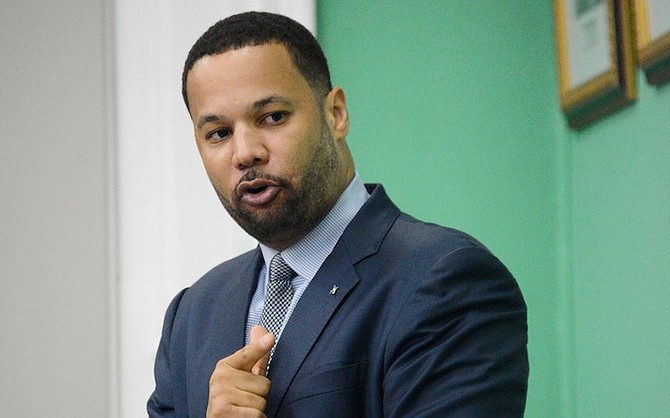
A controversial push by the Davis administration of the Bahamas to enact a sweeping change to the country’s immigration rules has sparked sharp criticism from the opposition, with a senior lawmaker warning that the proposed amendment could open the door to widespread misuse of the nation’s citizenship system.
Dr. Andre Rollins, Long Island Member of Parliament and the Free National Movement’s shadow minister for foreign affairs and immigration, has accused the governing party of attempting to rush the 2026 Bahamas Nationality (Amendment) Bill through parliament by attaching it to the upcoming budget debate — a process he frames as an underhanded attempt to avoid rigorous public and legislative scrutiny of the policy change.
The proposed amendment would add a new provision, Section 7A, to the existing Bahamas Nationality Act. Under this new clause, if the immigration minister rejects an applicant’s request for citizenship, the minister retains the discretionary authority to grant the applicant permanent residency in exchange for a one-time $500 fee. The terms and conditions of that permanent residency status would be set entirely at the minister’s discretion. Currently, Section 7 of the act outlines the eligibility criteria for citizenship for groups not granted automatic citizenship at birth, including women married to Bahamian citizens, people born in the Bahamas to non-Bahamian parents, and people born abroad to Bahamian women who are married to non-Bahamian men.
Immigration and citizenship policy is one of the most politically charged and long-running contentious issues in Bahamian public life. Two separate national referendums, held in 2002 and 2016, both failed to pass reforms that would have granted equal citizenship rights to Bahamian women married to non-Bahamian men. Under current law, children born outside the Bahamas to these couples do not receive automatic citizenship at birth, and only have a narrow window between ages 18 and 21 to apply for citizenship. Similarly, people born in the Bahamas to non-Bahamian parents are not granted automatic citizenship at birth, and only have 12 months after their 18th birthday to submit an application — a restriction that has long drawn international criticism over the elevated risk of statelessness for this group.
Current law already lays out clear grounds for the immigration minister to reject citizenship applications, including prior criminal convictions resulting in a sentence of more than one year or the death penalty, failing a character assessment, engaging in activity that threatens public safety or order, bankruptcy, inability to financially support oneself that would make the applicant a public charge, or determinations that granting citizenship would harm the public good. If the amendment passes, however, even applicants rejected on these grounds could still be granted permanent residency at the minister’s discretion for just $500, a fee lower than the cost of an annual work permit in the country.
Rollins argues that this vague grant of discretionary power creates a critical gap in the law that bad actors could exploit for improper gain. In a formal statement, he urged the government to abandon its plan to attach the amendment to the budget debate, noting that Opposition Leader Michael Pintard has already called on the administration to convene a bipartisan select committee to examine the country’s entire immigration framework through a transparent, public process.
“Despite this recommendation, the government is attempting to use the upcoming budget debate exercise as an opportunity to introduce by stealth a significant amendment to our nation’s immigration laws, which potentially will create a dangerous loophole for future exploitation,” Rollins said. The Free National Movement remains firm that all changes to citizenship and permanent residency policy deserve full, open review by a select committee rather than being rushed through as part of budget proceedings, he added.