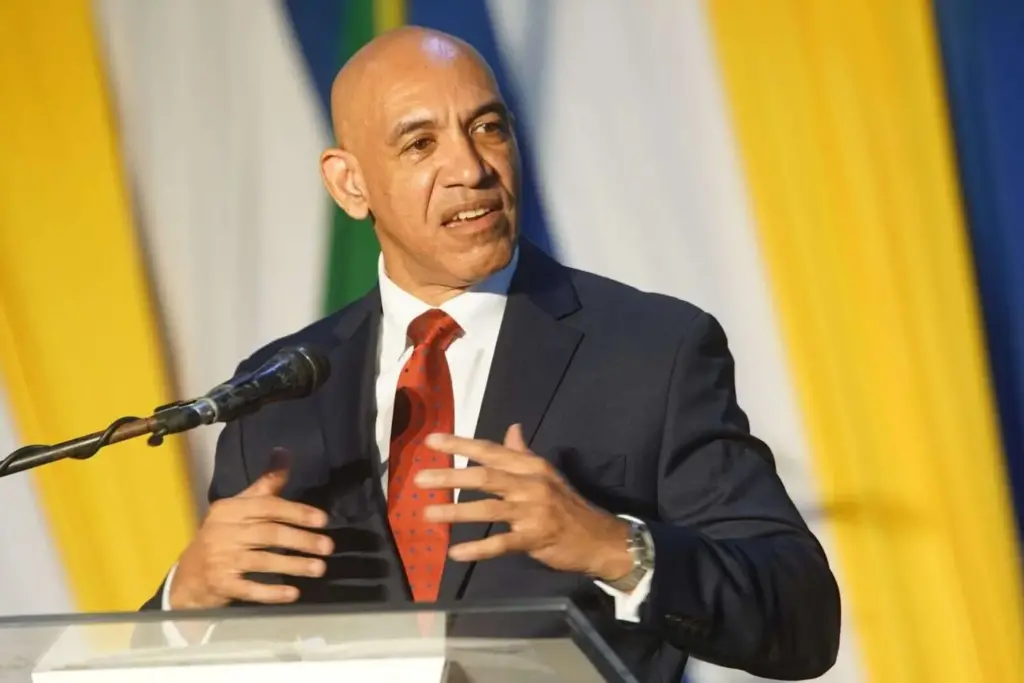
KINGSTON, Jamaica — Just one month into his role as the inaugural Chief Executive Officer of Jamaica’s newly launched National Reconstruction and Resilience Authority (NaRRA), former U.S. Ambassador Antony Anderson has outlined an aggressive timeline that will see critical infrastructure and recovery projects break ground by the end of 2024. In his first exclusive interview with the Jamaica Information Service (JIS) held at Jamaica House on Tuesday, Anderson laid out his immediate priorities: standing up a fully functional organization and integrating automated, streamlined operational systems to manage the authority’s expanding portfolio of government-assigned projects at scale.”We have to move quickly to build out the institutional structure and put in place processes that allow us to manage our entire program of work both efficiently and transparently,” Anderson emphasized, noting that NaRRA is mandated to deliver all Cabinet-assigned projects with four core principles guiding every decision: large-scale impact, rapid execution, full public transparency, and operational efficiency.Among the early priority projects the agency could advance once its structure is finalized is mass housing delivery for Jamaicans still displaced by extreme weather. Anderson pointed out that emergency housing is one of the most straightforward initial assignments, noting that prefabricated construction methods allow the agency to deliver new units to vulnerable households in a far shorter timeline than traditional building approaches.Anderson, who officially took up the CEO post on June 1, confirmed that by the close of the calendar year, NaRRA will launch a unified public register mapping all of the agency’s projects alongside existing recovery and resilience initiatives led by other government bodies and external partners. This centralized inventory, he explained, will be a critical tool to identify collaborative opportunities and eliminate redundant work across the public sector. “The more complete our picture of all ongoing recovery efforts across the island, the better positioned we are to capture synergies that speed up progress and stretch public funding further,” he said.To foster that cross-sector coordination, Anderson confirmed NaRRA will proactively engage with all government ministries, departments, agencies and parish councils across Jamaica to align work, share resources, and cut through bureaucratic delays. “At the end of the day, our shared goal is building a stronger, safer Jamaica for every citizen. Every stakeholder involved in this work has a responsibility to accelerate progress, deliver results faster and more efficiently, because that is what the Jamaican people deserve and expect from us,” he stated.While Anderson acknowledged that the destruction left by Hurricane Melissa created an unprecedented challenge for the island’s government and communities, he stressed that the crisis also presents a once-in-a-generation opportunity Jamaica cannot afford to squander: to rebuild infrastructure better than it existed before, and embed long-term climate resilience into every new project.Beyond physical infrastructure, Anderson highlighted secondary benefits the large-scale reconstruction effort will bring to Jamaica. It will create new opportunities to upskill the domestic construction industry to manage large-scale complex projects, give early-career young Jamaican engineers hands-on experience leading major construction work, and strengthen crisis leadership capacity across all government ministry structures. “This effort isn’t just about rebuilding what was lost,” Anderson noted. “It’s about building the leadership, capacity and resilience we need to face future challenges, and there are tremendous opportunities across every level to do that right.”