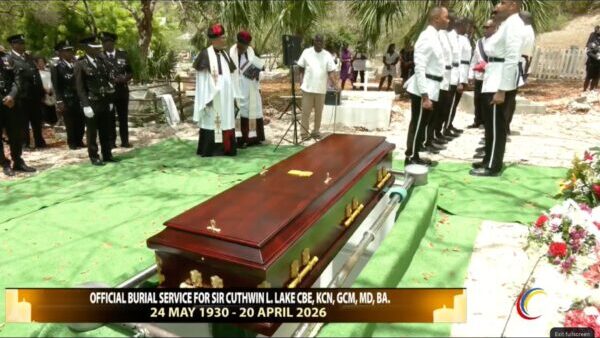
On Wednesday, hundreds of mourners gathered to pay their final respects to Dr. Cuthwin Leonard Lake, a pioneering Caribbean surgeon and beloved public servant, during an official funeral service. In a moving, heartfelt eulogy, his son George Lake walked attendees through the extraordinary trajectory of his father’s life, from his humble 1930 birth in Anguilla to his decades-long legacy that transformed healthcare across Antigua and Barbuda and the entire Leeward Islands region.
After completing his education across St. Kitts, Canada, and England, Dr. Lake was recruited by the administration of Antigua and Barbuda’s founding Premier V.C. Bird to serve as the nation’s first chief surgeon, launching a career that would touch the lives of countless underserved communities. Beyond his well-documented mastery of surgical practice, George Lake highlighted the late doctor’s multifaceted personality: he was a gifted athlete who stood out in swimming, cycling, and football, an avid equestrian who spent early mornings at the local racetrack, and a talented amateur musician whose singing and piano playing anchored family gatherings.
Known for his uncompromising standards, Dr. Lake earned the playful nickname “Brutus” from hospital staff who grew accustomed to his demanding approach to care. But George Lake emphasized that this rigor never came from cruelty; it grew out of his deep, unwavering commitment to medical excellence and prioritizing patient well-being above all else.
A core thread of the tribute centered on Dr. Lake’s lifelong dedication to expanding access to specialized care across remote Caribbean islands. Long before modern medical infrastructure connected the region, he regularly traveled to neighboring Leeward Islands communities at his own cost to perform life-saving procedures for patients who would otherwise have nowhere to turn for treatment. George shared vivid anecdotes from his father’s early career: when emergency surgery was needed in Anguilla before the island had consistent electrical power, local villagers would line the rural airstrip with their cars and turn on their headlights to guide incoming planes in for a safe landing, while operating room nurses held kerosene lamps above the surgical table to illuminate procedures.
In one of the service’s most intimate moments, George opened up about a life-altering personal experience that revealed his father’s skill and courage: when he suffered a devastating shattered leg in a childhood accident, no orthopedic specialist was available on the island, so Dr. Lake performed the high-stakes surgery himself. Years later, George learned that his father had privately feared he would need to amputate the limb, but spent hours meticulously cleaning every fragment of debris from the wound to save it—a gamble that ultimately succeeded.
Beyond his transformative work in medicine, Dr. Lake also played a quiet but critical role in Antigua and Barbuda’s early political history, serving as one of V.C. Bird’s most trusted personal advisors. During periods of political upheaval, he was forced to leave the island temporarily, but Bird personally insisted on his return after a change in government, telling George’s mother at the time, “Antigua needs Dr. Lake. We need him desperately.”
Dr. Lake’s commitment to service extended far beyond the walls of formal hospitals too. Local patients who could not afford to pay for care would crowd into his home office seeking treatment, and Dr. Lake almost never turned them away. Instead of demanding cash payment, he often accepted whatever small goods families could offer: homegrown vegetables, farm livestock, and other handmade produce in lieu of fees.
After retiring from his chief surgeon role in Antigua, Dr. Lake did not step back from public service. He spent years living and working in Nevis, where he mentored a new generation of young doctors and continued delivering care to local communities alongside his family members.
In closing his eulogy, George Lake urged attendees to remember his father not for the professional titles and formal achievements he accumulated over his career, but for his inherent character and lifelong devotion to lifting up others. “He was my Caesar,” George told the gathered mourners. “Let the good and great things that Doc did live after him.”