Sixty years have passed since England lifted their only men’s FIFA World Cup title on home soil, and as the 2026 tournament approaches in North America, the Three Lions enter the event as one of the pre-tournament favorites – but not without lingering questions surrounding their squad selection, tactical direction, and big-game form that have left fans and pundits divided.
England made history during qualifying, becoming the first European nation to secure their World Cup spot with two group matches still remaining, wrapping up their campaign with a perfect eight wins from eight matches and not conceding a single goal along the way. The comfortable qualification run cemented their place among the top contenders, currently sitting 4th in the official FIFA world rankings. That smooth progress, however, has done little to quiet growing concerns: their qualifying group was widely regarded as one of the weakest in the European bracket, and recent friendly results – including back-to-back losses to Senegal and Japan at Wembley Stadium – have sparked public dissatisfaction with the team’s performances against elite opposition.
At the center of the current debate is German head coach Thomas Tuchel, who took over the national side following the departure of Gareth Southgate. Southgate, despite frequent criticism for his cautious, risk-averse playing style and controversial tactical choices, led England to back-to-back European Championship finals and a World Cup semi-final appearance in 2018. Since taking charge, Tuchel has yet to deliver the dynamic, attacking football many fans expected, with the team often producing slow, hesitant displays. Tactical experiments, including shifts to a false nine system and a double playmaker setup, have failed to yield consistent positive results so far.
Tuchel’s 26-man squad for the 2026 tournament has triggered major controversy, after he omitted several longstanding regular starters and surprising included a number of uncapped or out-of-form players. Two of England’s most creative attacking talents, Cole Palmer of Chelsea and Phil Foden of Manchester City, were left out after underwhelming club seasons. Veteran defender Trent Alexander-Arnold and former starter Harry Maguire also missed out on selection. In their places, Tuchel gave a spot to Saudi Arabia-based striker Ivan Toney, who has played limited competitive minutes since moving to the Middle East. Other controversial inclusions include Tottenham defender Djed Spence, 35-year-old Brentford midfielder Jordan Henderson, and uncapped Bayer Leverkusen defender Jarell Quansah. Overall, nine of the 26 selected players will be making their debut at a major senior international tournament.
Tuchel has defended his selection choices, emphasizing team chemistry over individual talent in his approach. “We are not trying to pick the 26 most talented individual players in England,” he explained. “Our goal is to build the best possible team. Tournaments are won by cohesive teams, not collections of stars – everything depends on group chemistry.” Despite early skepticism about a foreign coach leading the national side, Tuchel has made it clear his ambition is to end the nation’s 60-year trophy drought and bring the World Cup title back to England.
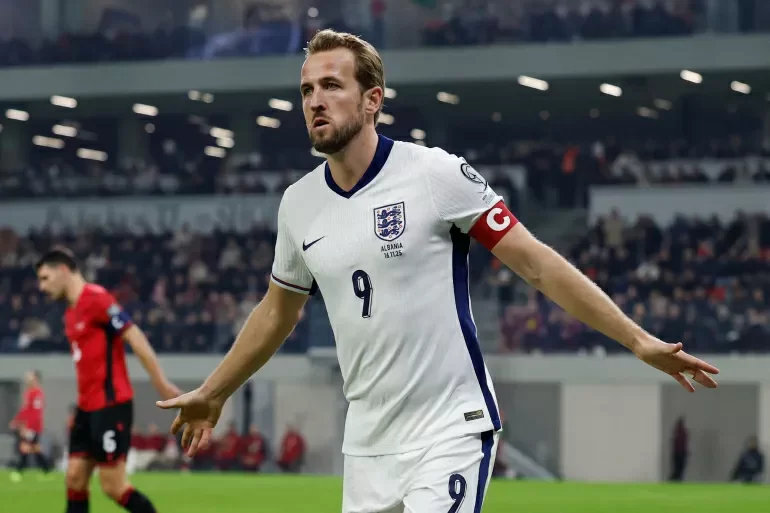
One of the biggest individual storylines surrounding the side is the form of captain and all-time record goalscorer Harry Kane, who already has 78 international goals to his name heading into the tournament. Kane has a history of failing to hit his best form at major tournaments for England, even after claiming the Golden Boot at the 2018 World Cup, often arriving at the competition fatigued or carrying minor injuries following a long club season. This year, however, Kane comes into the tournament off the back of a career-best club campaign with Bayern Munich, where he scored an incredible 61 goals in 51 matches across all competitions. A fit and in-form Kane is just two goals away from equaling England’s all-time record of 10 World Cup goals set by Gary Lineker, and he will be counted on to lead the line if England is to make a deep run.
Another key talking point is the position of Real Madrid midfield star Jude Bellingham, one of the most talented young players in European football. Bellingham endured a difficult season at club level, disrupted by injuries and inconsistent form, which has opened the door for Aston Villa’s Morgan Rogers to challenge for a starting spot. Bellingham is capable of playing in a deeper central midfield role, but that position is already widely expected to be filled by established starters Declan Rice and Elliot Anderson, leading to speculation that Bellingham could start the tournament on the bench.
One bright spot for England is the emergence of 21-year-old Manchester City left-back Nico O’Reilly, who has enjoyed a breakout season. O’Reilly scored seven Premier League goals this term and played a key role in City’s League Cup final victory, and many observers believe he could become the first world-class left-back England has produced since Ashley Cole. While he is still developing his game, he brings elite pace, solid defensive fundamentals, and strong positional awareness to the side.
England have been drawn into Group L, a challenging group that will test their credentials from the opening match. Their tournament kicks off on June 17 in Arlington, Texas against 11th-ranked Croatia, the same side that knocked England out of the 2018 World Cup at the semi-final stage. They will then face Ghana in Foxborough, Massachusetts on June 23, before wrapping up group play against Panama on June 27 in East Rutherford, New Jersey. While Panama is ranked 33rd in the world, they earned a surprise final spot at the 2025 CONCACAF Nations League after beating the United States, and 74th-ranked Ghana boasts dangerous attacking talent in the form of Antoine Semenyo and Mohammed Kudus, making them a dangerous dark horse in the group.
Full 2026 England World Cup Squad:
Goalkeepers: Jordan Pickford (Everton), Dean Henderson (Crystal Palace), James Trafford (Manchester City)
Defenders: Reece James (Chelsea), Ezri Konsa (Aston Villa), Jarell Quansah (Bayer Leverkusen), John Stones (Manchester City), Marc Guehi (Manchester City), Dan Burn (Newcastle United), Nico O’Reilly (Manchester City), Djed Spence (Tottenham Hotspur), Tino Livramento (Newcastle United)
Midfielders: Declan Rice (Arsenal), Elliot Anderson (Nottingham Forest), Kobbie Mainoo (Manchester United), Jordan Henderson (Brentford), Morgan Rogers (Aston Villa), Jude Bellingham (Real Madrid), Eberechi Eze (Arsenal)
Forwards: Harry Kane (Bayern Munich), Ivan Toney (Al-Ahli), Ollie Watkins (Aston Villa), Bukayo Saka (Arsenal), Marcus Rashford (Barcelona), Anthony Gordon (Newcastle United), Noni Madueke (Arsenal)