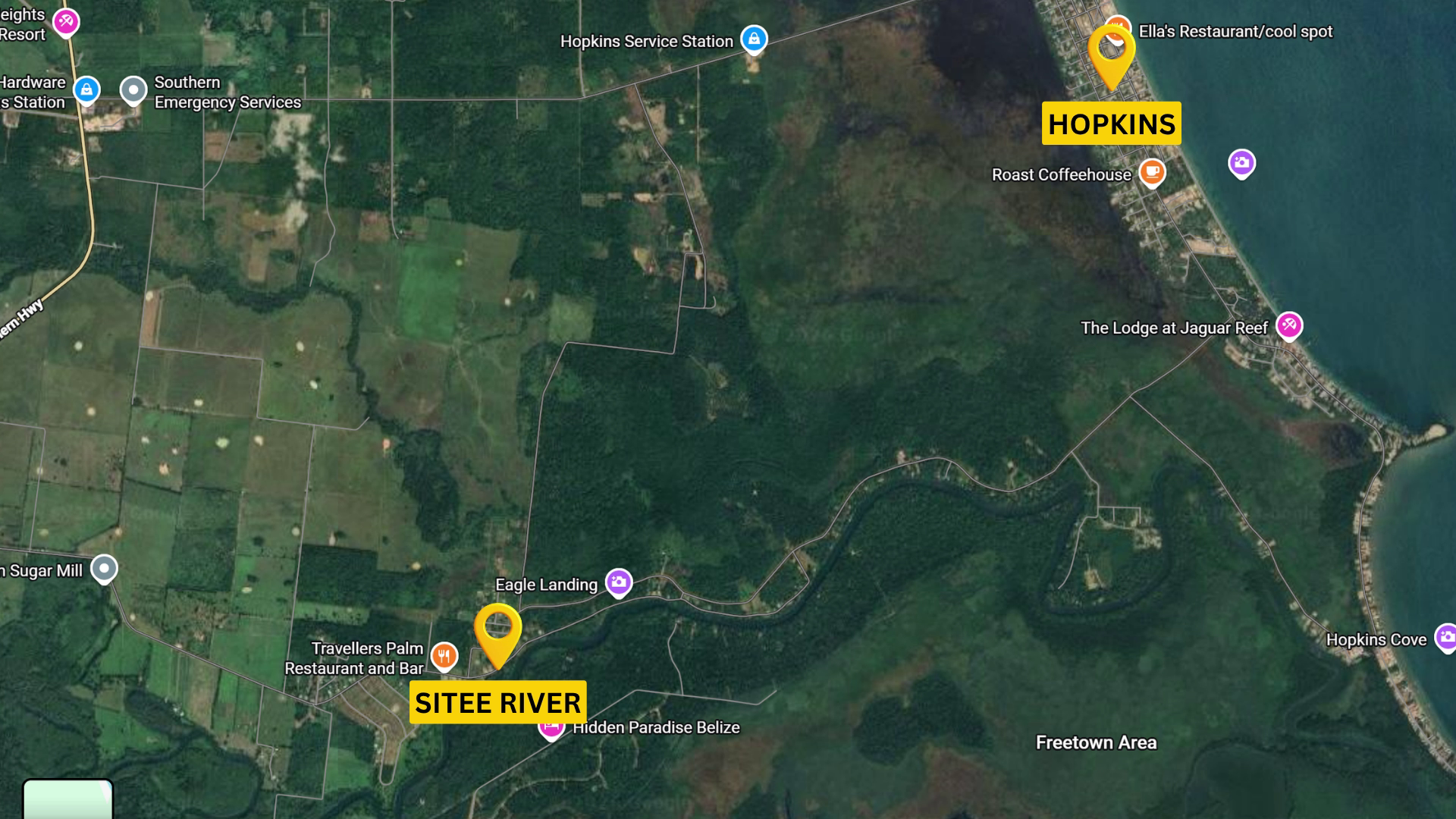
On Belize’s rapidly developing southern coast, a routine government project to map village boundaries has escalated into a high-stakes standoff over Indigenous sovereignty, cultural heritage, and land ownership, as Garifuna leaders warn that the formal demarcation process risks enabling the further loss of traditional territories to foreign investment and large-scale development.
The Belizean government launched the boundary initiative last October, tasking an independent multi-stakeholder commission with resolving long-running border disputes between neighboring communities along the Placencia Peninsula, including Sittee River and Hopkins, as well as Placencia and Seine Bight. Made up of representatives from government departments including the Elections and Boundaries Commission, the Ministry of Natural Resources, the Attorney General’s Ministry, plus representatives from the judiciary, the National Association of Village Councils, and the private sector, the commission is on track to wrap up its work and submit final recommendations to the government by August or September 2026, per Clifford King, Director of Local Government at Belize’s Ministry of Rural Transformation. King emphasized that while the issues of village boundaries and communal Indigenous land rights are connected, they require separate policy consideration.
“The matter of village boundaries is in regards to the jurisdiction for a village council,” King explained in an interview. “The matter of communal land is an issue that is now being taken up by the indigenous people of Belize which is a related matter, as I’m saying, but it is a different matter. But again, these are kinds of things that I think the commission will certainly want to understand how they intersect, where they intersect, if they intersect.”
For the National Garifuna Council, however, the boundary project cannot be decoupled from the broader crisis of land dispossession facing Garifuna communities across Central America. Garifuna people, a group of mixed Indigenous and African descent that has inhabited Belize’s coastlines since well before 1800, have a centuries-long tradition of stewarding land and marine resources in a sustainable, non-exploitative way, according to Ifasina Efunyemi, Assistant Treasurer of the National Garifuna Council. Efunyemi noted that this pattern of dispossession is not unique to Belize, pointing to ongoing displacement of Garifuna communities in neighboring Honduras and Guatemala.
“After we have been stewards of these lands, and we have been stewards of these lands since before 1800,” Efunyemi said, “here come people now claiming” ownership of territories that have been managed by Garifuna for generations.
National Garifuna Council President Alex Nolberto echoed this framing, arguing that attempts to separate the boundary mapping process from broader territorial rights are untenable. The organization is now ramping up its advocacy to demand holistic, permanent protection for all traditional Garifuna territories.
“What I see happening is that they are trying to separate the issues of the territorial, traditional Garifuna territory and this village boundary conversation, and I don’t see how you can separate the two, right? They are one and the same in my view, and hence the reason why now this fight has to be elevated to address Garifuna territory, to look at traditional Garifuna spaces and to protect them,” Nolberto said. “So this has gone beyond a village boundary, in my view, and now it’s time to take the gloves off and deal with this situation with the greatest of surgical precision and holistically once and for all.”
As the commission works to meet its end-of-year deadline, the stakes of the process extend far beyond lines on a map. For Garifuna communities already grappling with increasing amounts of their traditional coastal land falling into foreign ownership, the commission’s final recommendations will have long-lasting implications for their ability to preserve their cultural identity and retain control of the territories that have sustained their community for more than two centuries.