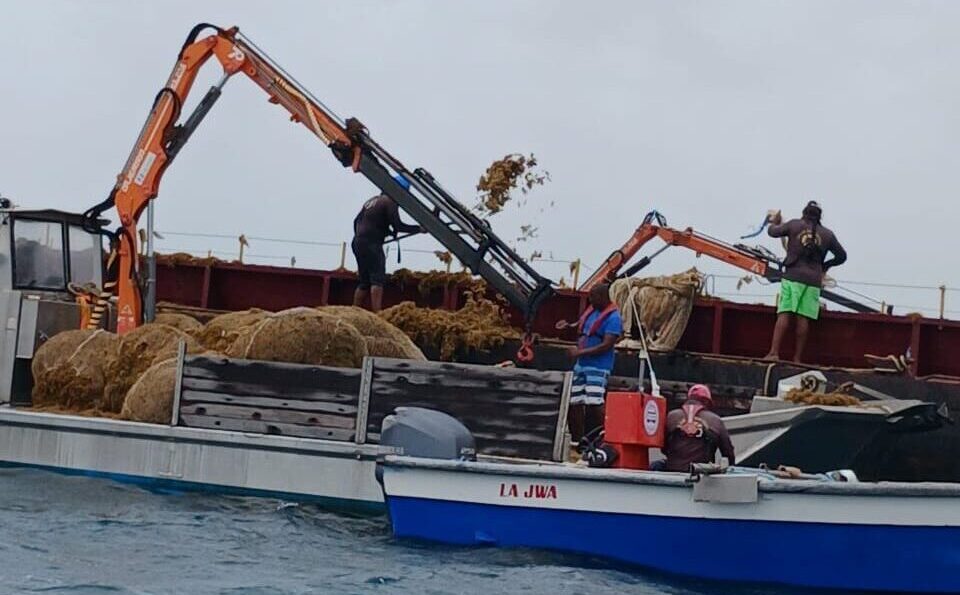
For more than a decade, massive, recurring blooms of sargassum seaweed have plagued the small island developing nations of the Caribbean, leaving widespread damage in their wake. These invasive influxes disrupt fragile coastal ecosystems, threaten marine biodiversity, trigger public health concerns from rotting biomass, and undermine the economic stability of communities that rely heavily on coastal tourism and fishing. Now, a coordinated regional effort is bringing stakeholders together to share proven solutions and strengthen collective action against this transboundary threat.
Following recent regional meetings for the Sargassum Regional Strategies for Ecosystem-based Actions (SARSEA) project in Dominica, a delegation representing nine Caribbean states and territories under the Organisation of Eastern Caribbean States (OECS) has launched a four-day technical study mission, running from June 1 to 4, 2026, in the French Caribbean territories of Martinique and Guadeloupe. The core goals of the mission are to examine locally developed sargassum management frameworks and explore viable pathways to turning harvested seaweed into marketable, value-added products.
Supported jointly by the European Union and the OECS, the initiative forms part of long-standing regional collaboration aimed at fostering cross-border knowledge exchange and building more robust collective responses to the overlapping environmental, economic and public health harms caused by repeated sargassum landings. Over the years, Martinique and Guadeloupe have built comprehensive, multi-faceted strategies covering every stage of sargassum management, from open-ocean monitoring and early warning to large-scale collection, risk mitigation and innovative processing of harvested seaweed into useful goods. The mission gives delegates the chance to observe these strategies in action, hold direct discussions with local public and private stakeholders, and map out opportunities for deeper regional coordination on the shared challenge.
The first half of the itinerary is focused on technical visits and demonstrations across Martinique, spanning June 1 and 2. On opening day in Le François, the delegation will start with a morning tour of offshore containment barriers and dedicated collection barges, followed by an afternoon visit to two air quality monitoring sites run by local operator Madininair. The day will conclude with a formal presentation on sargassum monitoring systems and early-warning tools at Le François Town Hall.
On June 2, the schedule moves to Le Vauclin, where delegates will first join guided tours of manual sargassum collection sites at Macabou and Pointe Faula, led by representatives of local organization ACI. After a working meeting with GIP and ACI representatives at Le Vauclin Town Hall, the group will travel back to Le François to visit Holdex, a local company pioneering commercial and innovative applications for processed sargassum. The Martinique portion of the program will close with a presentation on ongoing initiatives to develop value-added sargassum products, delivered by Dominique Bœuf of SARA/SERD. After concluding the Martinique leg, the delegation will travel to Guadeloupe for the final two days of the mission, June 3 and 4, to continue learning from that territory’s management approaches.
The entire mission is backed by the SARSEA project, which receives funding from the Agence Française de Développement and is implemented through a partnership between Expertise France and the OECS Commission. SARSEA’s core mandate is to build technical capacity across the Caribbean, strengthen regional governance frameworks for sargassum management, and promote ecosystem-centered approaches to addressing the bloom crisis.
Event organizers emphasize that the study mission underscores Martinique and Guadeloupe’s commitment to sharing their hard-won experience with neighboring Caribbean territories through a foundation of cross-border cooperation, collective solidarity, and innovative problem-solving. Echoing this collaborative spirit, an OECS representative participating in the mission noted that sargassum is a transboundary problem that does not respect national borders. “By combining our knowledge, expertise and resources, we can better protect our coastlines, our economies and our communities,” the representative said.