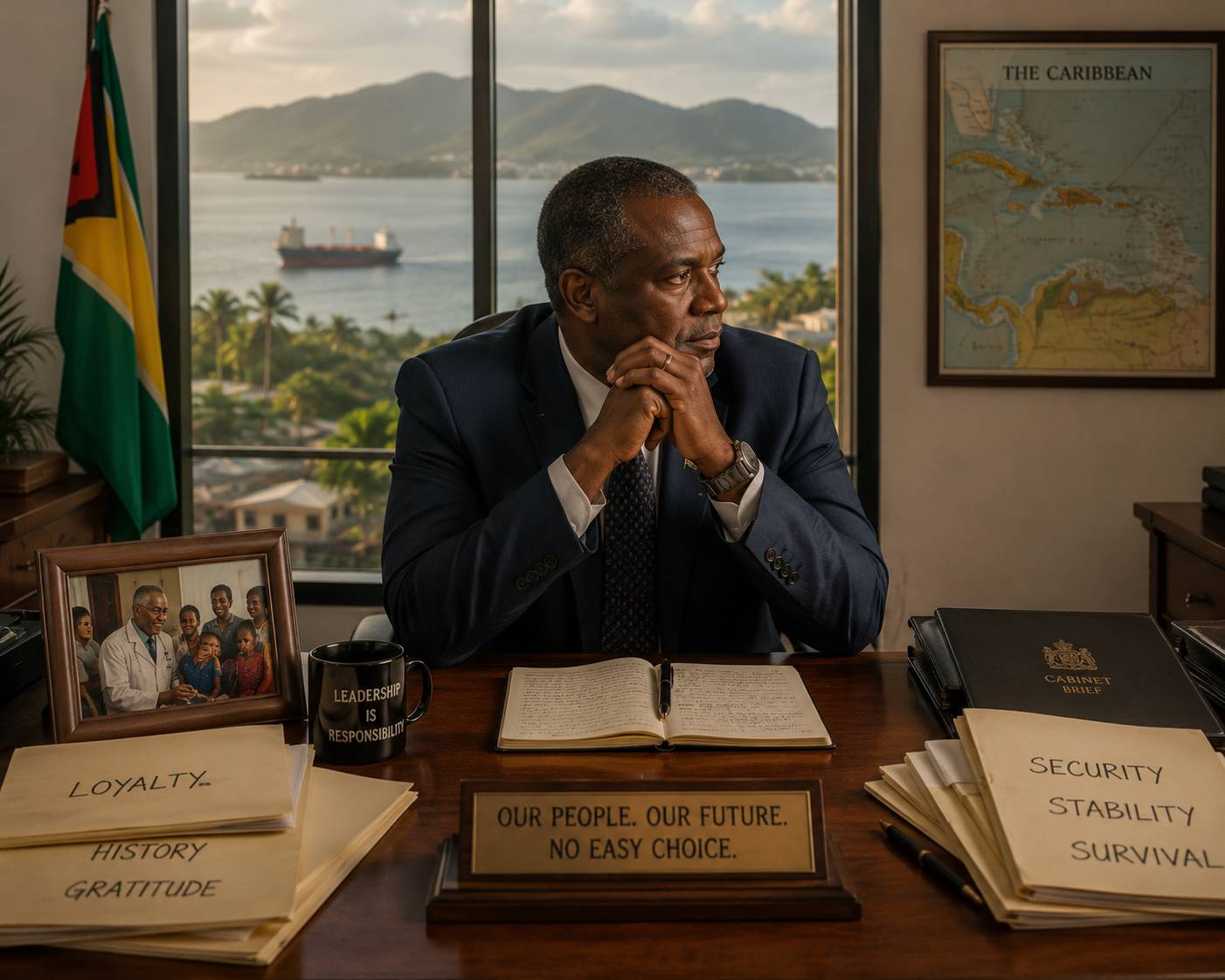
For decades following the end of colonial rule, small Caribbean nation-states have navigated a persistent, unresolvable contradiction at the heart of their regional identity and foreign policy. These countries publicly uphold the values of national sovereignty, cross-border solidarity, anti-imperialism, and regional fraternity, but they must operate in a global order defined by crippling power asymmetries—economic, military, and political—that tilt the playing field sharply against smaller actors. Nowhere is this tension more acute than in the region’s current fraught positioning between Cuba, Venezuela, and the United States.
On the surface, the choice appears to be a simple binary: stay loyal to Cuba, a decades-long ally and benefactor to the region, or realign to align more closely with Washington, the undisputed dominant superpower of the Western Hemisphere. But the reality is far more nuanced, with Venezuela sitting at the core of the calculus across economic, ideological, geographic, and military lines. Today, Caribbean nations find themselves pulled in conflicting directions by gratitude, strategic fear, moral principle, and the raw imperative of national survival.
Cuba’s role in the Caribbean extends far beyond transactional diplomatic exchange. For generations, Havana has supported the region in ways that major global powers never prioritized. Cuban medical professionals have staffed under-resourced rural clinics across dozens of Caribbean islands, and Cuban disaster response brigades have deployed immediately after hurricanes, disease outbreaks, and other catastrophic events when international support was slow to arrive. When Western university education was out of financial reach for most Caribbean young people, thousands earned full scholarships to study medicine in Havana. Today, entire national healthcare systems across the region remain deeply dependent on Cuban medical personnel.
This bond is rooted in more than aid: it grows from a shared history of colonial exploitation, racial justice struggles, geographic vulnerability, and collective resistance to external domination. Like individuals, nations remember unwavering loyalty when it was offered when no one else would step forward.
The regional solidarity network deepened dramatically with the launch of Venezuela’s PetroCaribe initiative. The program offered Caribbean nations heavily subsidized oil on generous concessionary terms, giving fragile, debt-burdened regional economies critical breathing room during periods of energy crisis, fiscal collapse, and global market shock. PetroCaribe was never just an economic program: it was a deliberate act of oil diplomacy, converting Venezuela’s energy wealth into regional political influence and collective solidarity.
At the heart of this arrangement was the tight strategic partnership between Cuba and Venezuela. Caracas provided the subsidized energy that kept regional economies afloat, while Havana contributed technical expertise, intelligence support, and ideological legitimacy to the project. Caribbean nations reaped the benefits of both, turning what could have been a crippling energy burden into a foundation for modest growth and stability. For many regional governments, this alignment was never about ideological alignment—it was a matter of basic national survival.
But that calculus of survival has shifted dramatically in recent years. As Venezuela descended into deep economic collapse, growing authoritarianism, and increasingly assertive territorial claims in the region, the moral and strategic equation has flipped, particularly for two key Caribbean states: Guyana and Trinidad and Tobago.
Guyana currently faces what it frames as an existential territorial threat from Venezuela over the long-running Essequibo border dispute, a resource-rich region that Caracas claims as its own. Trinidad and Tobago, which sits just miles off Venezuela’s coast, confronts the constant risk of cross-border spillover from Venezuelan instability, including surges of irregular migration, the expansion of transnational organized crime, and heightened strategic vulnerability to external pressure.
At the same time, many members of the Caribbean Community (Caricom) remain wary of Trinidad and Tobago’s close alignment with the current U.S. administration’s regional policy, especially when that approach is seen as overly interventionist or heavy-handed. This dynamic lays bare a new reality for the region: governments are no longer simply choosing between old friendship and great power influence. Increasingly, they are forced to navigate a raw tension between inherited historical loyalties and urgent contemporary security needs.
In this context, moral clarity becomes impossible to maintain. Core principles remain important, but when a state’s core security and territorial integrity are perceived to be on the line, absolute ethical positions often give way to painful trade-offs and deeply uncomfortable choices.
This unenviable predicament echoes a famous thought experiment proposed by philosopher William Godwin in his work *An Enquiry Concerning Political Justice*, widely known as “The Archbishop and the Chambermaid.” Godwin asked the public to imagine choosing which person to save from a burning building: a prominent archbishop whose work benefits thousands of people, or an unknown chambermaid whose death would impact only a small circle. Godwin’s utilitarian conclusion was that morality demands saving the archbishop, as his survival creates greater collective good.
Critics quickly countered with a devastating question that upends the utilitarian logic: what if the chambermaid is your mother, your spouse, or a lifelong benefactor who saved your life when no one else would? That is exactly the Caribbean’s dilemma with Cuba.
Purely strategic logic would seem to point toward alignment with the United States. Regardless of the contradictions and moral flaws of U.S. foreign policy in the region, only Washington possesses the combination of military and economic power capable of deterring Venezuelan aggression against Guyana or containing wider regional instability.
But for the Caribbean, Cuba is never just an abstract piece on a geopolitical chessboard. Cuba is the ally that showed up when major powers turned away. Abandoning Cuba under pressure from Washington feels to many regional leaders and populations less like pragmatic diplomacy and more like a betrayal of a trusted friend.
Philosopher Bernard Williams further refined this moral dilemma, arguing that if a person pauses to calculate whether morality permits them to save their own wife from a fire before acting, they have already had “one thought too many.” Williams’ core point is that human morality cannot function by treating loved ones as interchangeable with strangers; loyalty itself is a core moral good that gives meaning to collective and individual life.
Yet national governments are not private individuals. States hold a fundamental obligation not just to honor old friendships and historical gratitude, but to protect the survival and well-being of their current citizens. In moments of crisis, nations often practice a brutal form of political triage: prioritizing the survival of the state and its people, even when the choice inflicts deep moral harm.
This is why the Caribbean’s predicament cannot be resolved through abstract moral rules alone. Immanuel Kant’s ideal of acting only on principles that one would want to be universally applied becomes impossible to uphold when the very existence of a small state is at stake. Absolute loyalty to old alliances can become national suicide, but unbridled self-interest destroys the regional trust and solidarity that small nations depend on to counterbalance great power influence.
The cruelest irony of this dilemma lies in the role of the United States itself. Washington often frames its demands on the region in moral terms, but its own history in Latin America and the Caribbean is marked by unilateral interventions, economic embargoes, covert operations, and deeply inconsistent commitments to democracy and national sovereignty, undermining any claim to moral high ground.
Even so, Caribbean nations face an uncomfortable, unignorable truth: if Venezuela truly moves to threaten Guyana’s territorial integrity or trigger wider regional instability, only the United States has the credible military and economic power to deter that action. Not Cuba, not Caricom, not international law alone can provide that deterrence.
This is the core tragedy of small-state power politics: moral discomfort does not eliminate the reality of strategic dependence. Great powers can afford to speak in the abstract language of principle, because they never face the existential consequences of their choices. Small nations rarely have that luxury.
For every Caribbean state, every diplomatic choice carries existential stakes. Aligning with Cuba risks jeopardizing critical security partnerships and economic access to U.S. and global markets. Aligning with the United States feels like abandoning a loyal friend that stood by the region for decades. Opposing Venezuela carries the risk of immediate retaliation, while accommodating Caracas opens the door to future coercion.
There is no morally clean path forward, because Caribbean states do not control the global and regional power structure that forces these choices on them. That is the deepest lesson of this crisis: abstract ethical theories are easy to defend when one’s survival is not on the line. For small nations living next to great powers and unstable neighbors, morality is never an abstract intellectual exercise. It is negotiated every day under the weight of historical memory, fear, necessity, and the constant, unending calculation of survival.
Today, the Caribbean’s challenge is no longer simply balancing principle against power. For states facing immediate security threats, it has become a painful, ongoing struggle to reconcile decades of cross-regional political solidarity with urgent, immediate concerns for territorial integrity, domestic stability, and national survival.