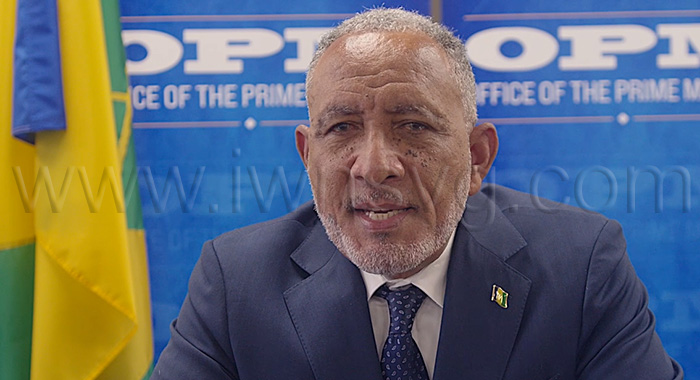
As the 2026 Atlantic hurricane season officially gets underway, St. Vincent and the Grenadines (SVG) Prime Minister Godwin Friday has delivered an urgent national address, calling on all Vincentians to take immediate action to shore up defenses against potential threats, warning that the island nation is entering the season facing a dangerous overlap of long-running natural challenges and man-made constraints, including a persistent severe drought and depleted funding for disaster response and recovery.
Friday opened his address, delivered on the opening day of the 2026 season, by highlighting the ongoing climate-driven crisis already impacting SVG: a prolonged, unforgiving drought that has plagued large swathes of the country. Even with scattered light rain over recent weeks, conditions remain dire, he confirmed, noting that the current dry trend matches long-term scientific projections that forecast increasingly arid conditions across the Caribbean region in the coming decades.
“This is the new reality of global warming,” Friday emphasized. “It demands that we adapt proactively and take every possible step to reduce its harmful impacts.”
Drawing on data from the country’s Meteorological Office, Friday outlined a clear downward trend: annual rainfall across SVG has dropped consistently over the past eight years, with 2025 recording the lowest annual total on record, breaking the previous benchmark set just three years earlier in 2022. This trend points to a future where dry spells will grow more frequent and longer-lasting, the prime minister added.
Looking at hurricane activity patterns, Friday noted that 2025’s season followed a now-familiar trend linked to a changing climate: total storm numbers were below the long-term average, but the count of major hurricanes (Category 3 strength or higher) was above average. Out of 13 recorded tropical storms in 2025, five strengthened to hurricane status, and four of those reached major hurricane intensity. Fortunately, SVG avoided a direct hit last year – a stroke of good fortune coming just 12 months after Hurricane Beryl caused catastrophic damage across the Southern Grenadines. “We pray we will be equally fortunate this year,” Friday said.
For 2026, leading forecasting bodies including Colorado State University (CSU) and the U.S. National Oceanic and Atmospheric Administration (NOAA) are projecting a slightly below-average season in terms of total named storms. CSU’s forecast calls for 13 named storms, six hurricanes, and two major hurricanes, while NOAA predicts a range of 8 to 14 total storms, 3 to 6 hurricanes, and between 1 and 4 major hurricanes. But Friday stressed that storm track predictions remain uncertain, and complacency is not an option. “While predictions may vary, and the paths of the potential storms are yet unknown, we must nevertheless prepare for whatever this hurricane season brings,” he said.
The prime minister stressed that SVG enters the 2026 season with unprecedented levels of uncertainty, compounded by overlapping natural and economic hazards. Most pressing is the limited government funding available for disaster management and post-storm recovery, a challenge exacerbated by global economic volatility driven by elevated oil prices tied to the Gulf War. Friday noted that his administration has already put preliminary mitigation measures in place to cushion the economic blow, as outlined in a separate national address earlier last week. “The potential convergence of multiple crises makes it urgent that we prepare our responses and heighten our vigilance to address all possibilities,” he said. “Our government stands ready to support citizens in both preparation and response efforts.”
Central to Friday’s message is the framing of disaster preparedness as a shared responsibility between government and all citizens. Repeatedly warning against complacency, he urged every household to take practical steps ahead of any potential storm. “Failure to prepare for hurricanes or other weather events will make us more vulnerable to the ravages of nature,” he said. “We cannot allow that to happen. So together we must act and encourage one another to prepare.”
Drawing on hard-won experience, the prime minister pointed to past destructive storms – Hurricanes Thomas, Elsa, and Beryl – as painful but critical lessons. “We have heard it said that those who fail to learn from history are doomed to repeat it, so let us take the painful lessons learned from those storms as a call to action, ensuring every family is secured and ready for the 2026 hurricane season,” he said.
To make preparation accessible for all households, Friday boiled his guidance down to five clear, actionable steps:
First, he urged residents to rely exclusively on official information from the National Emergency Management Organization (NEMO) and the Meteorological Office for all updates on impending storms, heavy rain, rough seas, and high wind events.
Second, every household should develop a written, comprehensive emergency plan covering all phases of a weather event. The plan should start with a home safety audit: Friday called for urgent roof repairs where needed, trimming of overhanging tree branches near structures, and clearing of residential and community drains to prevent clogging and flooding. The plan should include input from all family members, with clear roles assigned for before, during, and after a storm, and a full list of emergency contacts for local and national services. Households should also make contingency arrangements for evacuation, whether staying with family, friends, or at an official emergency shelter, and Friday strongly warned against delaying evacuation, noting that late evacuations put lives at unnecessary risk.
Third, residents should stockpile a minimum of one week’s worth of emergency supplies, including food, water, personal hygiene items, and necessary prescription medications. This is particularly critical for anyone planning to stay at an official emergency shelter, where essential supplies may be limited.
Fourth, Friday appealed to individual citizens and private sector organizations to prioritize supporting vulnerable communities, including people living with disabilities, the elderly, children, and women. “Look out for others, especially in emergencies. We have to be our brother’s keeper,” he said, noting that the past five years have made clear how critical cross-community partnerships and strong social support networks are for effective disaster response.
Finally, Friday urged residents to report all observed hazards and damage to NEMO immediately through any available communication channel, including phone lines and social media. Prompt reporting helps emergency responders quickly identify impacted communities and households to allocate support where it is most needed.