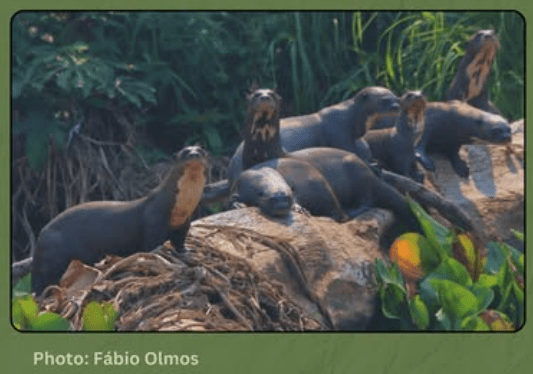
Marking World Otter Day 2026, conservation leaders gathered for a panel discussion hosted jointly by Guyana’s EMC Foundation and the Protected Areas Trust (PAT) on May 29, where they shared promising updates on efforts to protect the endangered giant river otter across the Rupununi region of southern Guyana.
The EMC Foundation reported that joint monitoring projects carried out in two critical conservation landscapes – the Kanuku Mountains Protected Area and the Karanambu preserve – have already established comprehensive baseline population data for the species. Early observations confirm that stable otter groups now occupy multiple river systems across the study area, a major milestone for long-term recovery efforts. A large part of this progress is credited to the on-the-ground work of trained local community rangers and volunteer citizen scientists, who not only map otter distribution across remote waterways but also identify growing threats to the species’ survival. Chief among these threats are unregulated illegal gold mining operations, which contaminate freshwater habitats with mercury, disrupt aquatic food chains, and destroy critical wetland ecosystems.
Globally classified as an Endangered species by conservation authorities, the giant river otter holds unique ecological importance across the Amazon and Guiana Shield. As a top predator in river and wetland systems, the species acts as a key indicator of overall freshwater ecosystem health. Guyana’s vast stretches of intact old-growth forest, expansive untouched wetlands, and interconnected undamaged river networks have made the country one of the last remaining strongholds for the vulnerable species.
During the panel discussion, stakeholders outlined the multifaceted strategy needed to secure the giant river otter’s long-term future in Guyana. Alona Sankar, Commissioner of the Guyana Wildlife Conservation and Management Commission (GWCMC), stressed that policy progress must be paired with stronger enforcement. “What we need to strengthen is our monitoring and enforcement capability to ensure that persons are actually abiding by what the law requires. Now we want to increase our giant otter populations, so if you’re affecting the viability of the species, that is very negative,” Sankar said, calling for bolstered protections, expanded monitoring infrastructure, and consistent regulatory enforcement to safeguard the species and Guyana’s broader wildlife resources.
Melanie McTurk, Managing Director of Karanambu Lodge, highlighted the persistent gaps in scientific understanding that still hamper conservation work. “Many people don’t realise that giant otters are one of the most understudied species, to the point where we don’t even know if they exist in some areas,” McTurk explained. She noted that this knowledge gap creates a critical opportunity for new research, including genetic studies of fragmented populations, to better understand how human activity impacts distinct otter groups and support more targeted conservation planning.
Dr. Deirdre Jafferally, a Community-Based Natural Resource Management Specialist, emphasized that lasting conservation depends on centering local leadership and traditional ecological knowledge. She pointed to successful community-led efforts to rescue and care for abandoned or injured giant river otter pups, which have already supported species recovery and helped otters return to regions where they had not been seen for decades. “Citizen science is an important part of that, as well as education and awareness. Educating people is important, getting them involved, not just those who already know and see and want to be involved in established forums,” Dr. Jafferally said.
Today, giant river otter conservation in Guyana relies on an unprecedented coordinated model that brings together Indigenous and local communities, government regulatory agencies, non-profit conservation organizations, academic researchers, and private sector partners. This cross-sector collaboration has already delivered tangible, on-the-ground results: community-led biodiversity monitoring systems have strengthened local governance of natural resources, and adaptive fishing management plans, designed to account for otter habitat needs, have supported recovery of both fish populations and otter territories.
Sarah Singh, speaking for the EMC Foundation, outlined the organization’s ongoing outreach work in the Mahaica Watershed through the Giant River Otter Education and Conservation Programme, launched in October 2025. Split into two core components – Research and Monitoring, and Education and Awareness – the initiative partners with local environmental clubs along the Mahaica River and leverages social media to reach broader audiences with science-based conservation messaging.
Founded by Shyam Nokta, recipient of the 2022 Anthony N Sabga Award for Entrepreneurship, the EMC Foundation works across Guyana to expand environmental education and awareness, build networks of conservation-focused stakeholders, and create opportunities for Guyanese to connect with the country’s extraordinary natural biodiversity. The Protected Areas Trust, the EMC Foundation’s partner for the panel discussion, was established to provide sustained flexible funding for effective management and protection of Guyana’s protected area network, supporting long-term biodiversity conservation, ecosystem stewardship, research and community engagement to safeguard the country’s natural heritage for future generations.