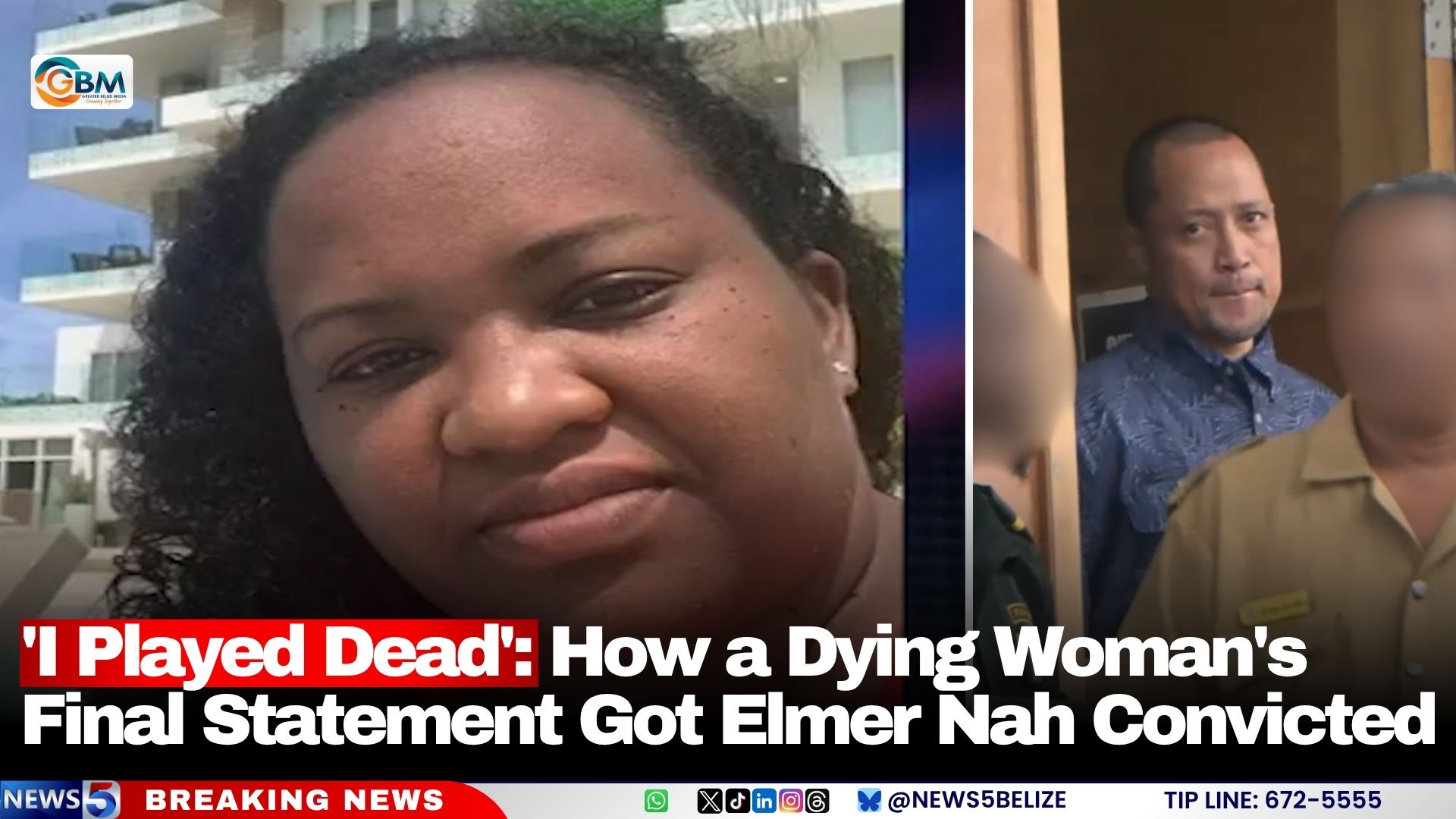
In a landmark murder trial that has gripped Belize, former Belize Police Department officer Elmer Nah has been found guilty of three counts of murder and one count of attempted murder, closing a more than three-year-long case built on extraordinary evidence from a fatally wounded victim. The convictions stem from a brutal New Year’s Eve 2022 attack in Belmopan that claimed the lives of Jon Ramnarace, David Ramnarace, and Vivian Ramnarace, and left a fourth victim, Yenie Alberto—David Ramnarace’s common-law partner—with life-altering injuries.
The sequence of violence unfolded shortly after 7:30 p.m. on December 31, 2022, when the Ramnarace family’s dog began barking unexpectedly. Jon and David Ramnarace stepped outside to investigate the disturbance, followed by Vivian Ramnarace (Jon’s wife) and Alberto. A masked gunman never was in this case: the attacker, clad entirely in dark clothing, approached the home unmasked and opened fire in a 25-second assault captured entirely by the family’s home security system. Jon and David were killed instantly; Vivian was shot multiple times and Alberto, hit in the abdomen, managed to escape through the home’s back entrance to get help.
Vivian Ramnarace survived the initial gunfire but ultimately died on January 15, 2023, from complications caused by her gunshot wounds. What made her survival between the attack and her death extraordinary, however, was the critical evidence she collected and shared with authorities before she died. Even with four life-ending gunshot wounds, she managed to retrieve her mobile phone, alert a neighbor, contact family via WhatsApp, and call emergency services before first responders arrived. Less than 48 hours after the attack, while recovering in intensive care at Belize City’s Karl Heusner Memorial Hospital, she gave a formal, detailed statement to police that would become the linchpin of the prosecution’s case.
In her statement, which was admitted to court as hearsay evidence due to her passing before trial, Vivian recalled that she saw the attacker for a combined 8 to 10 seconds: first 15 feet away outside the home, illuminated by streetlamps and the family’s Christmas decorations, and again 8 feet away inside the home under kitchen lighting. She told investigators the gunman wore no mask, allowing her to see his face clearly. She described him as a 5’6” light-complexioned young man in full dark clothing, with a small light-emitting device mounted on his head. Most critically, she told police she recognized him from media coverage: he was the nephew of former senior police superintendent Marco Vidal, a former officer who had been publicly charged in a 2021 drug trafficking plane landing case. That description, the court ruled, was an unmistakable reference to Elmer Nah, who fit every detail of the account and had been widely featured in Belizean media and social media following his 2021 drug charge.
Later that same day, still bedridden in her hospital room, Vivian participated in a photo array procedure. After reviewing 12 photos of men with similar physical characteristics, she immediately and without hesitation pointed to photo number 10: a photo of Elmer Nah.
Nah’s defense team launched an aggressive challenge to the identification evidence, arguing that extreme duress had compromised Vivian’s ability to accurately identify her attacker, that her comment “it looked like Number 10” betrayed uncertainty, that the failure to conduct a formal in-person identification parade made the identification unreliable, and that no physical evidence—including DNA, fingerprints, or gunshot residue—linked Nah to the crime scene. The defense also noted that Nah has a prominent tattoo stretching from his wrist to his knuckles on one hand, which was not visible on the shooter in the grainy surveillance footage.
Presiding Justice Nigel Pilgrim rejected every one of the defense’s arguments, upholding the conviction in a ruling that relied heavily on the consistency between Vivian’s account and the surveillance footage she had never seen before giving her statement. Justice Pilgrim identified nine specific points where Vivian’s written description matched the video record exactly: the timing of the dog’s barking, the order in which family members stepped outside, the attacker’s fast approach, the sequence in which victims were shot, the attacker forcing open the front door, the light on his head, the outdoor light sources she described, and the indoor kitchen lighting.
On the question of her phrasing “it looked like Number 10”, Justice Pilgrim noted that this reflected common colloquial speech patterns in Belize, and came immediately after an unprompted, firm identification of the photo. On the tattoo, he ruled the surveillance footage was too grainy to confirm whether a tattoo was present or not. On the absence of a formal identification parade, he accepted the prosecution’s explanation that Vivian was bedridden in intensive care and physically incapable of attending, and cited binding judicial precedent holding that such parades are unnecessary when a witness has already provided a full, specific identification that allows police to apprehend a suspect.
Even without additional circumstantial evidence, Justice Pilgrim ruled, the combination of Vivian’s hearsay statement and corroborating surveillance footage was enough to confirm Nah’s guilt beyond a reasonable doubt. That said, multiple pieces of circumstantial evidence further supported the conviction. When police arrived at Nah’s home on Messam Street—just five to seven minutes’ walking distance from the Ramnarace residence—shortly after the attack, they found him standing at his front door wearing a lit headlamp, exactly matching the light source Vivian described and visible on the attacker in the surveillance footage. The court also found Nah deliberately lied about his whereabouts during the critical 7 p.m. to 8 p.m. window when the killings occurred. Initially, Nah told police he was at the nearby Wei Li bar during that time, but bar surveillance footage showed no sign of him between 5 p.m. and 8:30 p.m. By the time of trial, Nah changed his account, claiming he visited the bar after 9 p.m., a shift the court ruled was a deliberate fabrication to create a false alibi.
The defense called multiple witnesses to corroborate Nah’s alibi, including his cousin Amin Nah, his common-law wife Epifania Caliz, and former colleague Dervin Sambula. Justice Pilgrim rejected all alibi testimony, noting that Amin and Caliz are close family members with a clear incentive to lie for Nah, and that Nah’s proven lie about his whereabouts had already destroyed his credibility. Even if Sambula’s claim that Nah sounded calm during an 8:30 p.m. phone call was accepted at face value, the justice ruled, it could easily be explained by Nah’s confidence that his crime would not be discovered. The court declined to give weight to forensic evidence linking a pair of rubber boots seized from Nah’s pickup to a boot print found at the Ramnarace home, noting the forensic analysis only confirmed a class match, not a definitive individual match.
Nah maintained his innocence throughout the trial, arguing in his dock statement that he was at home with family when the attack happened, that he had been washing tennis shoes in his yard and mistook the gunshots for New Year’s Eve firecrackers, and that he later went to collect his sheep on a dirt bike with his cousin. Those claims were entirely rejected by the court.
A sentencing hearing is scheduled for June 18, 2026. Under Belizean law, a murder conviction carries a mandatory sentence, so Nah will face a fixed punishment for his crimes.