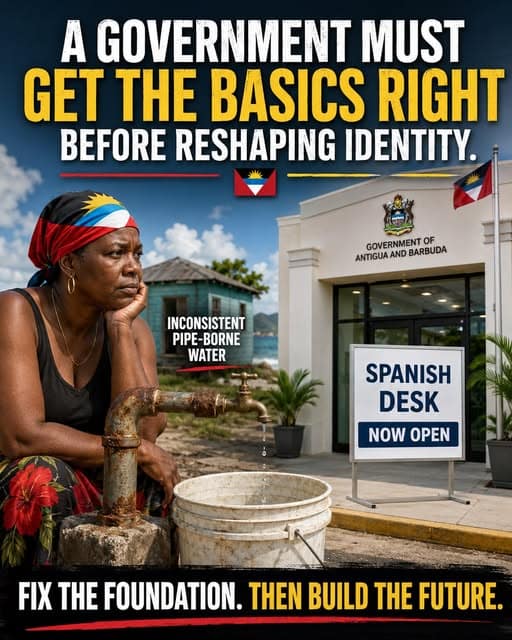
A prominent opinion piece from Yves R. Ephraim is calling on the government of Antigua and Barbuda to reverse its recent decision to designate Spanish as the country’s official second language, arguing the move poses existential, long-term risks to the small island nation’s core national identity that far outweigh any claimed benefits. Ephraim stresses that his opposition is not rooted in animosity toward Spanish or disrespect for the large Spanish-speaking Dominican community that has settled in the country; rather, it stems from a deep understanding that granting official language status is far more than a routine education policy adjustment. It is a foundational constitutional, cultural, administrative, and symbolic act that can permanently reshape the national character of a small, already vulnerable society, he says.
Antigua and Barbuda currently recognizes English as its sole official language, while the local Antiguan and Barbudan dialect serves as a cherished, widely embraced vernacular that encapsulates the nation’s shared history, collective humor, unique worldview, calypso tradition, and core collective identity. Already facing sustained demographic, economic, and cultural pressure from outside forces, elevating Spanish to official status without first holding a broad, inclusive national conversation sends a dangerous signal, Ephraim warns: that the language and cultural heritage of the native Antiguan and Barbudan people are no longer the central pillar of the country’s national narrative.
The timing of the policy has also raised questions about underlying political motivations. The Antigua Labour Party (ABLP) just returned to power in a landslide snap election held on April 30, 2026, claiming 15 out of 17 parliamentary seats despite winning the support of just 38% of all registered voters. When such a lopsided parliamentary victory is immediately followed by a major policy that would redefine national identity, Ephraim argues the public has every right to question whether the move is a genuine national development initiative, or a political reward to a strategically critical voting bloc.
Close examination of the Cabinet’s official statement further underscores the need for citizen concern, he adds. The policy does not stop at expanding access to Spanish language education; it explicitly ties official language status to a formal Dominican Republic Integration Programme, targeted support for Dominican nationals residing in Antigua and Barbuda, and the creation of a dedicated Spanish Desk within the Prime Minister’s Office. This package is far more than an effort to teach children a useful foreign language: it represents a state-endorsed reorientation of national identity, public administration, and diplomatic alignment around a single immigrant community and one foreign country. Ephraim points out that other long-established immigrant groups from across the Caribbean, including Guyana, Jamaica, and Dominica, have no comparable institutional support or official recognition for their cultural or linguistic traditions.
At its core, granting Spanish official status is a power shift, Ephraim argues. It sends the message that Spanish-speaking residents have no obligation to learn English or integrate into the established Antiguan and Barbudan way of life. While teaching Spanish in schools equips citizens with a valuable professional and personal skill, official status enshrines the language’s legal and institutional claim to space in courts, government documents, public signage, hiring processes, education policy, and formal public legitimacy. This opens the door to a host of unaddressed practical and governance questions: Will public servants be required to speak Spanish? Must all government forms be translated? Will courts need to provide full Spanish-language accommodations? Will Spanish-speaking applicants receive preferential treatment in government hiring? Will students already struggling with English and math be forced to take on an additional mandatory academic burden? These are not anti-Spanish questions, Ephraim emphasizes—they are basic questions of good governance that the government has failed to answer.
For small nations, the slow creep of cultural displacement is an underrecognized but profound threat, Ephraim notes. Cultural erasure rarely arrives as an overt, announced attack; it is almost always framed as modernization, regional integration, economic opportunity, inclusion, and improved global competitiveness. Each incremental policy change may seem reasonable on its own, but over decades, local language, collective memory, cultural traditions, speech patterns, community priorities, and native artistic expression are gradually pushed to the margins in their own homeland.
history offers two clear cautionary examples to guide Antigua and Barbuda’s decision-makers, Ephraim argues. In Ireland, after the Irish language lost its central place in public life following centuries of political and socioeconomic pressure that pushed English to dominance, reversing that decline and reviving the native tongue has proven extraordinarily difficult, even with sustained government support. In Singapore, the government’s Speak Mandarin Campaign, launched to unify the country’s Chinese Singaporean population, led to an unplanned, sharp decline in the use of regional Chinese dialects in family and community life, a shift that researchers and commentators have widely documented.
These cases demonstrate that granting Spanish official status is no trivial matter, Ephraim says. The true risk is not that Spanish will become more widely spoken—it is that deliberate state policy will unintentionally sideline the older, smaller, more fragile cultural and linguistic traditions that define Antigua and Barbudan identity. The country should not wait decades to discover that a policy marketed today as “integration” will be experienced by future generations as forced cultural displacement, he adds.
Ephraim also notes that the policy is particularly hard to justify at a time when the government has yet to resolve basic, pressing quality-of-life issues that affect citizens every day, including the persistent lack of reliable pipe-borne water across the country. A government that cannot consistently deliver this core essential service should be extremely cautious about adopting a new policy that will create new administrative costs, add burdens to the national school curriculum, impose new mandatory translation requirements on public agencies, and raise unmet public expectations, he argues. True national development must start with meeting the basic needs of citizens: reliable water access, improved education quality, strengthened public health, reduced crime, more affordable housing, upgraded infrastructure, and expanded economic opportunity for native-born residents.
Ephraim sums up his core position clearly: Spanish language proficiency is a valuable skill for Antiguan and Barbudans, but granting Spanish official status is unnecessary and carries dangerous risks for the nation’s future. Every legitimate goal the Cabinet has laid out for the policy can be achieved without changing the country’s official language architecture, he says, and proposes an alternative five-pronged National Multilingual Competency and Cultural Protection Policy that balances language access with protection of national identity.
First, the government should teach Spanish as a compulsory foreign language at appropriate grade levels, with a practical focus on skills for tourism, trade, hospitality, and regional communication. This gives Antiguan and Barbudan children a useful skill without altering the symbolic foundation of the state.
Second, any expansion of Spanish education must be paired with strengthened curriculum focused on protecting and promoting Antiguan and Barbudan identity. This includes expanding education on local history, civics, literature, folklore, the native dialect, local music, national heroes, Barbuda’s unique cultural heritage, and the country’s constitutional identity. Ephraim cites UNESCO’s 2025 guidance on multilingual education, which emphasizes mother-tongue-based learning and meaningful community input in policy design, noting that a policy that expands Spanish while neglecting local cultural transmission is not true multilingual education—it is cultural imbalance.
Third, the government can provide targeted Spanish language access services for public agencies where needed, such as hospitals, immigration offices, police departments, social services, tourism hubs, and emergency communications, without granting Spanish full official status. Many countries provide interpretation services for migrant and minority communities without granting official status to every major immigrant language, he points out, and this practical model works for both newcomers and native citizens.
Fourth, the Dominican Republic Integration Programme should be restructured to be reciprocal and centered on the host nation’s identity. Integration means welcoming newcomers to build lives in Antigua and Barbuda, not redesigning the entire country around the needs of newcomers. Dominican residents should receive structured support to learn English, understand local laws, respect local customs, and participate constructively in national life, while native Antiguan and Barbudans can access Spanish training to support trade, tourism, and diplomacy. Integration must be a two-way process, with the host nation’s identity remaining the central priority.
Fifth, any change to the country’s official language status requires direct national input, either through broad public consultation or a national referendum. A unilateral Cabinet decision is not sufficient for a policy that touches the core of national identity. At a minimum, the government should hold inclusive consultations with educators, historians, faith leaders, trade unions, youth representatives, Barbudan community leaders, cultural workers, immigrant communities, and constitutional experts before moving forward. Any permanent change to the state’s official language structure should be put to a direct vote of the Antiguan and Barbudan people.
Ephraim lays out a revised alternative policy framework that achieves all the government’s stated goals while protecting national identity: “The Government of Antigua and Barbuda shall strengthen Spanish-language education and provide appropriate Spanish-language access services where necessary for public safety, tourism, trade, education, and social inclusion. However, English shall remain the official language of the state, and Antiguan and Barbudan dialect, history, culture, music and civic identity shall be actively protected and promoted as central expressions of the national heritage.”
This approach delivers everything the government claims to want: improved communication, stronger tourism competitiveness, deeper trade ties with Latin America, smoother cooperation with the Dominican Republic, and more inclusive access to public services for Spanish-speaking residents. But it avoids the dangerous step of altering the foundational identity of the state by granting Spanish official status.
The debate is not over whether Antiguan and Barbudans should learn Spanish—Ephraim confirms they absolutely should. The core question is whether a small Caribbean nation should place a global language, tied to a politically significant immigrant community, alongside English as an official language, while the country’s own inherited cultural expressions remain underprotected. Opposing this policy is not xenophobia, Ephraim argues: it is responsible cultural self-defense.
A confident, welcoming nation can host immigrant communities from the Dominican Republic, Guyana, Jamaica, Syria, Lebanon, Europe, China, and across the world without surrendering the core of its own identity, he concludes. Antigua and Barbuda can be hospitable to newcomers without becoming culturally hollow, it can embrace multilingualism without being politically naive, and it can teach Spanish without making Spanish official. Ephraim calls on the government to immediately withdraw or suspend the official language element of its policy, and replace it with a national language competency strategy that expands Spanish education while explicitly protecting the unique identity of Antigua and Barbuda.