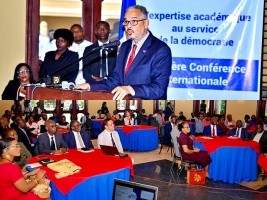
On May 30, 2026, Haiti’s capital played host to the closing ceremony of the country’s first-ever International Conference of the Electoral Chair, an event organized in partnership between the State University of Haiti (UEH) and the nation’s Provisional Electoral Council (CEP). Held at Port-au-Prince’s Karibe Hotel over three days from May 28 to 30, the gathering centered on the urgent and pivotal theme: “Ensuring Success in the 2026 Elections in Haiti: Expectations and Opportunities.”
The conference drew a diverse cross-section of stakeholders invested in Haiti’s democratic future. In attendance were CEP President Jacques Desrosiers, CEP Executive Director Uder Antoine, the body’s panel of electoral advisors, key international technical and financial partners for the electoral process, senior leadership and faculty from UEH, academic researchers, university students, and leading representatives from Haiti’s broad civil society network.
In his opening remarks to the closing ceremony, Desrosiers opened by praising the unprecedented level of engagement from Haiti’s academic community, independent research bodies, and grassroots civil society groups. He noted that the broad mobilization around discussions of Haiti’s democratic trajectory and upcoming electoral cycle signaled a widespread national desire for a renewed, legitimate political order. Desrosiers also underscored a non-negotiable priority for the process: the urgent need to establish and maintain a secure environment that allows elections to proceed safely, with full protection for all electoral infrastructure, staff, and participating voters.
Haitian Prime Minister Alix Didier Fils-Aimé, who headlined the closing ceremony, echoed Desrosiers’ remarks while framing the 2026 elections as a foundational milestone for the country’s long-stalled national reconstruction effort. The Prime Minister commended civil society for its proactive commitment to the electoral process, highlighting that their active participation in the conference’s deliberations reflected a shared ownership of Haiti’s democratic future.
Fils-Aimé used the platform to reaffirm the core governing priorities of his administration, which center on three interconnected pillars: restoring widespread security across the country after years of instability, revitalizing Haiti’s struggling economy to deliver tangible improvements to daily life for citizens, and delivering an electoral process that is fully transparent, fair, and internationally credible. In a stirring call for collective national investment in the process, Fils-Aimé told attendees: “To refuse to commit is to let others decide for us.”
The conclusion of the three-day conference marks a key milestone in Haiti’s preparations for the upcoming 2026 general elections, with stakeholders aligning around core priorities that will shape the months of preparation ahead.