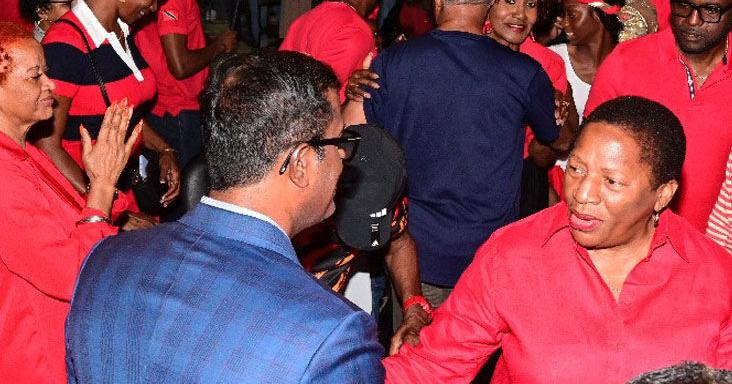
In a charged address to supporters of the People’s National Movement (PNM) at the Bon Air West Community Centre in Arouca Thursday evening, Opposition Leader Pennelope Beckles has laid out a bold accusation against the ruling administration: the Kamla Persad-Bissessar-led government is deliberately laying groundwork to extend the country’s existing state of emergency, a measure set to expire in roughly two weeks. The central flashpoint for this criticism is a recently issued legal notice that creates 15 designated no-protest zones, banning public demonstrations within 500 meters of high-profile State facilities including the national Parliament (the Red House) and the Police Administration Building. Beckles frames this new restriction as nothing less than a deliberate campaign of intimidation aimed at ordinary citizens.
Beckles further claimed that Prime Minister Persad-Bissessar was aware of the planned no-protest zones before the regulations were formally signed by Police Commissioner Allister Guevarro and publicly released on Wednesday, questioning the transparency of the government’s decision-making process around the new rules. The restrictions were enacted hours before one high-profile arrest: protest organizer Alyssa Phillip was taken into custody Wednesday afternoon on Richmond Street in Port of Spain, near the office of the Director of Public Prosecutions, during a demonstration supporting Kaia Sealy. Sealy is currently facing criminal charges connected to the January police-involved shooting death of her husband, Joshua Samaroo, and protesters have been demanding clarity on the legal proceedings against her.
Shortly after the protest, Prime Minister Persad-Bissessar publicly pushed back against the demonstrators, accusing them of intentionally provoking police and seeking unnecessary media attention. Beckles seized on this timing to raise questions about the chain of command behind the new restrictions: the Prime Minister had commented on the prohibited protest areas before the official document was released to the public, and the police only held a public explanatory press conference on Thursday. “That is kind of strange, so who really guarding the guards?” Beckles asked attendees, arguing the government is underestimating the public’s ability to recognize what she calls a deliberate tactic to create a pretext for extending the state of emergency.
Beckles questioned the democratic credentials of the current administration, arguing the quick crackdown on minor protest activity reveals a broader effort to strip citizens of their fundamental rights. “This Government is now saying to the people of Trinidad and Tobago that you don’t really have any freedom,” she said, emphasizing that peaceful public protest is a long-recognized democratic right deeply ingrained in Trinidad and Tobago’s civic culture. She pointed to a long history of public demonstrations, including previous marches organized by trade unions to the Diplomatic Centre, asking what the country’s powerful trade union movement will make of the new restrictions.
“Every right-thinking citizen of Trinidad and Tobago should understand that the concept we had of democracy and freedom of speech no longer exists under this UNC Government,” Beckles stated. “When a Prime Minister begins treating peaceful citizens as though they are enemies of the State, every citizen should understand one thing: the nation deserves answers from Kamla Persad-Bissessar.” She added that the arrest of organizers like Phillip and Jason De Silva, paired with the government’s reliance on emergency powers, proves the administration lacks a viable plan to address crime and can only govern through indefinite state of emergency measures.
Opposition Senator Larry Lalla joined Beckles in criticizing the government, arguing that the country has effectively been trapped in a permanent state of emergency under the current administration. Lalla noted that existing Trinidadian law already contains clear, balanced frameworks for regulating public protest: organizers are only required to provide 48 hours written notice to the Police Commissioner for public meetings, who must provide a formal justification if he chooses to ban an event, while public marches require prior commissioner approval. He argued that the blanket ban on protests around 15 key state institutions, including Parliament, is an overreach that does not qualify as a proportionate use of the emergency powers granted under the existing state of emergency.