On May 30 each year, people pause to reflect on a tragic yet iconic chapter of Caribbean colonial history, marking the 1650 mass suicide of more than 40 Island Caribs at Sauteurs in St Patrick, Grenada. Rather than submit to French invading forces, these Indigenous people chose to jump hundreds of feet from a steep coastal cliff to their deaths, an act of resistance that remains etched in Grenada’s collective memory centuries later.
The chain of events leading to the tragedy at what would become known as Leapers’ Hill is intertwined with narratives of betrayal, colonial expansion, and cultural genocide that defined European settlement in the Caribbean. The betrayal began with an Island Carib man named Thomas, who fell into conflict with the local community after he was rejected by the daughter of Chief Duquesne. After killing the chief’s son in retaliation, Thomas fled to the nearby French colony of Martinique, where he offered French governor Du Parquet a chance to seize control of Grenada’s Indigenous population by revealing the location of their secret gathering.
Acting on Thomas’s intelligence, a French force of 60 men launched a surprise night attack on a Carib longhouse perched on the hill overlooking Sauteurs Bay, opening a brutal, deadly assault on the unsuspecting community. Trapped with no path to a fair fight against the armed invaders, around 40 Caribs made the fateful choice to leap from the cliff’s edge instead of surrendering to what they saw as an inglorious life under colonial rule.
In the wake of the incident, the cliff was named Le Morne des Sauteurs – translated as the Hill of Leapers – a name that would eventually be passed to the nearby coastal town that grew around the bay. Contrary to common historical accounts that claim the massacre wiped out Grenada’s Island Carib population, surviving communities held on to their territory and identity through reduced, marginalized circumstances well into the mid-18th century. Even so, the Leapers’ Hill incident is widely recognized as the pivotal turning point that cemented French control over Grenada, ending effective Indigenous resistance to colonization on the island.
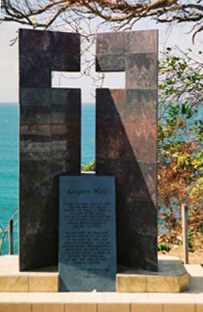
Today, the site draws visitors from across the globe, who come to confront the gravity of this ultimate act of collective self-sacrifice for freedom. The tragedy has long resonated with creative creators, inspiring poets, filmmakers, musicians, and visual artists to retell the story of the Carib resistance. For centuries, the quiet hill itself stood as a natural monument to the fallen, until 2007 when a formal marble memorial was installed at the site.
A layer of unintended irony surrounds the new monument: its design incorporates a Christian crucifix, a symbol of the European cultural imperialism the Caribs died to resist. Many have noted that the choice of symbolism makes the memorial a poor fit for honoring the legacy of the people who died defending their home and traditional way of life. Even so, historians point out that public monuments are as much about how contemporary societies process the past as they are about honoring the dead, making the memorial a marker of how far public recognition of this history has come – even as it reveals the work still left to do.
This article draws from *A-Z of Grenada Heritage*, written by John Angus Martin and originally published by Macmillan Caribbean in 2007, available for purchase through Amazon and local Grenadian retailers.