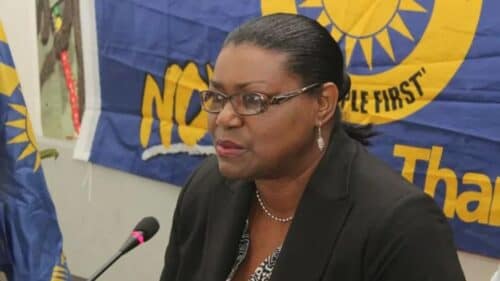
A prominent former parliamentary leader in Antigua has launched a scathing rebuke of how parliamentary officials managed a controversy involving Opposition Leader Jamale Pringle during a May 26 joint sitting of the national legislature, laying out her critique in an opinion column published by Real News Antigua.
D. Gisele Isaac, who previously held the post of Speaker of the House of Representatives and currently chairs the United Progressive Party, lays out a detailed timeline of missteps that led to the unnecessary public confrontation. According to Isaac, Pringle only appeared at the ceremonial joint sitting after receiving two formal communications: an initial invitation dated May 14, extended to him in his capacity as an elected member of parliament, and a subsequent official summons after he initially declined to attend.
Isaac emphasizes that parliamentary leadership was fully aware well before May 26 that Pringle had not participated in the May 18 Oath of Allegiance ceremony, and his reasons for skipping the swearing-in had already been communicated publicly to the body. No move was made to rescind the original invitation in the lead-up to the joint sitting, Isaac says, leaving Pringle with the clear expectation that he was permitted to attend as instructed.
Once Pringle arrived, the situation unraveled quickly: he was summoned to a private meeting with Senate President Alincia Williams-Grant, where he was told he could not stay in the parliamentary chamber because he had not yet completed the oath requirement. Rather than accept a private resolution, Pringle asked that the issue be brought before the full chamber for public handling—an outcome that ultimately led to him being ordered out of the building in full view of the sitting.
In her commentary, Isaac argues that the entire conflict was an avoidable administrative blunder that officials allowed to escalate for partisan reasons. She questions why parliamentary leadership, which holds the authority to manage its own internal procedures, did not simply arrange for Pringle to take the oath immediately before the sitting got underway to resolve the issue.
Isaac also takes aim at the debate that followed the incident, specifically calling out comments made by Prime Minister Gaston Browne during the sitting. She objects to the derogatory language Browne used to describe opposition lawmakers who walked out of the chamber in protest of Pringle’s treatment, defending the walkout as a principled stand against what she frames as a blatant display of partisan power that undermined parliamentary norms.
The incident has broader implications for the health of Antigua and Barbuda’s parliamentary democracy, Isaac warns. She says the missteps surrounding both the May 18 swearing-in and the May 26 Throne Speech joint sitting have eroded the core dignity of the legislative institution.
For its part, the governing administration has stood by its handling of the situation, reiterating that constitutional rules require all elected representatives to complete the Oath of Allegiance before they can take part in any parliamentary proceedings.